
30 March, 2026
API-first architecture is the primary solution for enterprises restricted by legacy software that lacks modern connectivity. By decoupling business logic from the user interface, organizations can implement a "Middleware Layer" to translate legacy data into 2026-ready formats. Whether using the Strangler Fig Pattern for gradual replacement or Middleware Orchestration for complex integrations, this approach ensures "AI-Readiness" and data sovereignty without the risk and expense of a total "Rip and Replace" strategy. iSyncEvolution specializes in architecting these secure, scalable bridges to transform technical debt into a competitive innovation hub.
Your legacy software still works. It runs your operations, holds decades of business data, and powers core workflows. But it can't talk to anything new. Every time your team wants to connect a modern tool, a cloud platform, or an AI feature, that old system becomes a wall instead of a foundation.
This is where API-first architecture changes the game. Instead of replacing systems that still deliver value, you build a communication layer around them. APIs become the universal translators that let your legacy software exchange data with modern applications, mobile apps, and cloud services. It's modernization without destruction.
In this guide, we'll break down what an API-first strategy looks like, walk through proven modernization patterns, cover security essentials, and give you a clear roadmap to start. Whether you're running a 15-year-old ERP or a custom-built platform from the early 2000s, this approach lets you move forward without throwing away what already works.
Legacy systems aren't just old, they're deeply embedded. They run payroll, manage inventory, process transactions, and store institutional knowledge that your business depends on. The problem isn't that they stop working. It's that they stop connecting.
As your business pushes toward 2026 goals, AI adoption, real-time analytics, and customer-facing mobile experiences, these aging systems become anchors. They hold you in place while competitors move ahead. Two specific traps make this worse than most leaders realize.
Your legacy system holds valuable data, but that data lives in formats modern applications can't easily reach. Customer records sit in one system. Order history sits in another. Financial data lives in a third. None of them shares information automatically.
This creates a cascade of inefficiencies:
When your data is locked inside legacy silos, every new initiative starts with a data extraction headache.
Legacy systems require specialized knowledge to maintain. The developers who built them may have retired. The programming languages they use may no longer be widely taught. Documentation, if it exists, is often incomplete.
This creates a maintenance trap where your IT budget goes toward keeping old systems alive rather than building new capabilities. Patches become riskier. Upgrades become impossible without breaking dependent processes. Every integration request turns into a multi-month project.
This is legacy system technical debt in its most expensive form. An API-first legacy modernization approach addresses both traps not by replacing the system, but by giving it a new way to communicate.
When people hear "API," they often think of a simple connector linking two tools. API-first architecture is fundamentally different. It's a strategic design philosophy that changes how your entire technology ecosystem is structured.
The core idea behind API-first is the "headless" approach. You separate the business logic, the rules, processes, and data management your legacy system handles from the interface users interact with.
Think of your legacy system as a brain trapped inside an old body. The brain still works. It knows how to calculate shipping costs, validate orders, and manage inventory. But the body, the user interface, and input methods are outdated and rigid.
An API-first strategy gives that brain a new nervous system. You build APIs that expose their capabilities in a standardized format. Once those APIs exist, any modern tool can tap in:
The legacy system doesn't change. The API layer handles translation, converting old formats into modern standards like REST or GraphQL. You're not asking the old system to become something new. You're building a bridge.
An experienced API development company in India understands this distinction. They design API contracts that serve as the foundation for your entire digital transformation.
The fear of modernization usually comes from one assumption: that you have to replace everything. The smartest organizations use targeted strategies that preserve what works while opening pathways to what's new.
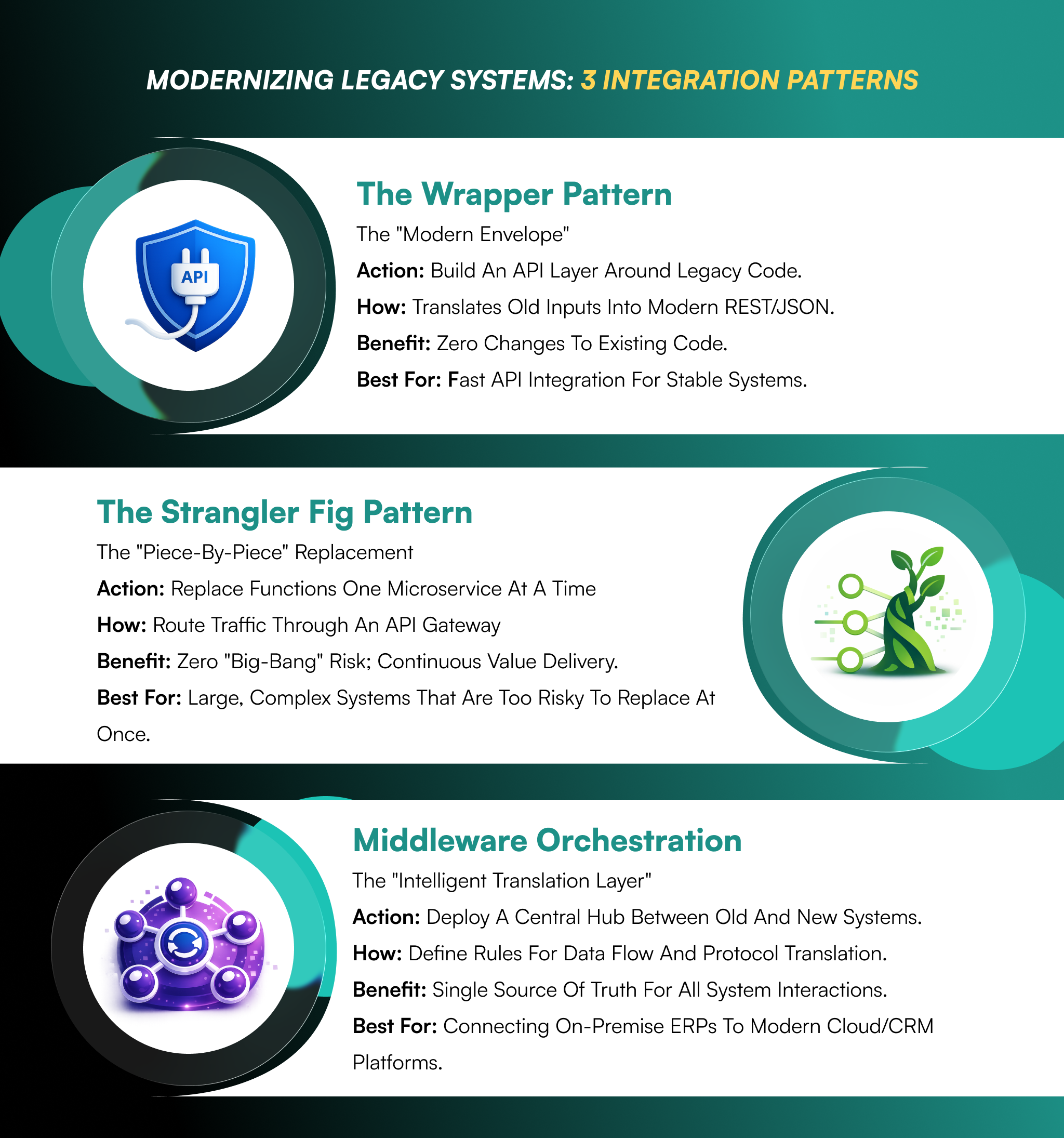
The wrapper pattern is the gentlest approach. You don't modify the legacy system. Instead, you build a modern API layer that translates its inputs and outputs into formats modern applications understand.
How it works:
The legacy system never knows it's being wrapped. This is the fastest path to API integration for legacy systems because it requires zero changes to existing code.
Best for: Stable systems that need to expose specific functions to new applications.
The wrapper pattern is a core capability within web application development projects where modern frontends need to pull data from legacy backends.
Named after the fig vine that gradually grows around a host tree, the strangler fig pattern modernization replaces legacy functionality piece by piece.
How it works:
Key advantages:
Best for: Large, complex systems where full replacement is too risky, but certain functions clearly hold back progress.
This approach aligns with Node.js development and full-stack development methodologies, where lightweight microservices can be built and iterated rapidly.
Middleware orchestration sits between the wrapper and strangler fig approaches. You deploy a middleware orchestration architecture layer that acts as an intelligent traffic controller between all systems.
How it works:
The middleware becomes the single source of truth for all system interactions. This is powerful when you need to integrate ERP with cloud platforms using APIs, connecting an on-premise ERP system to cloud-based CRM or analytics platforms.
Best for: Organizations with multiple legacy systems needing to work together and with new applications.
Understanding patterns is one thing. Seeing business impact is another.
Consider a mid-sized logistics company running a legacy transportation management system (TMS) from the early 2010s. The TMS handles route planning, shipment tracking, and billing, but it's a closed system with no APIs.
The problems:
The API-first solution:
Using wrapper pattern and middleware orchestration, the company builds an API layer exposing shipment status, route assignments, delivery confirmations, and historical data.
The results:
The TMS itself didn't change. Through the API layer, it went from closed and siloed to the data backbone of a connected operation.
This enterprise integration architecture work is where a specialized digital transformation partner delivers the most value.
Opening a legacy system through APIs creates new access points. Every access point is a potential vulnerability. Security isn't optional; it's foundational.
Every API request must be authenticated. OAuth 2.0 ensures only authorized applications access your endpoints. Tokens can be scoped to specific permissions, so a mobile app might only read shipment status while an internal dashboard accesses billing data.
Without rate limiting, a single client can flood your API with requests. Rate limiting controls requests per client within a timeframe, protecting both the API layer and legacy system from abuse.
Data entering your APIs must be validated before reaching the legacy system. Every input should be:
Proper system administration ensures these measures are continuously monitored and updated.
Knowing strategies and security requirements is important. Knowing where to start matters more.
Before writing code, get a complete picture of your current landscape:
This audit becomes your modernization blueprint.
Start with a contained, lower-risk use case:
This prototype proves the concept, reveals challenges early, and builds organizational confidence.
For organizations with multiple legacy systems, a simple prototype isn't enough. You must deploy an intelligent middleware orchestration architecture layer to act as the traffic controller:
With a successful prototype, expand systematically:
The cost of replacing legacy software with "off-the-shelf" solutions is often too high for established enterprises. However, the cost of doing nothing and allowing your legacy software to remain isolated is even greater.
An API-first architecture presents a strategic compromise. It enables you to maintain the stability of your core systems while gaining the agility of a modern tech stack for 2026. By implementing a Wrapper or Strangler Fig pattern, you can transform your "Technical Debt" into "AI-Readiness."
Are you ready to bridge the gap? Contact iSyncEvolution today to discuss how we can help you build an API layer that connects your legacy software to the future.
API-first architecture creates a standardized communication layer around legacy software, allowing old systems to exchange data with modern applications without requiring complete replacement.
Timeline varies based on system complexity. A single-function wrapper can be built in weeks. Full middleware orchestration across multiple systems may take months, implemented incrementally.
Yes, when implemented correctly. OAuth 2.0 authentication, rate limiting, payload sanitization, and encryption protect data flowing through APIs as rigorously as traditional system access.
Most legacy systems can be wrapped with APIs, though complexity varies. Systems with accessible databases or existing batch interfaces are easiest. Fully proprietary closed systems may require more creative approaches.
The wrapper pattern adds APIs without changing the legacy system. The strangler fig pattern gradually replaces legacy functions with modern microservices, eventually retiring the old system.
Nikhil Shah is the CTO and Co-Founder of iSyncEvolution, an engineering leader who aligns modern technology best practices with long-term commercial success. A veteran of cloud infrastructure and scalable web/mobile solutions, he specializes in building high-performance software environments. Nikhil helps global brands master their technical roadmaps, optimizing both code performance and development economics to fuel growth.
© 2026 iSyncEvolution Pvt Ltd. All Rights Reserved.