
06 April, 2026
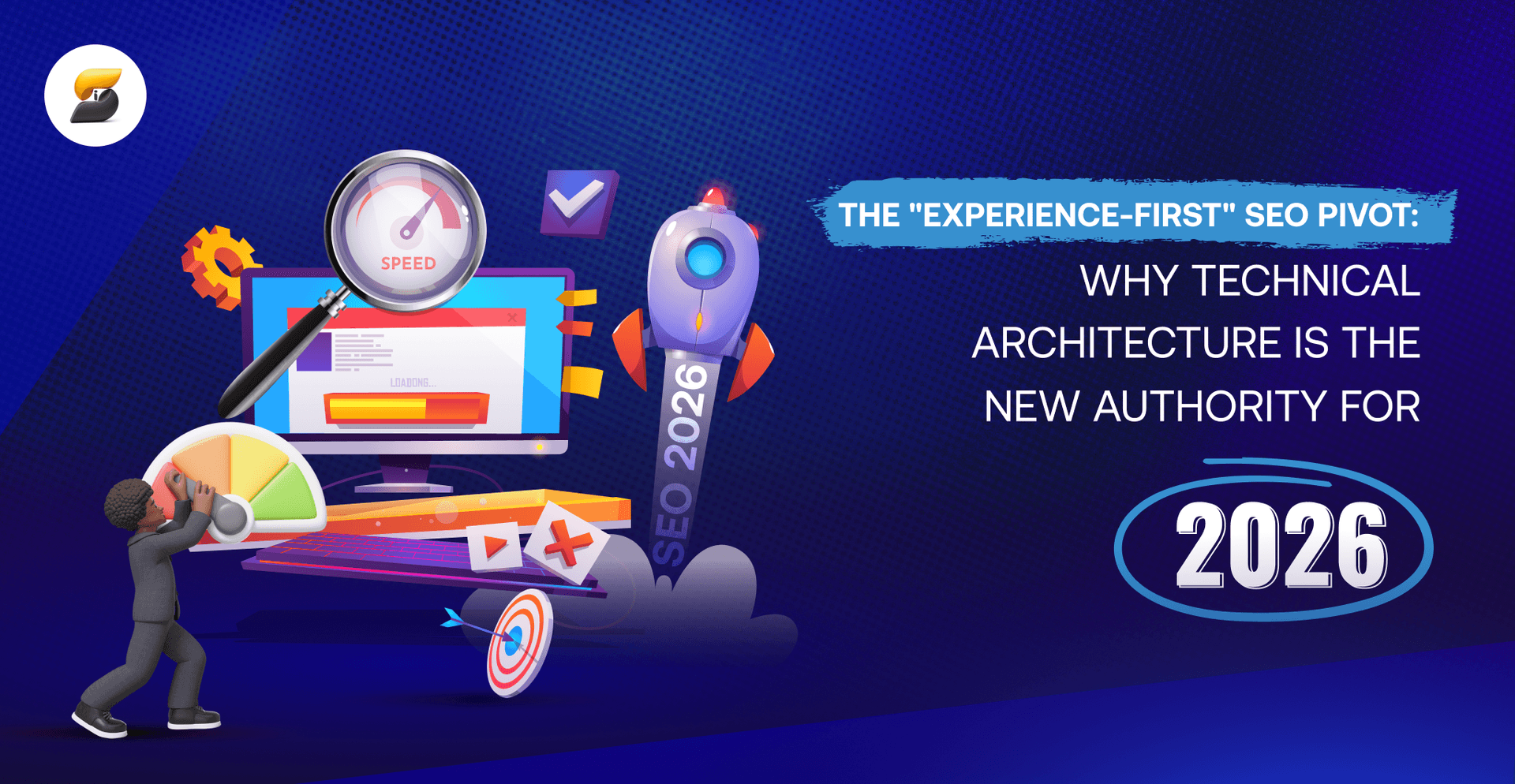
In 2026, content is no longer enough. If your technical architecture fails the user, you are invisible to search engines.
Google has pivoted: algorithms now prioritize Experience-First SEO, where site speed, interaction stability, and technical health are the primary validators of brand authority.
The Reality Check:
Code is Authority: Search engines equate poor performance (high INP, slow LCP) with a lack of expertise.
UX is the Ranking Signal: High-ranking content that delivers a high-friction experience will be de-indexed in favor of seamless journeys.
End of the Silo: SEO is now an engineering discipline. If your CTO and CMO aren't aligned on architecture, you aren't competing.
The Bottom Line:
Rankings bring visibility, but technical excellence builds the trust required to rank. In 2026, Technical Architecture IS your SEO Authority. Optimize the experience, or lose the traffic.
The rules of search have changed. Experience-first SEO is no longer forward-thinking; it's the baseline for any brand that wants to compete in organic search heading into 2026. Google's algorithms have moved beyond keyword matching and backlink counting. They now evaluate how users interact with your site, how fast your pages load, and whether your technical foundation supports a seamless experience.
For years, SEO lived inside the marketing department. It was a content exercise, a keyword spreadsheet, a monthly ranking report that told leadership what they wanted to hear but rarely connected to revenue. That era is ending.
The brands winning in search today treat SEO as an engineering discipline as much as a marketing one. They understand that technical SEO strategy, user experience signals, and authoritative content must work together, not in silos, but as one integrated system. This is the experience-first pivot, and it's reshaping how growth teams, CTOs, and CEOs think about organic search.
This guide breaks down what experience-first SEO means, why traditional approaches are falling short, and how forward-thinking organizations can build technical architecture that drives both rankings and revenue.
Experience-first SEO is a strategic approach that prioritizes measurable user experience, technical performance, and data-driven authority as the primary drivers of organic search success. Rather than treating SEO as a content-only function, it integrates engineering, design, and strategy into a unified system built around how users actually interact with your website.
The experience-first framework rests on four interconnected pillars. Each one feeds the others, and neglecting any single pillar weakens the entire system.
Performance is the technical backbone of experience-first SEO. It encompasses site speed optimization, server response times, rendering efficiency, and Core Web Vitals SEO metrics like Largest Contentful Paint (LCP), Interaction to Next Paint (INP), and Cumulative Layout Shift (CLS).
When pages load slowly or shift unpredictably, users leave. When users leave, Google notices. Website performance optimization isn't just a developer concern; it's a direct ranking signal.
Performance includes:
Experience goes beyond page speed. It includes navigation clarity, content hierarchy, accessibility, mobile usability, and the overall journey from search result to conversion. SEO user experience signals now encompass how people engage with your pages, whether they scroll, click, return to search, or convert.
Google's systems are increasingly sophisticated at measuring user satisfaction. A page that ranks well but delivers a poor experience will lose its position over time.
Authority in 2026 looks different from what it did even two years ago. EEAT signals Experience, Expertise, Authoritativeness, and Trustworthiness have become central to how Google evaluates content quality.
True authority comes from:
Data is the connective tissue. Without measurement, you're guessing. Experience-first SEO requires a robust analytics infrastructure that tracks engagement depth, conversion paths, page-level performance metrics, and the relationship between technical changes and business outcomes.
Data-driven SEO means every decision is grounded in evidence rather than assumption.
Most SEO reporting still revolves around rankings, organic traffic, and keyword visibility. These metrics aren't meaningless, but they're incomplete and increasingly misleading for teams trying to connect SEO to revenue.
A page can rank on page one, receive thousands of monthly visits, and still contribute nothing to the pipeline. If that traffic doesn't engage or convert, it's a vanity metric dressed up in a dashboard.
Traditional SEO KPIs fail growth teams for several reasons:
Enterprise SEO strategy in 2026 demands a new measurement framework, one that ties technical performance to conversions, and conversions to actual revenue.
There was a time when developers could build a website, hand it off to marketing, and move on. That separation no longer holds.
Modern search engines evaluate websites at the code level. How your site is built, its architecture, rendering method, JavaScript dependencies, and schema implementation directly determine search performance. SEO and development alignment is no longer optional.
If Google's crawlers can't efficiently render your pages, your content might as well not exist. Single-page applications and poorly implemented JavaScript can create crawl barriers that no amount of content optimization will overcome.
Core Web Vitals are measures of front-end code quality. Layout shifts happen because of unoptimized CSS. Slow interactions result from bloated JavaScript bundles. Poor LCP scores come from inefficient asset loading.
A technical SEO audit that doesn't include code-level analysis is incomplete.
How your site is structured, URL hierarchy, internal linking patterns, and breadcrumb logic affect how search engines understand content relationships and distribute authority. This is architectural work in the development domain.
Technical SEO services that bridge marketing strategy and engineering execution are essential for organizations competing at scale.
If experience-first SEO had a formula, it would be: sustainable organic growth equals authority multiplied by user experience multiplied by technical excellence. Remove any variable, and the equation breaks down.
Authority is built through consistent demonstration of expertise. EEAT signals tell Google your brand is a credible source. This means publishing content written by genuine experts, earning citations from reputable sources, and maintaining a transparent digital presence.
For enterprise organizations, authority also means ensuring offline reputation translates to online trust through case studies, thought leadership, and documented client outcomes.
Experience encompasses every touchpoint between a user and your website. Key factors include:
Technical stability is the invisible infrastructure that makes authority and experience possible. It includes server reliability, clean URL structures, proper redirect chains, and a codebase that doesn't introduce performance regressions with every deployment.
Enterprise website optimization requires treating technical SEO as an ongoing engineering discipline, not a one-time audit.
SEO's position within organizations has historically been a marketing responsibility. This model is broken, and it's costing businesses revenue.
When SEO is siloed within marketing, critical technical decisions get made without SEO input. Development teams launch redesigns that destroy organic traffic. Platform migrations happen without redirect strategies.
CEOs need to understand that organic search is often the largest and most cost-effective acquisition channel. When SEO performance degrades because of technical decisions made without cross-functional input, the revenue impact is significant.
CTOs need to understand that engineering teams are already making SEO decisions, whether they realize it or not. Every choice about rendering method, hosting infrastructure, and front-end framework has SEO consequences.
Organizations that will dominate organic search in 2026 are those where:
Building authority used to mean acquiring backlinks. While links remain a factor, the way winning brands build search trust has fundamentally expanded.
Building content authority requires:
Technical trust signals include:
A thorough technical SEO audit should evaluate both content-level and infrastructure-level trust signals.
How users interact with your site after clicking from search results sends powerful signals about content quality. High engagement and strong conversion rates indicate your content delivers on the promise of your search listing.
This creates a virtuous cycle. Better technical performance leads to a better experience. Better experience leads to stronger engagement signals. Stronger signals lead to improved rankings.
Implementing experience-first SEO requires coordinated effort across marketing, development, and leadership.
At its core, experience-first SEO is about connecting technical excellence to business outcomes.
We work with growth-focused B2B organizations to build technical SEO strategies that go beyond rankings reports. Our approach integrates deep technical audits, performance engineering, content authority development, and conversion-focused UX analysis into a unified system designed to drive measurable revenue.
Our technical SEO services bridge the gap between marketing teams that understand intent and development teams that control infrastructure. We help organizations establish SEO and development alignment to prevent costly regressions and turn search into a predictable revenue channel.
Whether you need a comprehensive technical SEO audit to diagnose performance issues or a strategic roadmap for enterprise website optimization, we bring the cross-functional expertise modern SEO demands.
Site speed optimization, development of the EEAT signal, improvement of Core Web Vitals, and conversion path optimization are all part of the system we build for every client.
The future of SEO belongs to brands that combine strategy, engineering, and measurable user experience. Rankings may bring visibility, but experience builds authority, and authority drives revenue.
Experience-first SEO is not a trend or tactic. It's a fundamental shift in how organizations must approach organic search. The convergence of Core Web Vitals, EEAT signals, and technical complexity means SEO can no longer live exclusively in a marketing silo. It requires partnership between developers, strategists, designers, and leadership.
The brands that win in organic search in 2026 won't be those with the most content or backlinks. They'll be the ones with the strongest technical foundations, best user experiences, and clearest connection between search performance and revenue.

Experience-first SEO prioritizes measurable user experience, technical performance, and data-driven authority as the primary drivers of organic search success. It integrates engineering, design, and strategy rather than treating SEO as a content-only function.
Core Web Vitals measure page load speed, interactivity, and visual stability factors that directly affect user experience and search rankings. Poor scores signal to Google that your site may not satisfy users.
Your site's rendering method, server response times, JavaScript implementation, and URL structure all determine how efficiently search engines can crawl, understand, and rank your content.
Yes. Engineering teams make decisions daily that affect SEO performance, from hosting infrastructure to front-end frameworks. CTOs who understand SEO implications can prevent costly regressions and accelerate organic growth.
Focus on revenue -connected metrics: organic pipeline contribution, conversion rate by landing page, engagement depth, and the relationship between technical performance improvements and business outcomes.
Nikhil Shah is the CTO and Co-Founder of iSyncEvolution, an engineering leader who aligns modern technology best practices with long-term commercial success. A veteran of cloud infrastructure and scalable web/mobile solutions, he specializes in building high-performance software environments. Nikhil helps global brands master their technical roadmaps, optimizing both code performance and development economics to fuel growth.
© 2026 iSyncEvolution Pvt Ltd. All Rights Reserved.