
01 December, 2025
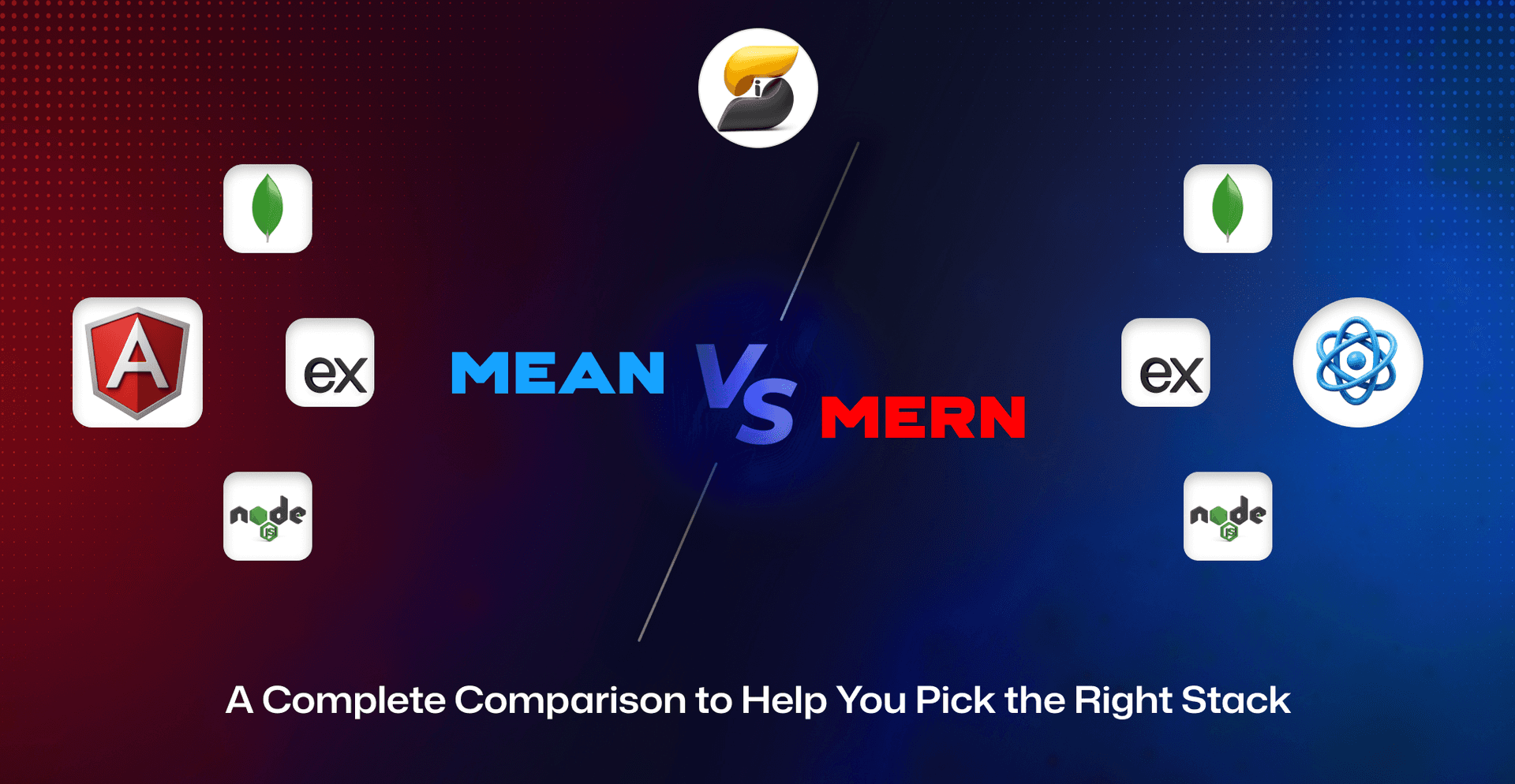
The choice between MEAN vs MERN stack fundamentally shapes how development teams approach modern web application projects. Both technology stacks have transformed full-stack development by enabling developers to use a single programming language across frontend and backend layers.
Understanding the differences between these powerful stacks helps businesses make informed decisions when building scalable web applications. Whether developing an enterprise platform or a consumer-facing application, selecting the right stack impacts development speed, maintenance costs, and long-term scalability.
A stack is the combined set of technologies used to build and run a software application. It includes the front-end, back-end, database, and supporting tools. A stack defines how each part of the system communicates and functions together. Without a clear stack, development becomes inconsistent and more complex to maintain.
The MEAN stack is a JavaScript-based technology stack consisting of MongoDB (database), Express.js (backend framework), Angular (frontend framework), and Node.js (runtime environment). This combination creates a unified ecosystem where JavaScript serves as the single programming language throughout the entire application architecture.
The MERN stack replaces Angular with React in the technology combination, consisting of MongoDB, Express.js, React, and Node.js. This stack leverages React's component-based architecture and virtual DOM to create dynamic, high-performance user interfaces while maintaining JavaScript consistency across all development layers.
Both stacks share three fundamental components that provide the foundation for modern JavaScript development. Understanding these shared technologies helps teams effectively implement either stack solution.
MongoDB's NoSQL architecture offers a flexible schema design essential for agile development. Document-based storage aligns naturally with JavaScript objects, eliminating the need for complex object-relational mapping. The database scales horizontally to handle growing data volumes and user loads.
Modern applications require database flexibility to accommodate changing requirements. MongoDB's schemaless design enables rapid iteration during development. Organizations seeking Database Architecture Services benefit from MongoDB's ability to handle diverse data types and structures efficiently.
Express.js provides a minimal, flexible Node.js framework for building web applications and APIs. Its middleware architecture enables modular request processing while maintaining clean server-side code. Express supports both RESTful APIs and GraphQL endpoints, allowing for adaptation to various architectural preferences.
The framework's simplicity allows developers to build custom solutions tailored to specific requirements. Express handles routing, request processing, and response generation with minimal overhead. Teams requiring API Development Services appreciate Express.js for its straightforward approach to backend development.
Node.js enables JavaScript execution on the server, unifying the development language across all application layers. Its event-driven, non-blocking I/O model delivers excellent performance for concurrent operations. The npm ecosystem provides access to over one million packages, accelerating development through code reuse.
The fundamental distinction between MEAN and MERN lies in their frontend frameworks. This choice significantly impacts development approach, team requirements, and application architecture.
Angular provides a complete solution with built-in features for routing, forms, HTTP requests, and state management. The framework's TypeScript integration delivers strong typing and enhanced IDE support. Development teams benefit from catching errors during compilation rather than at runtime.
Angular's opinionated structure enforces best practices across development teams. This standardization proves valuable for Enterprise Application Development, where consistency matters. The framework includes powerful features like two-way data binding, dependency injection, and comprehensive testing utilities.
The framework's CLI tool streamlines project creation, component generation, and build optimization. Angular's ahead-of-time compilation improves application performance and reduces bundle sizes. These enterprise features make Angular suitable for large-scale applications requiring long-term maintenance.
React focuses primarily on the view layer, providing flexibility in choosing complementary technologies. The virtual DOM optimization ensures exceptional rendering performance by minimizing actual DOM manipulations. Development teams can select their preferred libraries for routing, state management, and styling.
React's component-based architecture promotes code reusability and maintainability. JSX syntax combines JavaScript and HTML-like code for intuitive component development. Organizations offering React Development Services leverage the framework's extensive ecosystem to build customized solutions.
The library's learning curve proves gentler than Angular's comprehensive approach. Developers can start with basic components and gradually adopt advanced patterns. React Hooks enable state management in functional components, simplifying application logic.
Both stacks deliver excellent performance when properly optimized. Understanding their performance characteristics helps teams make informed architectural decisions.
React's virtual DOM typically provides superior performance for updating dynamic content. Applications that utilize real-time data or experience frequent UI changes benefit from React's efficient reconciliation algorithm. The virtual DOM calculates the minimal changes needed before updating the actual DOM.
Angular's change detection mechanism offers powerful capabilities but requires careful optimization in complex applications. The framework's OnPush strategy and trackBy functions help prevent unnecessary re-renders. Both frameworks support code splitting and lazy loading for improved initial load times.
Angular applications typically have larger initial bundle sizes due to the framework's comprehensive nature. Tree-shaking and lazy loading help reduce the size of production builds. Angular's Ivy renderer significantly improved bundle size optimization in recent versions.
React applications start small but grow with the addition of libraries for routing, state management, and other features. Careful dependency management prevents bundle bloat. Modern build tools, such as Webpack and Vite, optimize both frameworks effectively.
The developer experience has a significant impact on project timelines and code quality. Each stack offers distinct advantages depending on team composition and project requirements.
MEAN's Angular requires understanding TypeScript, decorators, observables, and framework-specific concepts. New developers typically need several weeks to become productive. The comprehensive documentation and structured approach help teams maintain consistency.
MERN's React offers faster initial productivity with a gentler learning curve. Developers familiar with JavaScript can start building components immediately. However, mastering the broader ecosystem requires learning additional libraries and architectural patterns.
Angular provides integrated tooling through Angular CLI, simplifying project setup and maintenance. Built-in features reduce decision fatigue and accelerate development for experienced teams. The framework's mature ecosystem includes official packages for various requirements.
React's ecosystem provides numerous options to meet every development need. Popular tools for project bootstrapping include Create React App, Next.js, and Vite. Teams providing full-stack Stack Development Services appreciate the flexibility to choose optimal tools for specific projects.
Understanding where each stack excels helps organizations select the most suitable one for their specific needs.
Financial institutions leverage Angular's strong typing and comprehensive testing capabilities for mission-critical applications. Healthcare providers appreciate the framework's security features and the support it provides for regulatory compliance. Government agencies benefit from Angular's enterprise features and long-term support.
Large organizations requiring standardized development practices often choose MEAN. The framework's structure supports team rotation and knowledge transfer. Complex business applications with extensive forms and data validation requirements are well-suited to Angular's capabilities.
Startups and digital agencies prefer React's flexibility for rapid prototyping and iteration. E-commerce platforms benefit from React's performance optimizations for dynamic product catalogs. Social media applications utilize React's efficient rendering capabilities for delivering real-time updates.
Consumer-facing applications prioritizing user experience often choose MERN. The ability to quickly integrate new features and experiment with different approaches supports innovation. React Native compatibility enables code sharing between web and mobile platforms.
Both stacks continue evolving with emerging web development trends. React Server Components represent a paradigm shift in client-server architecture, enabling improved performance and a better user experience. Angular's signal-based change detection promises improved performance and developer experience.
The rise of edge computing influences deployment strategies for both stacks. Serverless architectures and edge functions provide new opportunities for scalability. Companies offering Cloud Migration Services help organizations leverage these modern deployment patterns effectively.
WebAssembly integration opens new possibilities for performance-critical applications. Both the Angular and React communities are exploring WebAssembly for computationally intensive tasks. AI-powered development tools are increasingly supporting both frameworks, thereby improving developer productivity.
Selecting between MEAN vs MERN depends on multiple factors beyond technical capabilities. Consider your team's existing expertise when making this decision. Organizations with a strong background in object-oriented programming may find Angular's patterns familiar.
Project timeline influences stack selection significantly. MERN typically enables faster initial development for simple applications. MEAN provides a better structure for complex, long-term projects requiring extensive maintenance.
Budget considerations affect the decision process. React developers are generally more available in the job market. Angular developers often command higher salaries due to the high demand from enterprises.
The decision between MEAN vs. MERN stack significantly impacts your project's development experience and long-term success. MERN's flexibility and extensive ecosystem make it an attractive choice for diverse projects that require rapid iteration. MEAN's comprehensive framework approach provides structure and consistency valuable for enterprise applications.
Both stacks remain highly relevant in 2025, continuing to evolve with the JavaScript ecosystem. Success depends on aligning the stack choice with your team's expertise and project requirements. The shared MongoDB, Express.js, and Node.js foundation ensures seamless transfer of skills between stacks when needed.
Ready to build your next web application with the perfect technology stack? iSyncEvolution’s expert development team can help you navigate the MEAN vs MERN decision and deliver exceptional results.

A stack is the set of tools, frameworks, and technologies used to develop, run, and manage a software application.
MERN has an advantage through React Native, enabling code sharing between web and mobile platforms.
Yes, both work excellently with microservices. Node.js and Express.js are well-suited for building lightweight, scalable microservices.
MERN utilizes React for the frontend, whereas MEAN employs Angular. Both share MongoDB, Express.js, and Node.js, but differ in how they handle UI development and complexity.
Nikhil Shah is the CTO and Co-Founder of iSyncEvolution, an engineering leader who aligns modern technology best practices with long-term commercial success. A veteran of cloud infrastructure and scalable web/mobile solutions, he specializes in building high-performance software environments. Nikhil helps global brands master their technical roadmaps, optimizing both code performance and development economics to fuel growth.
© 2026 iSyncEvolution Pvt Ltd. All Rights Reserved.