
04 December, 2025
Selecting the right e-commerce platform can significantly impact the success of your online business. When evaluating Shopify, WooCommerce, and Magento, business owners face a decision that impacts development costs, scalability, and growth potential. Each platform serves distinct business needs and technical requirements. This comprehensive comparison examines features, pricing, and ideal use cases to help you choose the best e-commerce solution for your online store.
WooCommerce is a free, open-source e-commerce plugin designed for WordPress websites. Launched in 2011, this plugin transforms WordPress sites into fully functional online stores. WooCommerce offers extensive customization through thousands of themes and extensions, making it attractive for businesses seeking flexibility without monthly platform fees.
Magento, now known as Adobe Commerce since 2018, is an open-source e-commerce platform designed for enterprises and growing businesses with complex requirements. Available in both free, open-source, and paid, enterprise versions, Magento handles large product catalogs, multiple storefronts, and sophisticated pricing structures for businesses that require extensive customization.
Shopify is a hosted, subscription-based e-commerce platform that enables businesses to create online stores without requiring technical expertise. Founded in 2006, the platform offers a comprehensive solution that combines hosting, security, payment processing, and marketing tools for rapid deployment.
WooCommerce leverages WordPress's foundation to deliver unmatched customization potential. The platform provides complete control over code, database, and hosting environment.
As an e-commerce development provider, we've seen how WooCommerce enables businesses to implement Custom Software Development solutions without platform restrictions. The open-source nature allows unlimited product variations, built-in content management, and access to over 8,000 extensions.
Key technical advantages include complete access to the source code, the freedom to choose any hosting provider, and seamless integration with WordPress's extensive plugin ecosystem. This flexibility requires ongoing maintenance and technical expertise to ensure optimal performance. Businesses must manage security updates, performance optimization, and server administration independently.
Magento delivers enterprise-grade capabilities for complex e-commerce operations. The platform's modular architecture supports sophisticated customization and multi-channel commerce strategies.
Our experience with enterprise clients demonstrates that Magento excels in Cloud Infrastructure Services implementations for businesses requiring native B2B functionality, custom pricing, multi-store management from a single admin panel, and advanced inventory systems across multiple warehouses. The platform includes built-in customer segmentation tools and handles complex tax calculations.
Magento's robust features demand experienced developers and substantial hosting resources. The platform suits businesses with complex product configurations or those with international operations that require multiple currencies and languages. Enterprise-level security features protect sensitive customer data by ensuring compliance with PCI standards.
Shopify prioritizes user experience and rapid deployment through comprehensive built-in features. The hosted solution includes automatic updates, security patches, and scalable infrastructure, all of which are managed entirely by Shopify.
Business management tools include integrated payment processing, abandoned cart recovery, and mobile-responsive themes. The platform's 8,000+ app marketplace extends functionality without requiring custom development.
Shopify's simplicity makes it ideal for businesses that prioritize quick launch times over in-depth customization. The platform handles technical aspects automatically, letting merchants focus on sales and marketing strategies. Built-in CDN and global server infrastructure ensure fast loading times worldwide.
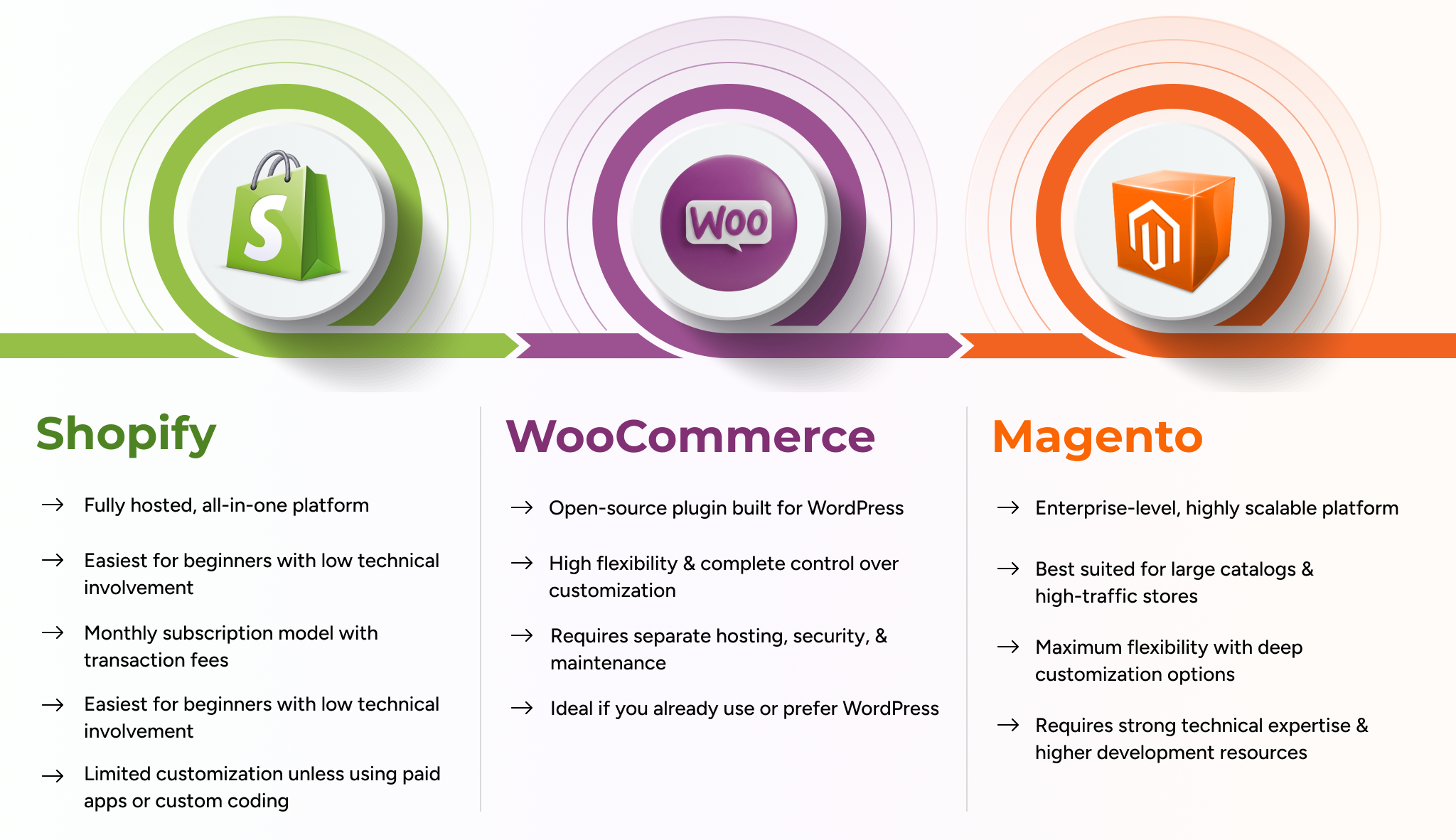
Understanding fundamental platform differences helps match solutions to specific business needs.
Shopify operates as a closed, fully hosted SaaS solution with standardized infrastructure; WooCommerce functions as a WordPress plugin, requiring self-hosting and server management. Magento provides a standalone platform with open-source community and enterprise cloud options.
These architectural differences impact everything from security responsibility to the depth of customization. Shopify merchants cannot access server configurations but benefit from automatic scaling. WooCommerce users control every aspect but shoulder complete responsibility. Magento offers flexibility with complexity, requiring experienced developers. If you choose to host your application logic externally to build custom storefront layers, utilizing an engineered headless Shopify development framework gives your company absolute backend scalability without exposing your database to public infrastructure vulnerabilities.
Shopify charges $39 to $299 monthly for standard plans, plus transaction fees of 0.5% to 2%. The WooCommerce plugin costs nothing, but hosting, themes, and extensions incur variable expenses. Magento Open Source requires only hosting costs, while Adobe Commerce includes enterprise licensing fees.
Consider long-term cost implications beyond initial setup. Transaction fees on Shopify accumulate with volume, unless you use Shopify Payments. WooCommerce's costs scale with hosting requirements and premium plugin subscriptions. Magento's development costs typically exceed those of other platforms due to its complexity.
WooCommerce offers unlimited modification through WordPress hooks and filters. Developers can alter any aspect of functionality through custom code. Magento offers extensive customization capabilities through its modular architecture and dependency injection. Shopify limits core changes but supports modifications to apps and Liquid templates.
Our Development team often implements headless architectures to overcome platform limitations. This approach separates frontend presentation from backend commerce functionality. All three platforms support headless implementations, with varying levels of complexity.
Each platform excels in specific business scenarios, tailored to the size, requirements, and growth strategies of each organization.
Feature / Metric | Shopify (SaaS) | WooCommerce (Plugin) | Magento / Adobe Commerce |
|---|---|---|---|
Hosting Environment | Fully Managed (Closed Cloud) | Self-Hosted (WordPress Engine) | On-Premise / Enterprise Cloud |
Code Customization | Limited to Liquid/App API | Full Access (PHP Open-Source) | Complete (Modular Architecture) |
Maintenance Model | Hands-off (Automated Updates) | Active (Manual Plugin Updates) | Heavy (Requires Core Dev Team) |
Ideal Scale | Startups to Large DTC Brands | Content Sites & Mid-Market | Enterprise High-SKU B2B/B2C |
Small to medium businesses need rapid deployment without technical complexity. Direct-to-consumer brands benefit from integrated marketing tools and social commerce features. Retail operations requiring point-of-sale systems find Shopify's omnichannel features valuable for unified inventory management.
Dropshipping businesses appreciate Shopify's integration with supplier apps. Subscription box services utilize recurring billing features effectively. Fashion and lifestyle brands leverage visual themes and Instagram shopping integration to enhance their online presence.
Content-driven businesses leverage WordPress's publishing strengths for SEO advantages. Budget-conscious companies with technical resources maximize value through free core functionality. Organizations that require complete data control prefer WooCommerce's self-hosted approach for meeting compliance requirements.
Educational institutions selling courses integrate with learning management systems easily. Publishers monetizing digital content benefit from WordPress membership plugins. Local businesses effectively combine e-commerce with content marketing strategies.
Enterprise businesses managing complex B2B requirements choose Magento's advanced features. International brands operating multiple storefronts benefit from centralized management capabilities. High-volume retailers require Magento's sophisticated inventory management systems for effective warehouse management.
Manufacturing companies utilize custom pricing rules and quote management features to streamline their operations. Wholesale distributors implement customer-specific catalogs and bulk ordering functionality. Global enterprises leverage multi-currency and translation management systems.
Platform selection requires careful evaluation of business requirements, technical resources, and growth projections to ensure a suitable match.
Your team's technical knowledge significantly impacts costs and maintenance overhead. WooCommerce and Magento demand developer expertise but offer greater control over functionality. Shopify offers simplicity at the expense of reduced flexibility for core modifications.
Consider ongoing maintenance needs beyond initial setup. WooCommerce requires regular WordPress updates and plugin compatibility checks to ensure optimal performance. Magento needs dedicated technical resources for optimal performance. Shopify eliminates most technical maintenance through managed hosting.
Cost structures vary dramatically across platforms. WooCommerce itself is free, but hosting, themes, and development add expenses over time. Quality hosting for WooCommerce typically costs $30-$ 500 per month, depending on the level of traffic. Shopify's monthly pricing simplifies budgeting, but it includes transaction fees ranging from 0.5% to 2%, unless you use Shopify Payments. Magento Open Source is free, while Adobe Commerce licensing starts at approximately $22,000 annually.
Hidden costs often surprise businesses during the implementation process. Consider theme customization, third-party integrations, and ongoing maintenance when calculating total investment. Our Business Consulting Services help clients create realistic budget projections for each platform.
Growth potential should guide long-term platform decisions. Shopify handles traffic spikes automatically through cloud infrastructure. WooCommerce scalability largely depends on the hosting choices and optimization efforts made. Magento excels with complex catalogs but needs robust infrastructure planning.
Database performance becomes critical at scale. WooCommerce shares WordPress database tables, which can potentially limit performance. Magento's dedicated architecture efficiently handles millions of SKUs, and Shopify abstracts database management entirely from merchants.
E-commerce platforms evolve rapidly with emerging technologies reshaping fundamental capabilities.
Headless commerce adoption continues to grow as businesses embrace modern frameworks alongside custom CMS integrations for rich text editors, page builders, and asset management. Shopify's Hydrogen framework, WooCommerce's REST API, and Magento's GraphQL support reflect this shift in architectural approach. Composable commerce enables the seamless integration of best-of-breed solutions across various platforms.
AI integration transforms platform capabilities through automated personalization and intelligent product recommendations. Machine learning algorithms optimize pricing strategies and inventory forecasting. These advances particularly benefit Digital Transformation Services initiatives, leading to improved operational efficiency.
Mobile commerce is expected to dominate, with over 72% of e-commerce sales continuously scaling across global markets in 2026. Progressive Web Apps (PWAs) and Accelerated Mobile Pages (AMP) have become essential for a competitive advantage. Voice commerce and augmented reality features emerge as differentiators.
Social commerce integration deepens across all platforms. Native shopping experiences on Instagram, Facebook, and TikTok drive discovery. Live shopping events and influencer partnerships are fundamentally reshaping marketing strategies.
Choosing between Shopify, WooCommerce, and Magento depends fundamentally on your business needs, technical capabilities, and growth goals. Shopify suits businesses that prioritize simplicity and rapid deployment, without incurring technical overhead. WooCommerce appeals to WordPress users seeking maximum flexibility without recurring platform fees. Magento serves enterprises requiring advanced features and extensive customization capabilities.
Consider budget constraints, technical resources, and scalability requirements when making this critical decision. Evaluate the total cost of ownership beyond initial setup expenses. Test platforms thoroughly before committing to long-term implementations.
Our E-commerce Development team provides expert guidance on platform selection and implementation tailored to your unique objectives. Contact our specialists today for personalized recommendations and implementation strategies that align with your business vision and growth trajectory.

Yes, migration tools are available for all three platforms, although the complexity varies significantly. Data migration typically includes products, customers, and order history. Custom functionality requires rebuilding on the new platform.
WooCommerce provides maximum SEO flexibility through WordPress plugins and complete code control. Magento includes extensive built-in SEO features that cater to the needs of enterprises. Shopify offers solid, basic SEO tools, but with some customization limitations.
Shopify's CDN and optimized infrastructure deliver consistent performance globally. WooCommerce speed largely depends on the quality of hosting and the optimization efforts made. Magento requires substantial resources but handles complex operations efficiently when properly configured.
All three platforms support multi-channel selling through various integrations. Shopify provides native social commerce and marketplace connections. WooCommerce and Magento require plugins or extensions for channel expansion.
Nikhil Shah is the CTO and Co-Founder of iSyncEvolution, an engineering leader who aligns modern technology best practices with long-term commercial success. A veteran of cloud infrastructure and scalable web/mobile solutions, he specializes in building high-performance software environments. Nikhil helps global brands master their technical roadmaps, optimizing both code performance and development economics to fuel growth.
© 2026 iSyncEvolution Pvt Ltd. All Rights Reserved.