
23 February, 2026
In 2026, ranking on Google is a vanity metric. As ChatGPT, Gemini, and Google AIO transition from "Search Engines" to "Answer Engines," your website is being treated as a free data source for their training sets. If your content is not engineered for Machine-Readable Authority, your brand will be synthesized into an anonymous answer, stripping you of traffic, attribution, and revenue.
This guide moves beyond "SEO" to Generative Engine Optimization (GEO). We outline the technical infrastructure required from llms.txt handshakes to Nested Entity Mapping to ensure your brand isn't just "read" by AI, but explicitly cited as the primary authority.
Here's an uncomfortable truth: your website might rank on page one of Google and still be completely invisible to ChatGPT, Gemini, and every other AI search engine reshaping how people find answers.
Welcome to the zero-click crisis.
Traditional search sent users to your site. AI search summarizes your content, references your competitors, and never sends anyone anywhere. The click is the foundation of two decades of digital marketing is disappearing. Most brands haven't noticed yet.
This isn't a future problem. It's happening right now. If your SEO strategy hasn't evolved to account for how large language models discover, evaluate, and cite brands, you're already losing ground. Generative engine optimization isn't a buzzword; it's the playbook your competitors are quietly adopting while you're still chasing keyword rankings that no longer drive revenue.
In this guide, we'll break down exactly what the zero-click crisis is, why it's happening, and what you can do about it starting today.
The zero-click crisis describes the accelerating shift where AI-powered search engines, such as ChatGPT, Gemini, Perplexity, and others, answer user queries directly without sending traffic to source websites. Users get what they need inside the AI interface. Your content gets consumed. Your site gets nothing.
This isn't about featured snippets stealing a few clicks. LLMs synthesize information from across the web, generate complete answers, and present them as seamless responses. The user never sees your URL, your brand name, or your call-to-action.
You contributed the knowledge. The AI got the credit.
Most SEO strategies in 2026 still revolve around a model built for Google's traditional index: optimize a page, earn a ranking, get a click. That model assumed users would always land on your website. AI search breaks that assumption entirely.
Here's where the disconnect happens:
Ranking #1 on Google doesn't mean ChatGPT or Gemini will reference your brand. LLMs don't crawl a ranked list; they synthesize from training data, retrieval-augmented sources, and entity relationships.
If your content isn't machine-readable, relying on JavaScript rendering, lacking structured data, or burying meaning inside walls of text, LLMs may never parse it accurately.
Google measures backlinks and domain authority. LLMs measure entity recognition, contextual frequency, and cross-source consistency. A strong backlink profile won't save you from being a ghost in AI search.
Traditional SEO balances user experience with crawler accessibility. AI search visibility requires a third layer: semantic clarity that machines can extract, interpret, and cite.
Your current strategy isn't wrong. It's incomplete. In a zero-click environment, incomplete means invisible.
Understanding how LLMs select which brands to mention is the first step toward fixing your AI search visibility. It's not random, and it's not purely popularity-based.
ChatGPT and Gemini are trained on massive datasets from the open web, books, research papers, and licensed content. If your brand appears frequently, consistently, and authoritatively across these sources, you have a training data footprint.
If you don't, no amount of on-page SEO will make you visible inside the model's knowledge.
Both platforms increasingly use real-time retrieval to supplement their training data. They pull from live web sources when generating answers.
Pages that are well-structured, semantically clear, and technically accessible have a higher chance of being retrieved and cited.
LLMs don't think in keywords; they think in entities. People, organizations, products, concepts, and the relationships between them.
If your brand isn't established as a distinct entity with clear associations (what you do, who you serve, what you're known for), AI search engines will default to competitors with stronger entity profiles.
When multiple independent sources confirm the same information about your brand, LLMs gain confidence in citing you.
A single optimized page on your own site isn't enough. The model needs corroboration from third-party mentions, industry publications, and structured knowledge bases.
Generative engine optimization isn't a replacement for traditional SEO; it's an expansion. Where SEO optimizes for search engine result pages, GEO optimizes for AI-generated answers.
The core difference: SEO asks, "How do I rank for this query?" GEO asks, "How do I become the answer even if the user never visits my site?"
This shift demands a different mindset:
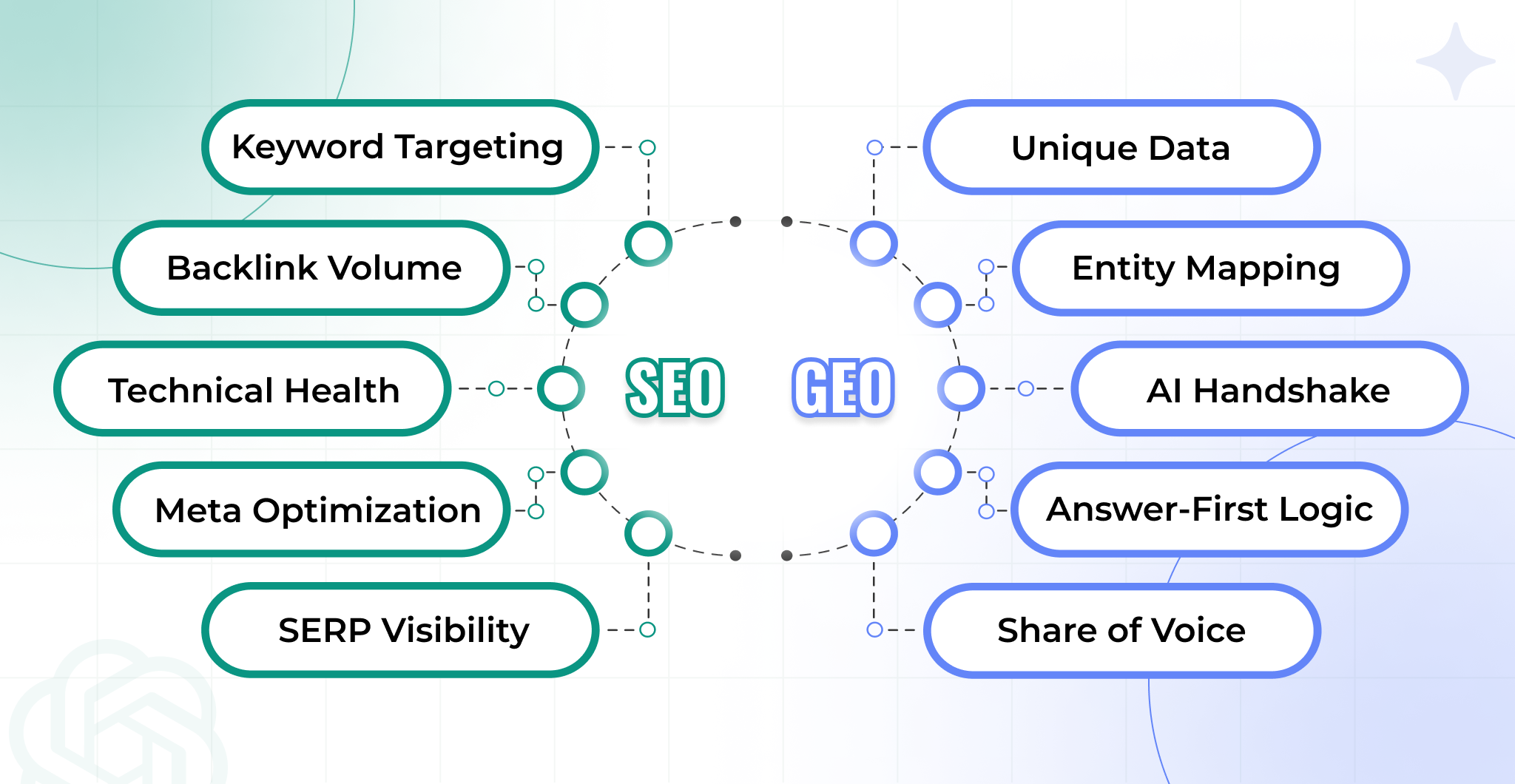
You still need strong technical SEO, quality content, and solid site architecture. However, you also need machine-readable authority signals, clear entity identification, and structured data that LLMs can parse directly.
AEO focuses on formatting content so AI engines can extract clean, citable answers. Think of it as the bridge between traditional content strategy and full GEO implementation.
Every piece of content needs to be built around topics, entities, and relationships, not just keywords.
Becoming visible to AI search engines isn't a single tactic. It's a system. These five pillars form the foundation of any serious generative engine optimization strategy.
The `llms.txt` file is to AI crawlers what `robots.txt` is to traditional search bots. It's a machine-readable file located at your site's root that informs LLMs about your site is content, what you want surfaced, and how your brand should be understood.
Without it, you're leaving the AI to guess, and guesses rarely favor you.
Key implementation details:
If your development team supports server-side rendering, implementing llms.txt SEO becomes significantly easier since content is accessible before client-side JavaScript executes.
Structured data for AI search goes beyond basic schema markup. In 2026, JSON-LD structured data needs to map your brand as an entity with defined relationships, attributes, and contextual relevance.
The standard schema tells Google your page has a product or FAQ. Entity mapping tells LLMs that your organization provides specific services, operates in specific markets, and holds specific expertise.
What this looks like in practice:
The goal: make your structured data comprehensive enough that an LLM can read your entity map directly, no interpretation needed.
Your brand needs to exist in the knowledge graph, not just Google's, but the informal knowledge graphs LLMs build from training data.
Brand graph seeding establishes your brand as a recognized entity across multiple authoritative sources:
When ChatGPT or Gemini encounters your brand in multiple independent contexts with consistent information, it builds confidence in referencing you.
Authority in AI search isn't just about backlinks. It's about producing content that machines can parse, verify, and attribute.
Practical steps:
If your e-commerce platform relies heavily on client-side rendering, your product descriptions may be invisible to AI retrieval systems entirely.
Visibility in one AI model doesn't guarantee visibility in another. ChatGPT, Gemini, Perplexity, and Claude each use different training data, retrieval methods, and citation logic.
Multi-model validation means testing your brand's presence across all major AI search platforms regularly. Ask each model about your industry, your competitors, and your specific services. Document where you appear, where you don't, and what the model says about you.
This isn't a one-time audit; it's an ongoing practice.
If users aren't clicking through, how do you know your GEO strategy is working? Traditional metrics don't capture the full picture in a zero-click world.
Here's what to measure instead:
Regularly query LLMs with industry-relevant questions. Track how often your brand appears and in what context.
Compare your brand's mention rate against competitors for the same queries.
Rising branded search indicates growing AI-driven awareness.
ChatGPT, Perplexity, and others do occasionally include links. Track this separately.
When an AI mentions your brand, is the information correct?
Monitor whether your markup passes validation for AI-specific parsers.
If you need hands-on help, you can hire an SEO expert from our team who specializes in GEO and AI search visibility.
The zero-click crisis isn't theoretical. It's the current state of search. ChatGPT and Gemini are already answering your customers' questions, and if your brand isn't part of those answers, you're losing influence that you may never recover.
Traditional SEO still matters. But without generative engine optimization layered on topof structured data for AI search, llms.txt implementation, entity mapping, machine-readable content, and multi-model validation, your digital presence has a blind spot growing wider each month.
Brands that act now will own the AI-generated answers in their space. Brands that wait will spend years wondering why traffic declines despite strong rankings.
The zero-click crisis is real. So is the opportunity for brands willing to evolve.
No. Traditional SEO still drives significant traffic through conventional search results. But relying on it exclusively means missing the growing segment of users who get answers directly from AI engines. GEO and SEO work together.
Focus on building a strong entity presence across the web, implementing JSON-LD structured data, creating machine-readable content, and deploying an llms.txt file. Cross-source consistency increases your chances of being cited.
An llms.txt file sits at your domain root and provides AI crawlers with structured information about your brand and content. It helps LLMs understand your site without guessing. Early adoption gives you an edge over competitors.
Track brand mention frequency in AI responses, share of voice against competitors, branded search volume trends, and referral traffic from AI platforms. These metrics reveal whether your brand is being cited in AI search.
Not at all. Smaller brands with strong niche authority and well-structured content can outperform larger competitors. LLMs prioritize entity clarity and contextual relevance, not just brand size.
Nikhil Shah is the CTO and Co-Founder of iSyncEvolution, an engineering leader who aligns modern technology best practices with long-term commercial success. A veteran of cloud infrastructure and scalable web/mobile solutions, he specializes in building high-performance software environments. Nikhil helps global brands master their technical roadmaps, optimizing both code performance and development economics to fuel growth.
© 2026 iSyncEvolution Pvt Ltd. All Rights Reserved.