
10 August, 2026
Regulators, auditors, and investor due diligence teams rarely reject a fintech product because of its UI framework. They reject it because no one can produce documented evidence of how card data, identity data, and transaction flows are controlled. For CTOs defending a cross-platform decision, the gap is architectural documentation, not technical capability.
You already know Flutter can build the product. The harder conversation starts when your board, your FCA examiner, or an investor’s technical diligence lead asks why a regulated financial application runs on a cross-platform framework. Most CTOs lose that room not because the choice is wrong, but because they arrive with a framework justification instead of a documented architecture. Successful Flutter Fintech App Development rests on security boundaries, controlled data flows, and evidence that sensitive data never sits where it should not. This guide covers the architectural decisions that make that case defensible and the ones that quietly create audit findings eighteen months later.
The framework debate consumes board time that should go to data flow design. Auditors do not certify Dart. They certify how your system stores, transmits, and controls regulated data and who can prove it.
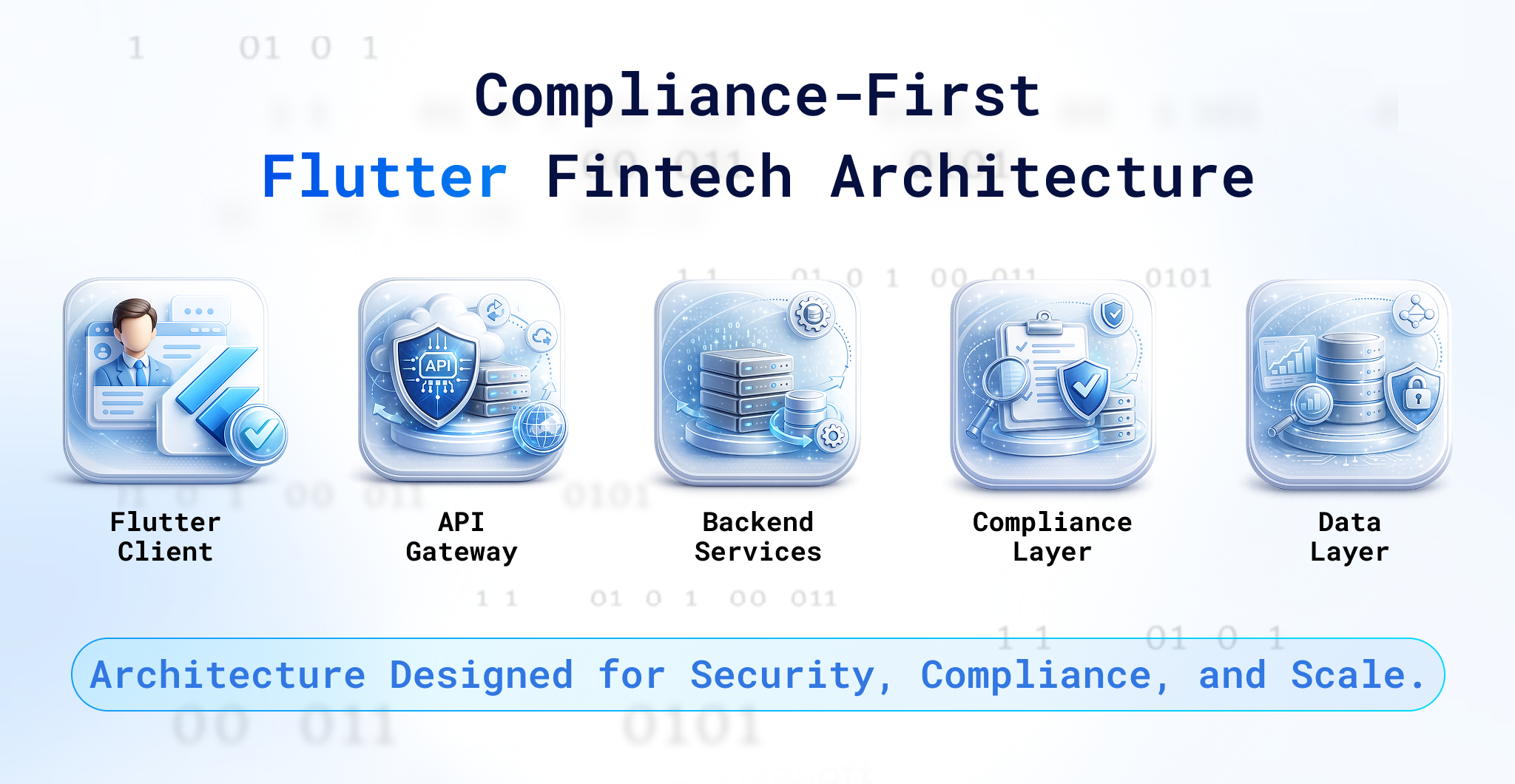
Due diligence assesses control effectiveness across the full system, not the rendering layer of the mobile client.
PCI-DSS asks where cardholder data lives. GDPR asks what personal data you process and why. Neither standard names a UI framework.
What examiners request is consistent: data flow diagrams, key management procedures, access control policies, and immutable audit logs. If those artifacts hold, the board-level framework objection loses its footing.
Resistance is a perception problem rooted in older cross-platform tooling, not current Flutter fintech security capability.
Boards remember hybrid webview apps with weak storage and slow platform parity. Flutter compiles to native ARM and calls platform keystores directly a material difference that rarely reaches the diligence conversation unless you surface it.
The counter-argument is documentation. A written Flutter fintech architecture that maps every regulated data element to its control ends the debate faster than any benchmark.
Retrofitting compliance after a build is finished is the most expensive mistake in regulated mobile projects. Every control added late touches architecture, testing, and release governance simultaneously.
| Regulation | Triggered By | Key Architectural Requirement | Market |
|---|---|---|---|
| PCI-DSS | Card acceptance | Tokenization, hosted payment flows, scope isolation | US · UK · EU |
| GDPR | Personal data processing | Lawful basis, data minimization, retention limits | UK · EU |
| KYC/AML | Identity capture, transactions | Backend verification service, audit trail, case management | US · UK · EU |
| DORA | Digital operational continuity | Resilience testing, vendor register, incident reporting | EU |
| FCA SYSC | Operational risk | System controls, outsourcing governance | UK |
Every product feature must map to the specific regulation it triggers before technical design work begins.
Skipping this map is how scope, cost, and audit exposure get locked in before a single sprint starts.
The cheapest compliance control is a boundary that removes data from scope entirely.
If raw card data never reaches your servers or the device, most PCI-DSS requirements no longer apply to those components. The same logic governs identity documents: process them inside the verification vendor’s environment, so your client and backend stay outside the highest-burden controls.
Scope reduction is an architectural decision, and it is the single strongest line in an audit response.
Threat modeling produces the artifact auditors ask for and most teams cannot supply.
A STRIDE review against each trust boundary device to API, API to core banking, core to third-party processor documents assumed attacker capability at each hop before build decisions harden. That record is what diligence teams expect when they challenge cross-platform fintech app development choices.
For regulated financial services software programmes, this document is a living control, revisited every release rather than filed once and forgotten.
Auditors rarely ask which framework you used. They ask where sensitive data lives, who can reach it, and whether every access leaves a trace. Three architectural decisions answer those questions before a single control gets tested.
Layered separation is what turns an audit into a fast walkthrough instead of a forensic dig. When presentation, domain logic, and data access sit in distinct layers, you can point an assessor to exactly where validation, encryption, and logging occur.
The business outcome is speed: evidence collection takes days, not quarters. It also lowers change risk, since a compliance-driven update touches one layer rather than the entire codebase. Poorly layered apps fail due diligence not because they are insecure, but because nobody can prove they are.
Treat the Flutter client as an untrusted rendering layer. Every authorisation decision, balance calculation, limit check, and compliance rule belongs on the server, where you control the runtime and retain immutable logs.
Thin clients shrink your attack surface and keep regulated logic out of a binary attackers can decompile. The trade-off is more network dependency and a heavier backend investment, a cost most boards accept once they understand it removes the mobile app from the trust boundary entirely.
Your APIs are the real regulated perimeter. Scoped tokens, short-lived sessions, mutual TLS for service-to-service calls, and per-endpoint rate limits form the controls auditors actually test.
Zero-trust means no internal service is assumed safe. Pair that with tamper-evident audit logs covering authentication, data access, and transaction state changes. Those logs are the single most requested artefact in FCA, OCC, and investor reviews across US and UK markets and the hardest to retrofit after launch.
PCI-DSS cost is a design choice. The architecture you approve determines whether your team faces a SAQ-A questionnaire or a full Level 1 assessment with annual on-site audits.
Tokenization removes card data from your systems entirely. The provider stores the PAN; your platform stores a token that is useless if exfiltrated.
This single decision can shift you from managing hundreds of PCI controls to a fraction of them, cutting audit cost and breach liability at the same time. For Flutter teams, it also means no card data ever enters the app's memory, storage, or logs an argument that ends most cross-platform security objections in one sentence.
Hosted fields and provider-issued SDKs keep card entry inside the processor's compliance boundary. Direct processing gives you full UX control but pulls your app, your CI pipeline, and your developers into PCI scope.
| Dimension | Hosted Payment Flows | Direct Card Processing |
|---|---|---|
| PCI Scope | SAQ-A (minimal) | SAQ-D or Level 1 (full) |
| UX Control | Limited — processor UI | Full — custom checkout |
| Audit Burden | Low | High — QSA required |
| Time to Compliance | Weeks | Months |
| Recommended For | Most fintech products | Differentiated checkout only |
Choose hosted flows unless a differentiated payment experience is core to your product. If you must go direct, budget for segmented environments, quarterly scans, and a QSA relationship from day one.
Investors look for concentration risk and reversibility. They ask which processor you depend on, what happens if that contract ends, and whether settlement, reconciliation, and refunds are independently auditable.
Document your provider abstraction layer, failover path, and reconciliation controls. A payment architecture that survives a provider change signals operational maturity and directly affects valuation in fintech diligence.
Identity is where regulated fintech products most often accumulate technical debt. Treating KYC, AML, and authentication as separate backend services keeps you adaptable as rules change across jurisdictions.
Vendor-agnostic verification behind your own identity service protects you from every regulator, pricing, and performance change that would otherwise force a release. Regulators differ by market, vendors underperform, and pricing shifts none of which should require a mobile update.
Flutter renders the flow; the backend owns decisions, document retention, and re-verification triggers. This modularity lets you enter a new market by configuring a provider rather than rebuilding onboarding, which shortens expansion timelines measurably.
AML screening, sanctions checks, and transaction monitoring must never touch the client. Rules change frequently and must apply retroactively across historical data.
Run monitoring as a backend service with case management, alert queues, and full decision history. Auditors want to see why an alert was raised, who reviewed it, and how long it took. That evidence trail matters more to a regulator than detection sophistication.
Session binding to hardware-backed keys is the standard regulators now expect. FIDO2 and platform biometrics through Secure Enclave and Android Keystore give you phishing-resistant authentication that satisfies PSD2 strong customer authentication requirements across Europe.
Biometrics should unlock a device-held key, never transmit biometric data. Combine this with step-up authentication for high-value transactions. The result is lower fraud loss and fewer password-reset support costs measurable outcomes your board understands.
Under DORA and equivalent regimes, resilience is now a compliance obligation, not an engineering preference. Regulators expect evidence that you can detect, recover from, and report disruption within defined windows.
Map your critical business services and the dependencies behind each one. Regulators expect documented impact tolerances, tested recovery objectives, and a register of third-party providers including your payment and KYC vendors.
Concentration risk in a single cloud region or processor is now a reportable weakness. Address it in architecture, not policy documents.
Detect failure before customers report it, or you inherit the reporting delay as a compliance gap. Transaction-level tracing, error budgets, and alerting on compliance-relevant events give you the reporting timelines regulators require.
Rehearse recovery. An untested continuity plan fails diligence as quickly as no plan at all, and incident response drills are increasingly requested as evidence.
Every release into a regulated environment needs traceability: who approved it, what changed, and how it was tested. Signed builds, protected branches, dependency scanning, and separation of duties form the baseline.
Flutter's over-the-air configuration options must be governed carefully; uncontrolled remote updates undermine change-control evidence. Explicit release governance protects both your audit position and your app store standing.
Use this before signing a statement of work. Gaps here become findings later, when remediation costs multiply.
Confirm these governance items are documented before approval:
Ambiguity over release sign-off is the most common diligence failure.
Require evidence for each security control before development begins:
Missing closure dates on past findings signal a partner who tests but never remediates.
Specialists in Flutter app development for regulated industries understand both architectural and compliance requirements, not just mobile apps. Ask for architecture decision records, audit support experience, and references from compliance-heavy sectors.
Review contract terms on IP ownership, source escrow, security incident obligations, and knowledge transfer. When hiring a Flutter development team, compliance literacy matters more than raw delivery velocity.
Flutter isn't the challenge in regulated fintech development architecture is. The platforms that pass regulatory due diligence are built with security, compliance, and auditability at their core from day one. By reducing compliance scope, securing sensitive data, and designing scalable backend-first architectures, CTOs can confidently deliver Flutter fintech applications that satisfy regulators, investors, and enterprise stakeholders.
Planning a Flutter fintech product? Contact Us at iSyncEvolution to build a secure, compliance-ready architecture designed for long-term growth and regulatory confidence.
Flutter is secure enough when the architecture around it is correctly designed. Compliance is determined by how your system controls regulated data, not which framework renders the screens.
Your payment architecture handles PCI-DSS, not Flutter. Tokenization and hosted payment flows keep raw card data out of the client entirely, reducing your compliance scope from a Level 1 assessment to an SAQ-A.
DORA requires documented recovery objectives, incident reporting windows, and third-party concentration risk controls. These must be designed into the architecture from day one, not retrofitted after the first regulatory review.
KYC and AML belong on the backend, not the mobile client. The Flutter client renders the flow; a vendor-agnostic backend service owns every verification decision, retention action, and audit trail.
Ask whether they treat compliance as architecture or paperwork. Request architecture decision records from prior regulated builds and references from compliance-heavy sectors, not just mobile delivery portfolios.
Nikhil Shah is the CTO and Co-Founder of iSyncEvolution, an engineering leader who aligns modern technology best practices with long-term commercial success. A veteran of cloud infrastructure and scalable web/mobile solutions, he specializes in building high-performance software environments. Nikhil helps global brands master their technical roadmaps, optimizing both code performance and development economics to fuel growth.
© 2026 iSyncEvolution Pvt Ltd. All Rights Reserved.