
25 May, 2026
Choosing between Flutter and React Native in 2026 has become harder, not easier. The performance gap has effectively closed, the global hiring market has shifted, and most mobile developers are still answering this question using an outdated playbook from three years ago.
As a result, CTOs and founders are routinely handed framework recommendations that ignore true Total Cost of Ownership (TCO), app category fit, and long-term team economics. The cross-platform choice is no longer a technical debate; it is a critical business decision wrapped in engineering language.
To help you protect your development margins and scale your product sustainably, this guide delivers an objective, risk-weighted decision framework focused on the core architectural shifts impacting your engineering roadmap:
Your senior developer wants Flutter. Your contractor swears React Native ships faster. Your CFO wants the cheaper one. None of them is answering the question you actually need answered: which framework gives your business the lowest three-year total cost and the highest probability of shipping the right app. The Flutter vs React Native decision in 2026 is no longer a technical comparison; it is a business decision wrapped in technical language. Impeller changed the performance conversation, the hiring market changed the cost conversation, and the app category you are building decides which trade-offs actually matter.
Flutter and React Native are no longer separated by raw performance. Choosing between them is a multi-year Total Cost of Ownership (TCO) calculation. Flutter is the definitive choice for graphics-heavy, cross-platform apps requiring long-term architectural stability. React Native remains the practical selection for content-driven apps where leveraging an existing React web team maximizes upfront development velocity.
The performance gap that defined this debate for five years has effectively closed for most app categories. What replaced it is a more uncomfortable conversation about team economics, app category fit, and what happens in year three. If your developers are still arguing about render speeds and bridge overhead, they are answering a 2022 question with 2022 data, and you are about to fund the consequences.
Flutter's Impeller rendering engine eliminated the jank and shader-compilation stutter that gave React Native its remaining performance advantage in graphics-heavy apps. That is the single most important technical shift of the last two years.
Before Impeller, React Native held a credible edge in scroll-heavy ecommerce flows and animation-dense interfaces on lower-end Android devices. After Impeller's full rollout, that edge disappeared for most production scenarios. Flutter now renders predictably across the device tiers your customers actually use, including the older Android hardware still dominant across European and emerging markets.
For a CTO evaluating a fintech or ecommerce build, the Impeller engine's measurable impact on retail app performance is no longer a roadmap promise; it is a shipped reality you can benchmark today.
What this means for your decision: performance is no longer the tiebreaker. If a developer pitches React Native to you purely on performance grounds in 2026, they are working from outdated assumptions. The real decision criteria sit elsewhere in hiring, maintenance, and app category fit.
The cost of picking the wrong framework is rarely visible in year one. It surfaces in year two when you need to add a payments module, in year three when half your React Native dependencies are abandoned, and in year four when you discover the rebuild costs more than the original app. Framework choice is a TCO decision disguised as a tech stack decision.
The highest hidden cost in cross-platform development is not the build; it is the cumulative tax of native module maintenance, dependency churn, and platform parity work that nobody quotes in the original SOW.
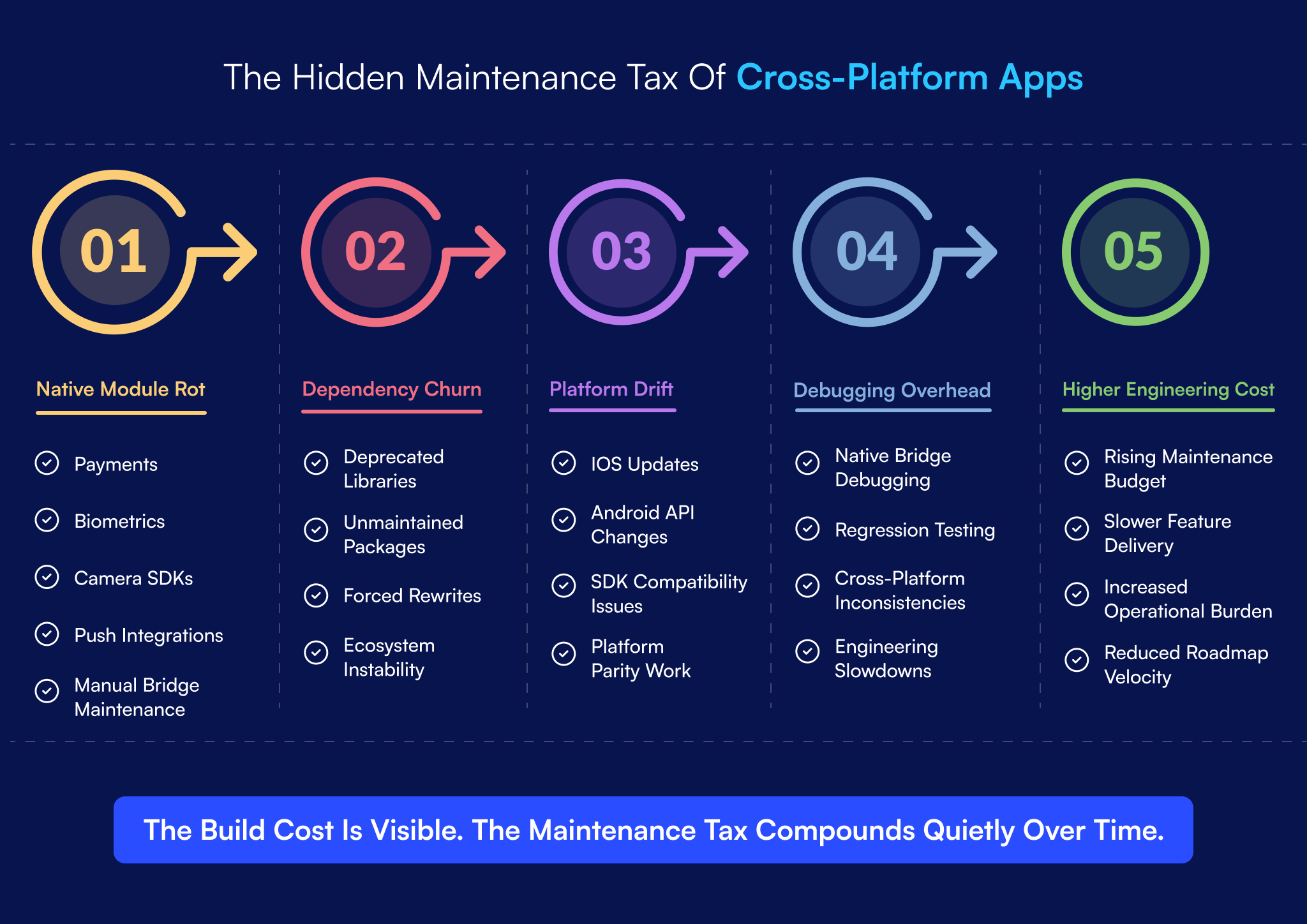
iSyncEvolution has watched founders rebuild apps twice in four years because the year-one decision optimized for sprint velocity instead of three-year economics.
Framework choice should follow the app category, not the developer's preference. The wrong pick shows up 18 months later as performance complaints, hiring bottlenecks, or a rewrite budget that no one approved. Below is the decision pattern we see consistently across US fintech, UK retail, and European logistics builds, where regulation, performance, and team scale all pull the decision in different directions.
| Decision Vector | Flutter (with Impeller Engine) | React Native (New Architecture) |
|---|---|---|
| Rendering Pipeline | Draws directly to a hardware-accelerated canvas; 0% OS-bridge latency. | Runs on a synchronous C++ Shadow Tree via Fabric and Yoga 3.0. |
| Graphics & UI Control | Absolute pixel control. Renders identically across flagship and legacy device tiers. | Leverages native platform components; highly complex custom animations require native overrides. |
| 3-Year Maintenance Tax | Minimal. The core engine absorbs major iOS and Android platform updates natively. | Moderate. Requires ongoing upkeep for custom TurboModule bridges as native SDKs evolve. |
| Talent Pool Economics | Dart features a 2-week onboarding curve for standard mobile teams. Low runtime debugging overhead. | Unlocks direct access to JavaScript/React web pipelines. Requires native platform specialists for deep debugging. |
| Multi-Surface Scaling | Deploys natively to Mobile, Web (Wasm), Desktop, and embedded screens from a single codebase. | Excellent code-sharing targets for React Web configurations; optimized primarily for mobile surfaces. |
| Best-Fit App Categories | Fintech platforms, transactional apps, graphic-heavy e-commerce, and high-frequency dashboards. | Content-driven applications, internal corporate tools, B2B dashboards, and rapid web-parity MVPs. |
React Native is the right choice when your product is content-driven, your team already runs a React web stack, and your performance ceiling is moderate. In these scenarios, the shared talent pool and code reuse with web outweigh Flutter's rendering advantages.
For fintech, ecommerce, media-heavy, or animation-driven products, the equation flips. Flutter's Impeller rendering, single-codebase consistency, and pixel control deliver outcomes that React Native cannot match, which is why most custom Flutter app development engagements should start with a category audit before a framework recommendation.
The framework debate often skips the most expensive variable: who you can actually hire, retain, and scale across the next three years. Talent supply, salary bands, and onboarding speed differ sharply between Flutter and React Native, and they differ again between the US, UK, and European markets, where developer rates and availability are not symmetric.
Dart is not the hiring bottleneck React Native advocates claim it is. The real talent constraint in 2026 is senior cross-platform engineers, and that scarcity hits both ecosystems equally. What changes is the economics underneath.
Flutter developers in Eastern Europe and South Asia are now priced competitively against React Native developers, and the Dart learning curve for an experienced mobile engineer is roughly two to three weeks, not the six months the myth implies.
React Native projects frequently need a native iOS or Android specialist on standby for bridge issues, doubling the effective team cost. Flutter teams rarely carry that overhead because the rendering engine ships with the app.
For founders weighing team structure against build velocity, the decision to hire dedicated Flutter developers usually pays back within the first release cycle through reduced native debugging overhead.
The single mistake that derails cross-platform projects is picking the framework before defining the business outcome. Vendors who quote before auditing your category, compliance load, and team reality are selling capacity, not judgment. Here is how to separate the two.
This is the audit pattern iSyncEvolution runs before any engagement, and it's the conversation worth having before you commit a budget. Book a framework decision audit.
The Flutter vs. React Native decision in 2026 is not a framework debate; it's a business decision about category fit, team economics, and three-year cost exposure. The right answer is the one that survives your roadmap, your hiring market, and your compliance load. The loudest developer in the room is rarely the one who has modeled all three.
If you're still getting conflicting advice, the problem isn't the frameworks. It's that no one has run the decision framework against your actual business yet.
Relying on generic internet comparisons or siloed engineering preferences is a multi-year financial risk. To build an app that safeguards your runway and scales predictably, you need an engineering partner who evaluates code through the lens of business infrastructure.
At iSyncEvolution, we cut through ecosystem bias to deliver mobile strategies rooted in long-term Total Cost of Ownership (TCO) and operational efficiency. Whether you need to build a high-performance transactional asset or optimize an existing talent pool, we help you engineer with intent. Don’t let your tech stack choices dictate your business limits. Contact iSyncEvolution today to schedule a comprehensive framework decision audit with our principal mobile architects.
Technically yes, but practically no. While you can embed Flutter screens into React Native via native views, running two distinct runtime environments overcomplicates your dependency tree. A phased full rewrite tied to major feature updates is the cleaner, more cost-effective path over a 12-month timeline.
The framework choice has zero direct impact on compliance. Both ecosystems fully support enterprise-grade data encryption, secure storage, and comprehensive audit logs. Your compliance risk is entirely determined by your team’s architecture and implementation discipline, not the framework label.
Flutter typically ships 3 to 5 weeks faster. Because Flutter draws directly to its own canvas via the Impeller engine rather than relying on an asynchronous native bridge, developers spend significantly less time debugging platform-specific UI glitches.
Your exit path is a standard UI rewrite, the same risk you face with Meta and React Native. Sudden deprecation is highly unlikely given Flutter’s massive open-source community and global enterprise adoption. Framework risk across both options is completely symmetric.
Upfront hourly rates are identical, but Flutter yields lower long-term overhead. React Native teams frequently require specialized native iOS/Android engineers to step in and fix custom bridge regressions. Flutter teams operate more autonomously, reducing total engineering resource strain.
Nikhil Shah is the CTO and Co-Founder of iSyncEvolution, an engineering leader who aligns modern technology best practices with long-term commercial success. A veteran of cloud infrastructure and scalable web/mobile solutions, he specializes in building high-performance software environments. Nikhil helps global brands master their technical roadmaps, optimizing both code performance and development economics to fuel growth.
© 2026 iSyncEvolution Pvt Ltd. All Rights Reserved.