
08 January, 2026
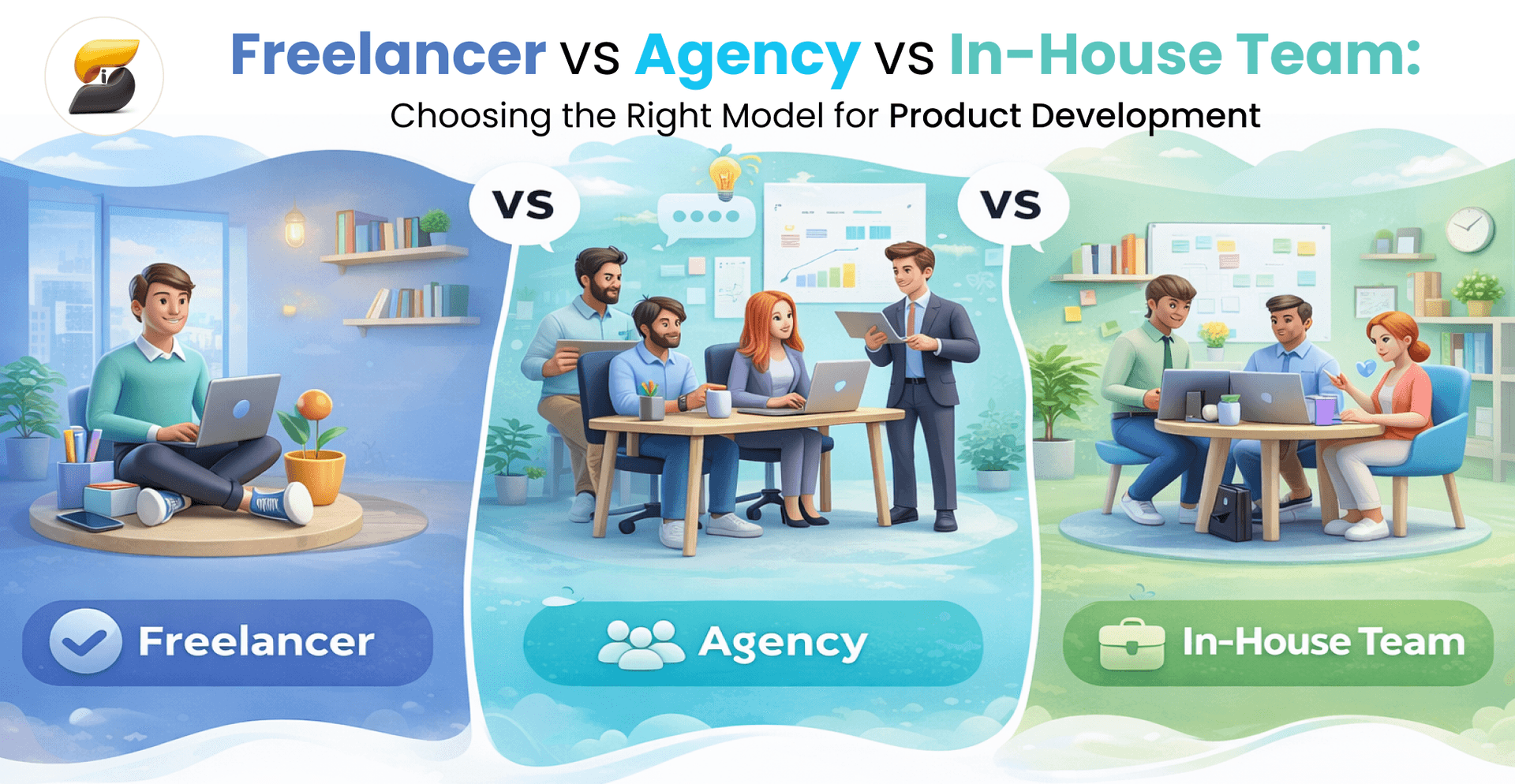
Choosing between a freelancer vs agency vs in-house team for product development is one of the most critical decisions you'll make as a business owner. Each option brings distinct advantages and challenges that directly impact your project's success, timeline, and budget. Whether you're building a mobile app, launching a digital platform, or scaling an existing product, understanding these three models helps you make the right choice for your business goals and available resources.
An agency is a professional service company providing comprehensive development solutions through a team of specialists. Operating as external partners, agencies offer structured processes, project management, and diverse expertise under one roof. They handle everything from consultation to final delivery—ideal for businesses seeking turnkey solutions. When considering mobile app development services, agencies typically provide end-to-end support, including design, development, testing, and deployment.
A freelancer is an independent professional offering specialized services on a project or contract basis without permanent employment at your company. They work remotely or on-site temporarily, manage their own schedule, and typically handle multiple clients simultaneously.
An in-house team consists of full-time employees working exclusively for your company. These professionals integrate into your organization's culture and processes, dedicating their working hours to your products and projects. Building an in-house team means investing in long-term talent that grows alongside your company while maintaining deep institutional knowledge.
Agencies provide comprehensive solutions that transform your product vision into reality through structured processes and team expertise.
When evaluating agency vs in-house team options, agencies offer immediate access to multidisciplinary teams—designers, developers, project managers, and QA specialists working on your project.
Managed software agencies bring structured deployment methodologies and battle-tested delivery frameworks that drastically minimize systemic project risks. Their cross-industry exposure means their engineers instinctively anticipate structural bottlenecks and implement rapid solutions before they impact production timelines. When you collaborate with a dedicated full-stack development company, you gain an elite accountability factor; these end-to-end teams manage both frontend user interfaces and backend database routing within a unified, seamless pipeline.
Scalability becomes frictionless under this outsourced model. Full-stack agencies can rapidly reallocate specialized cloud infrastructure architects or engineering resources to accommodate aggressive launch deadlines or unexpected scope changes, completely bypassing the expensive recruitment, onboarding, and overhead bottlenecks associated with assembling an equivalent in-house team.
Cost often becomes the primary drawback. Agencies charge premium rates covering overhead, team salaries, and profit margins—potentially prohibitive for startups or small businesses with limited budgets.
Less direct control over individual team members can frustrate some clients. Communication typically flows through account managers rather than directly to developers, sometimes causing miscommunication or feedback delays.
Working with freelancers offers unique advantages for businesses seeking flexibility and specialized expertise without long-term commitments.
Cost-effectiveness stands out when comparing freelancer vs agency options. Freelancers charge lower rates than agencies since they have minimal overhead—you pay only for work completed without additional expenses like office space, benefits, or equipment.
Many freelancers are experts in specific technologies or niches, bringing specialized skills to your project. Their flexibility lets you scale quickly based on project needs without lengthy contracts or termination processes.
Direct communication eliminates management layers, leading to faster decisions and clearer requirement understanding. This streamlined approach often delivers quicker turnarounds for smaller projects.
Reliability concerns arise with individual freelancers. Without backup support, illness or emergencies can derail timelines. Managing multiple freelancers for complex projects requires substantial coordination from your team.
Quality varies widely among freelancers, making thorough vetting essential. Popular freelancers often juggle multiple clients, potentially affecting their responsiveness to your needs.
Building an in-house team represents a strategic investment in your company's technical capabilities and product development future.
Complete control and cultural alignment make in-house teams invaluable for long-term development. Team members fully understand your business goals and processes, leading to better strategic decisions. When you hire dedicated developers, they become invested in your company's success beyond individual projects.
Knowledge retention stays within your organization, building institutional memory that improves efficiency. In-house teams develop deep product understanding, grasping nuances external partners might miss—particularly valuable for complex products requiring continuous iteration.
Communication flows naturally within in-house teams. Daily standups, impromptu discussions, and quick pivots happen seamlessly when everyone shares the same environment or timezone.
Financial commitment extends beyond salaries. Benefits, equipment, office space, training, and management overhead significantly increase total costs. When comparing freelancer vs in-house team expenses, the latter runs 2-3 times more per resource.
Scaling challenges emerge when project demands fluctuate. Hiring takes time, and reducing team size during slow periods damages morale and loses valuable knowledge. Recruitment itself requires substantial time and resources, especially for specialized roles.
Selecting the right model depends on your project requirements, timeline, and business stage.
Freelancers excel at short-term projects with defined scopes. If you need specific expertise temporarily—implementing features or fixing technical issues—freelancers provide cost-effective solutions. Startups with limited budgets often succeed using freelancers for MVP development or proof-of-concept projects.
Small businesses needing occasional technical support benefit from freelancer relationships. The freelancer vs agency decision often comes down to project complexity and budget constraints.
Agencies suit businesses launching major products or undergoing digital transformation. When you need complete solutions from strategy through implementation, agencies provide comprehensive support. Companies without technical leadership particularly benefit from agency partnerships.
For time-sensitive projects requiring multiple skills, agencies deliver faster than assembling freelance teams. Their established processes handle complex projects efficiently when quality and timelines are non-negotiable.
In-house teams become essential when your product drives your business model. Technology companies, SaaS providers, and digital-first businesses need dedicated teams for continuous development. If you're building proprietary technology or handling sensitive data, in-house teams provide better security and control.
Long-term roadmaps with frequent updates benefit from team continuity. Deep product knowledge becomes invaluable for strategic decisions and rapid market response.
Each model offers different scalability advantages affecting your ability to grow development capacity.
Freelancers provide immediate scalability for specific skills, but coordinating multiple freelancers becomes complex as teams grow. You can quickly add specialists, but maintaining consistency across large freelance teams requires significant management effort.
Agencies excel at rapid scaling, allocating resources from their talent pool as needed. They handle coordination internally, reducing your management burden—ideal for projects with variable requirements or aggressive growth plans.
In-house teams scale slowly but build stronger dynamics over time. Established team cohesion and communication efficiency often outweigh slower scaling. However, rapid growth may require supplementing with freelancers or agency support.
Understanding how each model handles these factors helps you choose based on management style and risk tolerance.
With freelancers, you maintain direct control but assume most project risks. Communication stays straightforward but requires active management. If freelancers become unavailable, quick replacements prove challenging. IP agreements need careful attention to protect your interests.
Agencies share project risks through contracts and service agreements. While you have less direct control, professional agencies manage risks through established processes and backup resources. Communication follows structured channels—sometimes bureaucratic, but ensuring documentation and accountability.
In-house teams give maximum control with shared risk among permanent employees. Communication happens organically, but managing team dynamics becomes your responsibility. Key employees leaving remain a risk, though notice periods provide transition time.
Creating a decision framework helps evaluate which model aligns with your specific situation.
Start by assessing project scope and timeline. Short-term, defined projects suit freelancers. Complex, multi-phase projects benefit from agency expertise. Ongoing development requires in-house teams. Consider our guide on app development timelines for better project planning.
Evaluate your budget beyond initial development—include long-term maintenance. Factor in hidden costs like management time, recruitment, and knowledge transfer. The cheapest initial option may not provide the best lifecycle value.
Consider internal capabilities. Without technical leadership, agencies provide guidance and best practices. With strong technical management, coordinating freelancers becomes feasible. Companies with established processes can effectively build in-house teams.
Assess risk tolerance and control needs. High-stakes projects with strict compliance often necessitate in-house teams. Projects prioritizing speed-to-market might benefit from agency resources. Experimental features or MVPs can leverage freelancer flexibility.
Many successful companies combine models to maximize advantages while minimizing disadvantages.
A core in-house team supplemented with freelance specialists provides stability with flexibility. Your permanent team maintains product knowledge while freelancers handle specialized tasks or overflow work, balancing cost control with capability building.
Partnering with agencies while building in-house teams accelerates initial development. The agency delivers your first version while you recruit and train permanent staff—effective for companies entering new technical territories. We offer flexible engagement models, including the ability to hire mobile app developers who work as team extensions.
Some companies maintain small in-house teams for core functionality while using agencies for major features. This keeps fixed costs low while accessing expertise when needed. Clear boundaries and communication protocols between groups remain essential.
Project-based combinations work effectively, too. Use freelancers for prototyping, agencies for major development, and in-house teams for maintenance. This optimizes resource allocation across the product lifecycle.
Choosing between a freelancer vs agency vs in-house team isn't about finding the universally "best" option—it's about matching the right model to your needs, resources, and goals. Freelancers offer flexibility and cost-effectiveness for specialized tasks. Agencies provide comprehensive solutions and scalability for complex projects. In-house teams deliver long-term value through deep product knowledge and cultural alignment. Many successful products leverage hybrid approaches, combining models to optimize outcomes. Consider your project scope, budget, timeline, and internal capabilities when deciding. Remember that your choice can evolve as your product and business grow.

Identify critical freelance roles and hire for those positions first. Maintain freelancer relationships during transition to ensure continuity. Document all processes systematically to preserve project knowledge.
Yes, but coordination becomes crucial. Establish clear boundaries between agency responsibilities and communication protocols. Consider designating one lead agency for coordination, though costs may increase.
Use comprehensive NDAs and work-for-hire agreements with freelancers and agencies. Ensure contracts clearly state IP ownership transfers. Consider [mobile app security essentials](https://www.isyncevolution.com/blog/mobile-app-security-essentials) when sharing sensitive information.
Switch when your current approach no longer serves your growth stage. Move from freelancer to agency when projects become too complex to coordinate. Transition from agency to in-house when technology becomes core to your business.
Nikhil Shah is the CTO and Co-Founder of iSyncEvolution, an engineering leader who aligns modern technology best practices with long-term commercial success. A veteran of cloud infrastructure and scalable web/mobile solutions, he specializes in building high-performance software environments. Nikhil helps global brands master their technical roadmaps, optimizing both code performance and development economics to fuel growth.
© 2026 iSyncEvolution Pvt Ltd. All Rights Reserved.