
07 September, 2026
Trend coverage tells technical leaders what is popular, but rarely what to change. For a 20–200-person company, the cost of following the wrong trend is measured in migration months, hiring mistakes, and infrastructure bills that grow faster than revenue. This guide translates the full-stack development trends for 2026 into architecture, hiring, and budget decisions.
You have read the same twelve trend lists this quarter. None of them told you whether to move your authentication layer, whether to hire a platform engineer or two more product engineers, or what your cloud bill looks like in eighteen months. Full stack development trends get reported as technology news, not as decisions with budgets attached, and a trend only matters if it changes architecture, team composition, operating cost, or delivery speed. This guide sorts those trends by that standard for companies large enough to feel architectural mistakes and small enough that recovering from them hurts.
Most trend content optimises for novelty. You optimise for consequence. The gap between those two goals is why so much of what you read never converts into a decision your engineering team can act on.
A technology becomes a business decision only when it changes what you spend, who you hire, or how fast you ship.
A new framework release is news. Replacing your rendering layer is a two-quarter commitment with hiring implications. Trend reports collapse both into the same sentence.
The useful filter is simple: if adopting something requires no change to headcount, budget, or delivery cadence, it is a preference, not a strategy. That is the standard iSyncEvolution applies when a trend reaches the leadership table.
Four questions eliminate roughly 80% of trend-driven work before it reaches a sprint.
1. Does this change our architecture?
If it only changes syntax or tooling, it is a team preference; decide it locally, not at the leadership level.
2. Do we need different people?
New paradigms carry hiring costs that rarely appear in the evaluation document.
3. Does this raise or lower operating cost?
Model it at 3x your current traffic, not today's.
4. What happens if we ignore it for 18 months?
If the honest answer is "nothing," you have your decision.
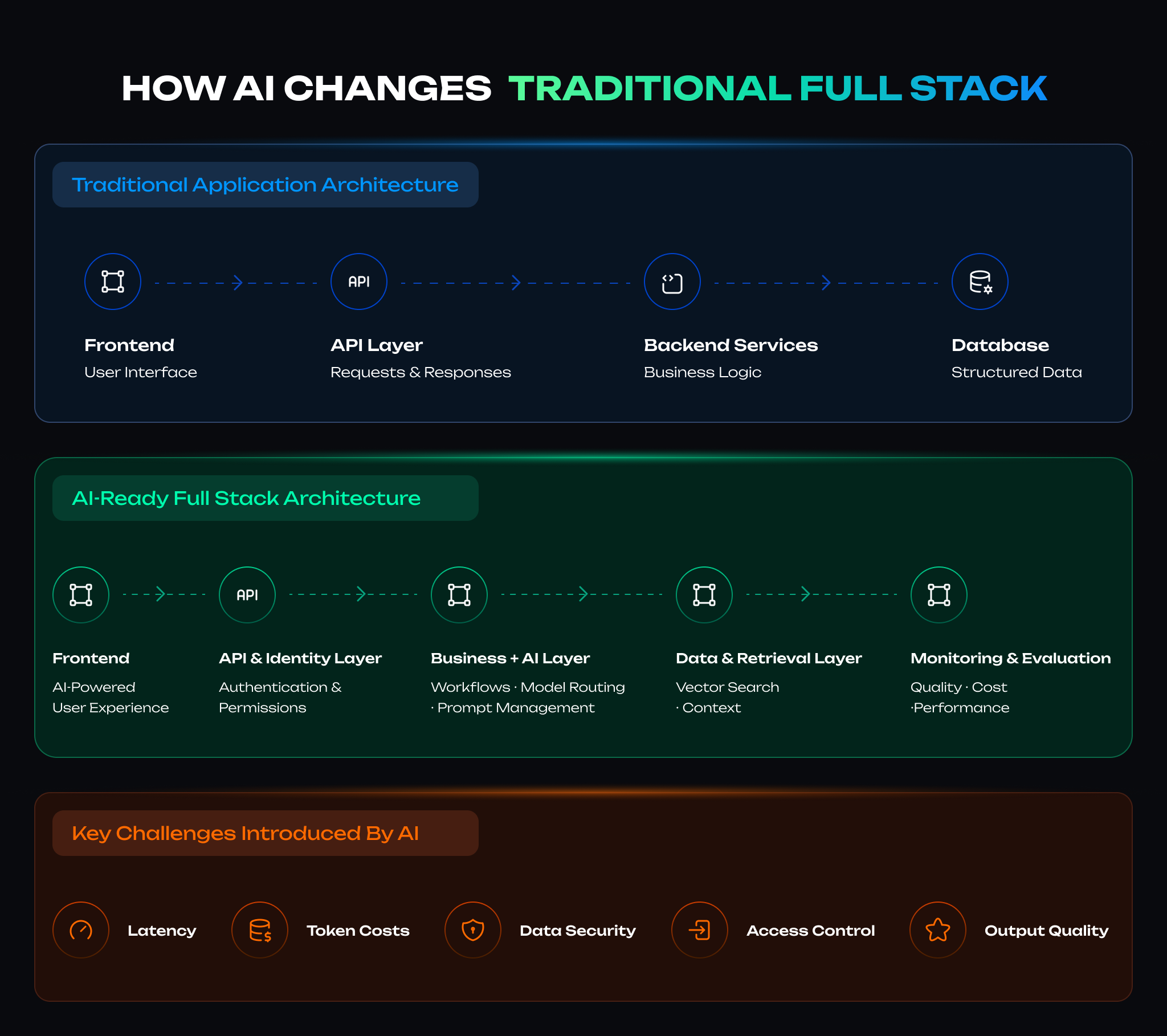
AI stopped being a feature you bolt onto an existing product. It changes how data moves, how APIs are secured, and what your infrastructure costs per user. Treating it as a UI addition is the most expensive mistake available to a CTO in 2026.
AI-native architecture means your data, permissions, and service boundaries were designed with model access in mind, not retrofitted afterwards.
The difference shows up at the second or third AI feature. Teams that shipped a chat widget against a legacy schema discover their data is unstructured, unlabelled, and impossible to scope by user permission, while teams that treated retrieval, evaluation, and access control as shared services ship the next three features in weeks.
Deciding when to add AI features to a web application is a product question. The architecture question comes first.
AI workloads break the assumptions your CRUD backend was built on, and those broken assumptions show up in delivery speed, unit economics, and compliance risk.
Your team needs applied AI engineering skills, not machine learning research skills.
The practical gap is in retrieval design, prompt and output evaluation, cost monitoring, and safe tool access for agents. These are engineering disciplines, and most strong backend engineers pick them up within a quarter given real problems to solve.
Hiring a data scientist to solve an integration problem is the common misfire. What you usually need is a senior engineer who understands data flow and is comfortable with probabilistic outputs.
Security has moved from a release checkpoint to a design constraint. Enterprise buyers, insurers, and regulators now ask architectural questions during procurement. Retrofitting answers is expensive.
Late-stage security work forces rewrites of authentication, data access, and logging the most entangled parts of any system.
Fixing it after launch typically costs several times more than building it in. It also delays enterprise deals, because a failed security review can stall a contract for quarters.
Identity now determines what every service, client, and AI agent is allowed to do.
Once web apps, mobile clients, partner integrations, and automation all read the same data, permissions become core business logic. Get roles, tenancy, and token scopes right early; they are the hardest thing to change later.
Security-first development means secrets management, dependency scanning, zero-trust service calls, and audit logging become sprint work, not backlog items.
It slows the first two months and speeds everything after. The business outcome is shorter security reviews, cleaner compliance evidence, and fewer emergency patches.
Cloud spend has become a board-level line item. The 2026 question is not whether to use cloud, but which parts justify their price.
Cost-aware architecture means you know the unit economics of your product before you scale it.
Track cost per customer, per request, and per AI call. Teams that add this visibility early routinely cut 20–40% of spend without changing a single feature.
Serverless fits spiky, event-driven workloads. Containers fit steady, predictable traffic. Managed platforms fit small teams.
Kubernetes makes sense when you have people whose full-time job is running it. Below that threshold, it converts engineering time into operational overhead and slows delivery.
Portability is negotiating leverage and risk insurance, not a migration plan you expect to execute.
Keep your data, authentication, and core services on standard interfaces. Accept lock-in where it buys real speed. Document where you are locked in so pricing changes never catch you off guard.
Team shape now affects delivery speed more than framework choice. Smaller teams with broader ownership consistently ship faster than large, specialised ones.
No, but the boundaries are shifting.
Full stack engineers now cover more ground because platforms and AI tooling absorb routine work. You still need specialists for security, data, and infrastructure at critical moments. The winning model is a broad core team with targeted depth.
Hire product-minded engineers who understand cost, security, and data, plus one platform engineer before you need three.
Judgement matters more than framework familiarity. If hiring depth quickly is a constraint, hiring full-stack developers through a partner keeps delivery moving while you build in-house capability.
AI-assisted coding raises output volume, which shifts your bottleneck to review, testing, and architecture.
Update your workflow accordingly: stronger code review standards, automated tests, and clear ownership. Teams that skip this ship faster for one quarter and pay it back over the next four.
Real-time features, AI pipelines, and background processing all push work out of the request cycle. Event-driven design solves this well and creates real complexity when applied too broadly.
Event-driven architecture pays off when work must happen reliably but not immediately: notifications, billing, AI processing, integrations, and audit trails.
The return is resilience. Slow third parties and model calls stop blocking your user experience, and retries become routine rather than incidents.
Events are the wrong choice for simple CRUD flows that a direct call handles cleanly.
Asynchronous systems are harder to debug, test, and reason about. If your team cannot trace a failed event end to end, you have added risk, not scalability.
Your API is now consumed by clients you did not design for, including automation and AI agents. That changes how you version, document, and secure it.
Every modern product serves web clients, mobile apps, partners, internal services, and increasingly AI tools.
If business logic lives in the frontend, each new consumer duplicates it. A clean API layer turns new channels into weeks of work instead of quarters.
Treat your API as a product: versioned, documented, permissioned, and rate-limited from day one.
AI agents amplify weaknesses because they call endpoints at machine speed. Scoped tokens and clear contracts protect both your data and your infrastructure bill.
Integrated platforms now bundle frontend hosting, backend, database, authentication, observability, and deployment. They are the fastest way for small teams to ship with a dependency question attached.
Integrated platforms remove weeks of setup and let a five-person team operate like a fifteen-person one.
You get authentication, monitoring, and deployment pipelines that would otherwise consume a quarter. For early products, that speed usually outweighs the premium you pay.
Ask one question before adopting any platform: what would it cost us to leave in two years?
If the answer is a rewrite, limit the platform to non-core capabilities. Keep customer data and identity in systems you can export. Convenience is fine; unpriced dependency is not.
Not every trend deserves a decision this year. This matrix separates the ones with real cost or risk consequences from the ones you can simply watch.
| Trend | CTO Decision | Priority |
|---|---|---|
| AI Integration | Redesign data and backend boundaries | Act Now |
| Security-First | Build security into architecture | Act Now |
| Cloud Cost | Optimise for cost and portability | Act Now |
| Event-Driven Systems | Use for async workloads | Depends |
| Edge Computing | Use where latency requires it | Depends |
| New Frameworks | Avoid unnecessary migrations | Usually Wait |
| AI-Assisted Development | Update engineering workflows | Act Now |
The logic is simple: act now where the cost of retrofitting is high AI data flows, identity, security, and cloud economics. Treat event-driven and edge as conditional, driven by workload rather than fashion. Framework migrations rarely return their investment.
Trends only matter once they change what you build next quarter. These five shifts apply to nearly every company in the 20–200 person range.
Make your data accessible, structured, and permissioned before you add any AI features.
Most AI projects stall on data quality, not models. Clean boundaries let you add or swap providers without touching product code.
Define tenancy, roles, and token scopes in week one, not after your first enterprise deal.
This single decision shortens future security reviews and prevents the most expensive rewrites in modern applications.
Choose the simplest infrastructure your team can run at 2 a.m. without a specialist on call.
Every unnecessary layer costs availability and hiring flexibility. Complexity you cannot operate is not sophistication; it is unpaid risk.
Pick the stack your team already ships confidently in, unless a specific problem demands otherwise.
Popularity does not shorten your roadmap. Familiarity does. Measure decisions by cycle time and defect rate.
Isolate database, cloud provider, and AI vendor choices behind internal interfaces.
Reversibility costs a little upfront and saves entire quarters later. It also protects you from pricing changes outside your control.
The pattern across every full stack development trend is the same: decisions that are cheap to make early become expensive to reverse later. AI data flows, identity, security, and cloud economics reward teams that treat architecture as a business decision, not a technical afterthought.
You do not need to chase every trend. Focus on the decisions that create the greatest long-term cost when they are wrong and address them while change is still affordable.
Planning your next application architecture? Contact iSyncEvolution to build a full stack strategy that balances scalability, security, performance, and long-term cost.
Four trends carry real cost or risk consequences: AI-native architecture, security-first design, cost-aware cloud, and updated AI-assisted delivery workflows. The rest event-driven systems, edge computing, and new frameworks are conditional and can wait until a workload demands them.
No. Most companies in this range integrate models rather than train them. You need engineers with data modelling, evaluation discipline, and cost awareness a skill set far easier to hire than research-level ML expertise.
From week one. Late-stage security work forces rewrites of authentication and data access, costs several times more than building it in, and can stall enterprise deals for quarters during failed reviews.
No. Cloud is now a board-level cost line, and the question is which parts justify their price. Track cost per customer, request, and AI call; teams that add this visibility early routinely cut 20–40% of spend.
Yes, but selectively. Ask what leaving would cost in two years. If the answer is a rewrite, keep customer data and identity exportable and limit the platform to non-core capabilities.
Nikhil Shah is the CTO and Co-Founder of iSyncEvolution, an engineering leader who aligns modern technology best practices with long-term commercial success. A veteran of cloud infrastructure and scalable web/mobile solutions, he specializes in building high-performance software environments. Nikhil helps global brands master their technical roadmaps, optimizing both code performance and development economics to fuel growth.
© 2026 iSyncEvolution Pvt Ltd. All Rights Reserved.