
29 June, 2026

Most Founders and COOs who hire offshore or external full-stack development teams end up becoming full-time project managers. The real issue is not developer skill; it is delivery maturity. This guide gives you a precise evaluation framework to identify, before signing any contract, whether a team will work independently or require constant direction to function.
What you will take from this guide:
You hired an external full-stack team to scale faster. Instead, you're spending two hours a day micromanaging tasks, chasing status updates, and breaking ties on minor technical decisions. Sourcing talent is only half the battle; the real choice is whether a team will proactively own delivery or constantly pass accountability back to your desk.
While typical hiring guides focus on sourcing channels and salary benchmarks, this guide targets the real metric that costs you time and money: identifying an autonomous engineering unit before you sign the contract.
Management overhead isn’t a technical skill problem; it is a delivery maturity problem. Senior developers can write beautiful code while completely draining your executive calendar if they lack operational independence. Here is where the dependency trap forms:
Instruction-dependent teams treat any ambiguity as an emergency brake. If a requirement is unclear or a third-party API behaves unexpectedly, they flag the ticket as "blocked" and wait for your input. This creates cascading delays that wreck your two-week sprint cycles.
If progress updates only happen when you text or email the team, delivery ownership is broken. When status reporting is purely reactive, the team learns that updates are driven by your vigilance rather than their accountability.
Order-taker developers build exactly what they are told without referencing business metrics. This yields a flawless sprint review for a feature that completely fails to move the needle, forcing expensive, post-launch architectural rewrites.
An autonomous team is structurally engineered to decrease your management burden with every passing sprint. They do not look to you to fill operational gaps; they arrive with pre-built governance.
Task-completion teams measure success by closed Jira tickets. Outcome-driven teams measure success by product impact. When real-world scope shifts mid-sprint, they adapt within agreed parameters and surface the solution rather than freezing execution.
Low-overhead teams identify dependency risks days before they can compromise a release, giving you strategic room to pivot. High-overhead teams only mention a structural blocker the morning it completely halts production.
Self-sufficient teams operate within a clear decision matrix established during onboarding, mapping out exactly what they own versus what requires your sign-off. Mature agencies will explain how technical choices are documented and escalated unprompted right at the proposal stage. For Founders evaluating full-stack development services, a team's inability to articulate this framework beforehand is a definitive warning sign of impending management overhead.
You receive concise sprint summaries, risk metrics, and velocity tracking like clockwork every Friday. They own the communication loop completely, eliminating the need for mandatory, calendar-draining status meetings.
An independent team requires significantly less of your attention in month three than it did in month one. By building institutional context and documenting architecture choices cleanly, they actively stop consuming your daily cognitive bandwidth.
The signals that predict how a team will operate after hire are visible before you sign anything. Most hiring conversations focus on technical credentials and day rates. The teams that end up requiring the least management reveal their delivery maturity in how they handle the evaluation process itself.
A team that leads with business questions before discussing architecture or technology has already demonstrated the orientation that produces low-overhead delivery. They are trying to understand what success looks like, not just what to build.
Early business questions typically surface goals, constraints, user behavior, and commercial metrics. They signal that the team will frame technical decisions against business outcomes, rather than building in isolation and handing over something technically correct but strategically misaligned. Pay attention to the sequence in the first conversation. If the first thirty minutes are dominated by tech stack, tools, and hourly breakdowns, that is the lens they will apply to your product. If they ask what the feature is for before they ask how it should work, that is a team oriented toward outcome ownership.
Teams that accept every requirement without question are not agreeable; they are deferring the risk back to you. When they build against an unclear brief, the resulting rework cost lands in your lap, not theirs.
A mature team pushes back on vague acceptance criteria, asks what done looks like before starting, and flags requirements that conflict with each other or with previously agreed-upon scope. That behavior protects your timeline. During the proposal stage, note whether the team asks clarifying questions that reveal a real understanding of the problem. Generic proposals that accept the brief wholesale without a single clarification request are a reliable indicator of a team that will execute instructions blindly and create rework rather than own delivery.
A proposal that only covers team composition, hourly rates, and estimated timelines tells you what a team costs. A proposal that describes how delivery ownership is structured tells you whether they will need managing.
Look for proposals that document who owns delivery decisions, how risks are escalated, what the reporting cadence looks like, and how scope changes are handled. These elements signal that the team has a delivery process, not just development capacity. The depth of a proposal is a direct proxy for delivery maturity. Teams that have shipped complex products for demanding clients have learned, often at cost, why these structural elements matter. Teams that are primarily focused on being awarded the work tend to produce thin proposals that raise all the hard questions after the contract is signed.
Proposing a communication structure before you ask for one is one of the clearest signals that a team operates proactively. It means they have a repeatable delivery process, not one they construct differently for every client.
Specifically, watch for teams that propose how they will report progress, how they will flag risks, what your involvement will look like week to week, and what decisions they will own versus escalate. Teams that wait until you raise these questions are likely to maintain a reactive communication posture throughout the engagement.
At iSyncEvolution, we build this operational framework directly into every initial proposal. The teams that consistently maintain low management overhead are the ones where the reporting and communication rhythm is agreed upon before the first sprint starts.
Teams that raise risks before the project starts are demonstrating that they have run enough engagements to know where the problems typically occur. That experience is what allows them to manage risk proactively instead of reactively.
Listen for teams that identify known risk categories for your project types, such as integration complexity, third-party dependencies, unclear acceptance criteria, or migration risks, and explain how they manage them. That is not a sales pitch; it is process visibility. The alternative is a team that produces an optimistic timeline with no risk acknowledgment. Those engagements almost always require you to manage the fallout when the risks that were never discussed materialize in week four. Risk-aware teams make your job easier from the first conversation.
Delivery accountability lives at the team level, not the individual developer level. A proposal that presents only CVs and seniority levels tells you nothing about how delivery decisions are made, escalated, or owned.
Teams with genuine delivery maturity present a structure: who leads delivery, who owns technical architecture, how the team communicates internally, and what happens when a team member is unavailable. That structure is what allows the team to function without you filling the gaps. Staff augmentation models rarely include this; you get developers, and you become the structure that holds them together. Dedicated full-stack development teams operate with pre-built accountability structures that work regardless of how much attention you give them on any given week.
Teams that define project success in terms of delivered features have set up a relationship where completion and value are treated as the same thing. They are not. Features can ship on time and still fail to move the metrics they were built to influence.
A delivery-mature team defines success in terms of measurable outcomes, user adoption, performance benchmarks, error reduction, and business KPIs. That framing keeps their work anchored to what actually matters for your business. Ask directly: how do you define a successful engagement? Answers centered on velocity, story points, or on-time delivery are warning signs. Answers that reference business outcomes, quality metrics, and reduced rework indicate a team aligned to what you are actually paying for.
Technical interview questions reveal what a team can build. Operational questions reveal whether you will need to manage them after you hire. Focus heavily on operational maturity rather than just technical credentials. Use these in your initial conversation:
What to look for: You are looking for a clear internal process, not "we ask the client." A mature team has a defined way to resolve ambiguity within agreed boundaries.
What to look for: The answer should name a specific role or process. Diffuse answers like "everyone flags issues" mean no one is accountable. Look for a system where a delivery lead flags blockers daily before they affect the sprint timeline.
What to look for: Undocumented decisions create dependency. Look for teams that maintain clear decision logs so architectural context remains with the project if an individual engineer leaves.
What to look for: Listen for a structured cadence (e.g., weekly summaries covering completions, risks, and next commitments) rather than "whenever you want them."
What to look for: A mature team has a documented change management process that protects current sprint velocity while assessing the exact timeline impact of the new scope.
What to look for: The answer must be a named role, such as a delivery lead or project owner, not the collective team.
The engagement model you choose dictates the accountability structure you inherit. Most hiring decisions optimize for raw cost or speed-to-start, completely overlooking the hidden operational tax of the underlying model.
| Model | Best For | Management Overhead |
|---|---|---|
| Staff Augmentation | Scale-ups with existing, high-bandwidth internal engineering leadership. | High (You manage the individuals, assign tasks, and own delivery accountability). |
| Project-Based Delivery | Genuinely fixed, stable scopes (e.g., a simple data migration or standalone tool). | Medium (Overhead shifts from daily tech hand-holding to constant commercial renegotiation loops when scope changes). |
| Dedicated Team | Evolving, long-term product development where you want to hand off total execution. | Low (The agency supplies pre-built governance, internal scrum management, and outcome ownership). |
Staff augmentation embeds individual developers directly into your existing setup, meaning you supply the structure, code reviews, and daily sprint tracking. This works perfectly if you have an internal CTO or delivery lead with open bandwidth. However, if you lack internal management capacity, augmentation is a trap; you cannot solve a management shortage by adding more people who require daily direction.
Fixed-scope, fixed-price contracts offer short-term psychological comfort, but that clarity degrades the moment your product needs to evolve based on user data. In this model, every minor roadmap adjustment or unexpected dependency trigger turns into a commercial renegotiation before it turns into code. Your overhead doesn't disappear; it just changes from operational hand-holding into endless contract squabbles.
The dedicated team model builds structural accountability directly into the contract. You are hiring a self-contained engineering pod, complete with a Project Manager, Architects, and Developers that owns outcomes rather than just executing isolated tasks. The compounding advantage here is context accumulation: by month three, the team deeply understands your architecture and constraints, dramatically cutting the volume of daily decisions that ever reach your desk.
The first thirty days of any development engagement determine the management dynamic for the entire relationship. Teams that establish independent delivery rhythms in the first month maintain them. Teams that create dependency in the first month rarely break it.
The first week sets the structural foundation. Any team that wants to start building immediately without establishing these foundations is showing you the delivery posture you will be managing for the rest of the engagement.
Warning sign: a team that skips this week and jumps straight to development is a team that will create structural ambiguity that reaches your desk in week three.
Warning sign: No risk flags in week two means the team is not looking for them, not that there are none.
Warning sign: continued daily check-ins initiated by you in week three indicate that independent execution has not been established.
Warning sign: if week four looks like week one, the engagement structure has a fundamental problem that will not self-correct.
These indicators are visible early. None of them improve without structural intervention, and most are easier to identify before signing than to fix after delivery has started.
Use this checklist before countersigning any development contract. Each item corresponds to a structural element that determines whether you will manage this team or they will manage themselves.
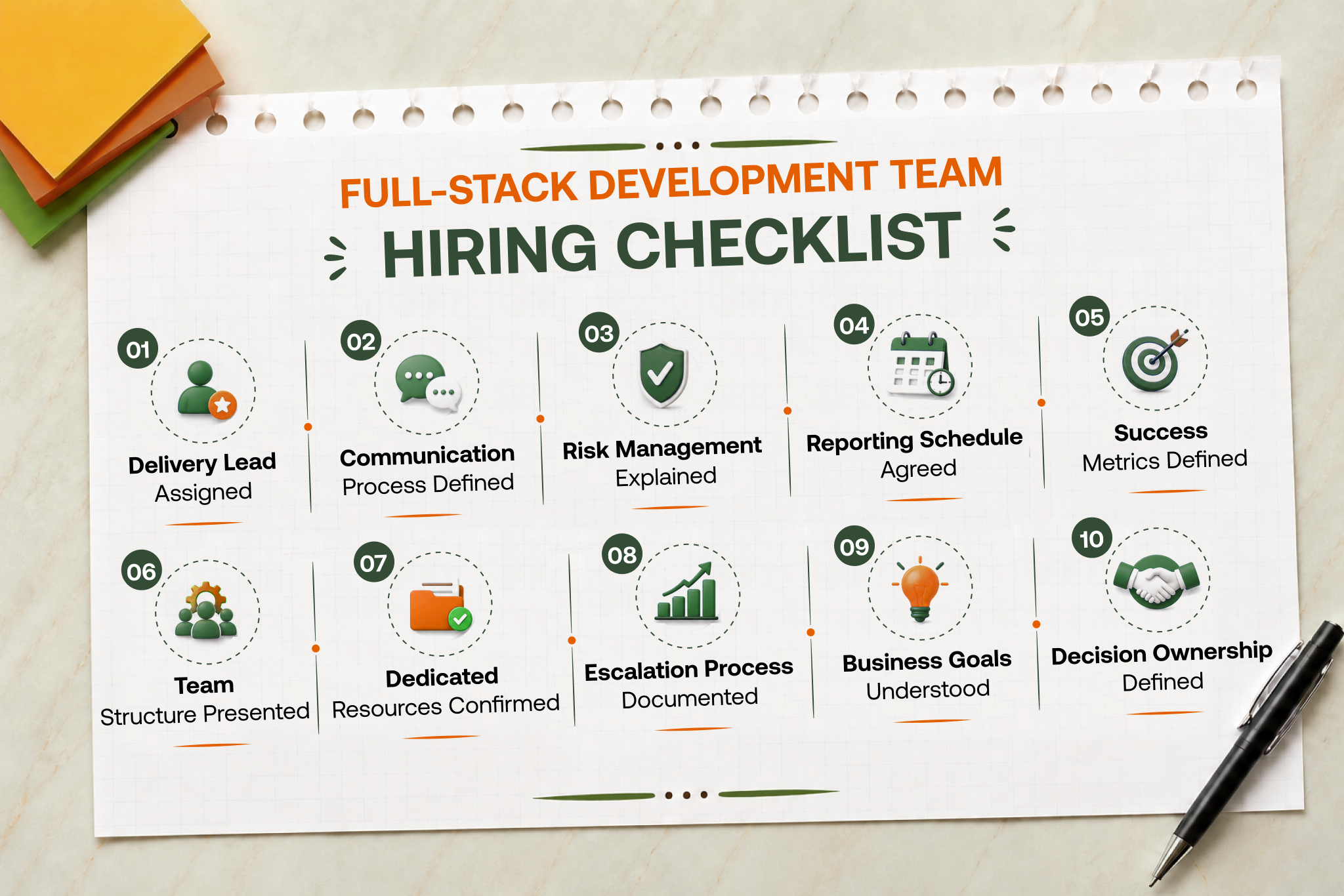
The goal is not to hire the cheapest developers or the largest agency. When you hire a full-stack development team, you are making a structural decision about how much of your calendar is consumed by development management for the next twelve months. The right team reduces that overhead from the first sprint and continues reducing it as context accumulates. The wrong team absorbs your time, defers your decisions, and delivers features that require explanation. Every signal, question, and checklist in this guide is designed to help you tell the difference before you sign, not after you have spent six months discovering it. If you are ready to stop acting as an accidental project manager and hand over execution to an autonomous engineering unit, contact iSyncEvolution today to map out a low-overhead development strategy tailored exactly to your business roadmap.
A mature team resolves ambiguity within agreed boundaries rather than escalating every minor detail. They clarify what they can, document their architectural assumptions cleanly, and only flag choices that carry genuine business risk.
A named delivery lead or scrum master should own risk escalation, not the team collectively. When everyone is responsible, no one is. Ensure a specific role owns surfacing issues before they turn into sprint blockers.
Technical decisions should live in an accessible decision log. Undocumented choices create dangerous knowledge silos. If a key engineer leaves, that architecture context should stay with your project, not vanish with the developer.
Establish a predictable, automated cadence before sprint one instead of a vague "whenever needed" approach. A clean weekly summary tracking completed features, emerging risks, and upcoming milestones completely eliminates the need for calendar-draining stand-ups.
The team must utilize a strict change management process that quantifies the exact timeline and resource impact of a scope shift before altering the live deployment branch.
Accountability belongs to a named delivery lead, not the collective team. Shared accountability results in diffuse execution. The delivery lead handles status reporting, unblocks engineers internally, and serves as your single point of operational contact.
Nikhil Shah is the CTO and Co-Founder of iSyncEvolution, an engineering leader who aligns modern technology best practices with long-term commercial success. A veteran of cloud infrastructure and scalable web/mobile solutions, he specializes in building high-performance software environments. Nikhil helps global brands master their technical roadmaps, optimizing both code performance and development economics to fuel growth.
© 2026 iSyncEvolution Pvt Ltd. All Rights Reserved.