
11 December, 2025
You have a brilliant app idea that could change everything. But before investing months and thousands of dollars into development, you need to know one crucial thing: will people actually use it? Learning how to validate your app idea before building it can save you from joining the 90% of apps that fail within their first year.
App validation isn't about proving your idea is perfect; it's about gathering objective evidence that your concept solves a genuine problem for real users willing to pay for that solution. This systematic approach transforms risky assumptions into data-driven decisions, helping you build apps that users actually want.
This guide walks you through a proven validation process that successful app entrepreneurs use to test their concepts, reduce development risks, and ensure product-market fit before writing a single line of code.
App idea validation is the process of testing whether your concept has real market demand, solves a genuine problem, and can attract paying users, all before investing in full development. It involves gathering evidence through user research, prototype testing, and market analysis to confirm or challenge your assumptions about the app's viability.
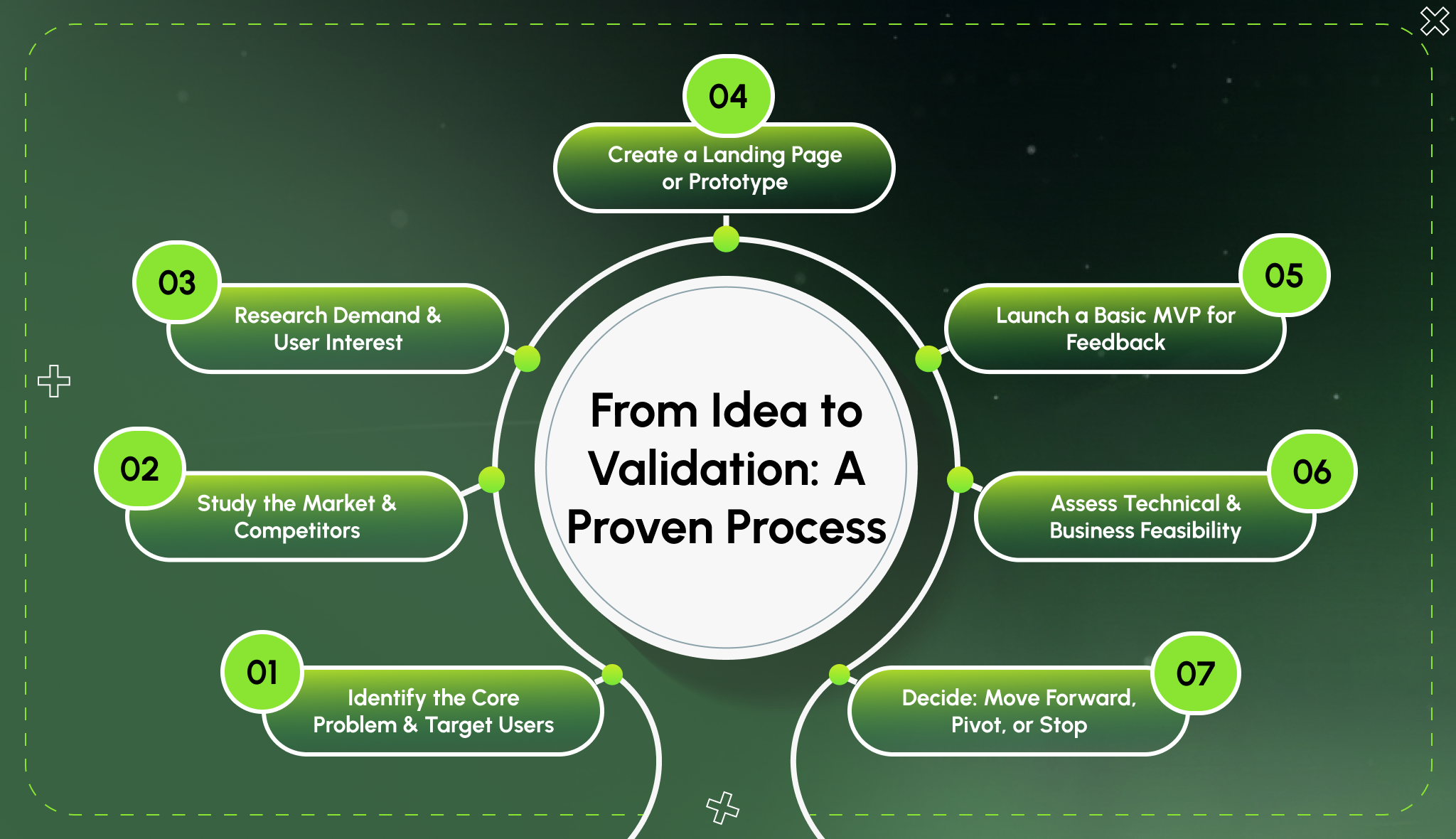
The app idea validation process doesn't have to be complicated or expensive. Following these seven strategic steps will help you gather the evidence needed to make confident decisions about your app's future while minimizing financial risk and wasted time.
Every successful app starts with a clearly defined problem and a specific group of people experiencing it. Without this foundation, your validation efforts will lack focus and produce misleading results.
Start by writing a simple problem statement describing exactly what issue your app solves. Be specific about the pain points, frustrations, or unmet needs your target users face. Then create detailed user personas that go beyond demographics, include their behaviors, goals, challenges, and current solutions.
Document your assumptions about user needs and behaviors to inform your design decisions. These hypotheses will guide your validation efforts and help you design targeted research to confirm or challenge your initial beliefs.
Understanding your competitive landscape provides crucial insights into market opportunities and potential challenges. Market research for app ideas reveals whether demand exists for your solution and how to differentiate it from existing options.
Begin your competitor analysis for mobile apps by identifying direct and indirect competitors. Direct competitors offer similar solutions to the same problem, while indirect competitors solve it through different approaches. Download and use their apps extensively, noting strengths, weaknesses, and user complaints in reviews.
Study market trends and growth patterns in your app category. Look for signals of increasing demand, emerging user needs, or technological shifts creating new opportunities. This research helps determine whether you're entering a growing market or fighting for share in a declining one.
Real user feedback transforms assumptions into insights. Customer validation for app concepts involves direct communication with potential users to understand their needs, preferences, and willingness to pay.
Start with qualitative research through user interviews. Reach out to 15-20 individuals who match your target user profile. Ask open-ended questions about their current challenges, existing solutions, and what would make them try something new. Focus on understanding problems rather than pitching solutions.
Supplement interviews with surveys to gather quantitative data from a larger sample. Utilize online survey tools to engage with over 100 potential users and validate patterns identified during interviews. This combination of qualitative depth and quantitative breadth provides robust validation data.
Prototype testing for mobile apps enables you to validate the usability and appeal of your concept without building a fully functional app. Create mockups or interactive prototypes demonstrating your app's core value proposition and user flow.
Use tools like Figma, Adobe XD, or Marvel to create clickable prototypes simulating the app experience. Focus on demonstrating the main user journey and key features rather than perfecting every detail. Your prototype should clearly show how users accomplish their primary goals.
Test your prototype with 10-15 potential users, observing how they interact and where they encounter confusion. Pay attention to:
Document feedback systematically, identifying patterns in confusion points, feature requests, and emotional responses. This feedback guides refinements before MVP development, ensuring your mobile app development process starts with validated design decisions.
MVP validation for app ideas focuses on building the minimum viable version that proves your core concept works. This isn't about creating a stripped-down app—it's about identifying and testing only the features essential to solving your users' primary problem.
Define your MVP scope by identifying one or two key features that deliver the core value of your app. Remove everything else, including nice-to-have features that don't directly address the main problem. This focused approach reduces development time and costs while providing precise validation data.
Launch your MVP to a small group of beta testers matching your target user profile. Track specific metrics indicating genuine engagement:
Use hypothesis testing for app ideas by setting clear success criteria before launch. Define what metrics would convince you to proceed, pivot, or abandon the idea. This data-driven app validation approach removes emotion from decision-making and provides objective evidence of market fit.
A technical and business feasibility assessment determines whether your validated idea can be developed into a sustainable product. Even with strong user demand, some ideas face insurmountable technical challenges or unsustainable economics.
Evaluate technical complexity by consulting with experienced developers or a mobile app development company. Consider required integrations, data security needs, platform limitations, and scalability requirements. Understanding these challenges early helps you make informed decisions about choosing your tech stack.
Develop a risk mitigation plan that addresses the identified challenges. Some risks might require adjusting your concept, timeline, or business model. Others might be acceptable given potential rewards. This comprehensive evaluation ensures you understand your commitment before full development begins.
Your validation data now guides one of three decisions: proceed with development, pivot to address discovered insights, or abandon the idea for better opportunities.
To proceed, you need clear evidence of product-market fit for mobile apps: strong user demand, validated solution effectiveness, a feasible development path, and a sustainable business model. If all indicators are positive, proceed confidently, using validation insights to inform development priorities.
Pivoting makes sense when validation reveals genuine user problems but suggests a different approach to solving them. Perhaps your research revealed adjacent issues that are more worth solving, or users consistently requested different features. Use these insights to refine your concept before proceeding.
Dropping an idea isn't failure—it's an innovative business approach. If validation reveals weak demand, insurmountable technical challenges, or unsustainable economics, abandoning the concept conserves resources for more promising opportunities. Document lessons learned to inform future validation efforts.
Smart validation tools accelerate your research and testing process while reducing costs. These resources help gather user insights, test concepts, and analyze market opportunities more efficiently than traditional methods.
Many entrepreneurs sabotage their validation efforts through predictable mistakes. Recognizing these pitfalls helps avoid wasted time and misleading conclusions that could derail your app's success.
Confirmation bias leads founders to seek only positive feedback while ignoring warning signs. Combat this by actively seeking criticism and asking users what would prevent them from using your app. Create structured interview guides that avoid leading questions to ensure accurate and unbiased responses.
Validating with the wrong audience produces unreliable data. Friends and family rarely provide objective feedback, and people outside your target market can't accurately assess the value of your solution. Focus validation efforts exclusively on individuals who match your ideal user profile.
Skipping competitive research leaves you blind to market realities. Even if your idea seems unique, users compare it to existing solutions. Thorough app idea competitive research reveals differentiation opportunities and helps understand user expectations.
Overbuilding the MVP defeats its purpose of rapid and affordable validation. Including too many features dilutes focus and delays learning. Resist the urge to perfect your MVP—its job is to prove the core concept's viability, not impress users with polish.
Proper validation directly impacts your development budget and timeline by providing clarity on what to build and what to skip. This evidence-based approach to app development prevents expensive mistakes and accelerates time to market.
Validation reveals which features users actually value, allowing you to prioritize development efforts effectively. Instead of building everything imagined, you focus resources on validated features, driving user adoption. This targeted approach can reduce initial development costs by 30-50%.
Your validation findings inform realistic timeline estimates. Understanding technical complexity, user expectations, and market dynamics helps set achievable milestones. When you hire mobile app developers, you can provide precise requirements based on validated user needs, rather than relying on assumptions.
The insights gathered during validation continue providing value throughout development and beyond. User feedback guides design decisions, feature prioritization influences mobile application maintenance planning, and market research informs marketing strategies. This foundation reduces risks and increases the likelihood of success.
Consider validation an investment paying dividends throughout your app's lifecycle. Time and money spent on validation saves multiples by preventing failed features, reducing redesign needs, and ensuring you build something users want. Successful app entrepreneurs never skip validation, regardless of confidence. Working with an experienced team requires careful consideration when hiring a mobile app development company, and validating data helps communicate your vision clearly and effectively.
Learning how to validate your app idea transforms risky assumptions into confident decisions backed by real user data. This systematic approach—from problem definition through MVP testing—provides evidence needed to proceed, pivot, or pursue better opportunities. Following these demand validation methods and avoiding common pitfalls significantly increases your app's chances of finding product-market fit and achieving sustainable success.
Validation isn't about proving perfection. It's about discovering what users need and whether your solution effectively addresses those needs. This evidence-based approach reduces risks, saves resources, and helps build apps that users love and are willing to pay for. Start your validation journey today with iSyncEvolution, and let real user insights guide your path to app success.

Validation typically takes 4-8 weeks, depending on the research depth and complexity of the MVP. Initial market research and user interviews can be completed in 2-3 weeks, while prototype testing and MVP validation may require additional time.
Yes, you can validate without coding through user interviews, surveys, competitive analysis, and clickable prototypes. No-code tools and design mockups let you test concepts before investing in development.
Conduct interviews with 15-20 users to gather qualitative insights and administer a survey to 100+ participants for quantitative validation. For MVP testing, 50-100 beta users provide sufficient data to identify patterns and validate core assumptions.
Validate through user research confirming the problem exists, competitive analysis showing market gaps, prototype testing demonstrating user interest, and pre-launch campaigns measuring actual demand. These methods provide strong indicators before development.
Nikhil Shah is the CTO and Co-Founder of iSyncEvolution, an engineering leader who aligns modern technology best practices with long-term commercial success. A veteran of cloud infrastructure and scalable web/mobile solutions, he specializes in building high-performance software environments. Nikhil helps global brands master their technical roadmaps, optimizing both code performance and development economics to fuel growth.
© 2026 iSyncEvolution Pvt Ltd. All Rights Reserved.