
28 September, 2026
The Model Context Protocol (MCP) is changing how AI agents connect to the systems behind your product. But for CTOs, the key question is not whether an agent can call your APIs; it is whether you can expose that access without creating a new class of security, cost, and reliability risk.
MCP's authorization and security patterns are still actively evolving, and tooling that auto-generates MCP servers from existing APIs makes it easy to expose far more than intended. Organizations considering adoption should treat it as a controlled architecture decision, starting with a narrow, read-only pilot rather than a wholesale integration.
Key Takeaways for CTOs:
Your application was designed for two kinds of consumers: humans clicking through a UI, and services calling well-defined APIs. AI agents are a third kind, and they behave differently from both.
An agent doesn't follow a fixed integration. It discovers what your system offers, decides which capability to use, chains several calls together, and acts on your behalf, sometimes on ambiguous or untrusted input. That changes the risk model, which is why the Model Context Protocol (MCP) has become an architectural decision rather than a developer convenience.
This guide is for CTOs, VPs of Engineering, and technical founders who need to decide what to expose to agents, where to put the control points, and how to keep it safe in production. It is not a protocol tutorial.
The Model Context Protocol (MCP) is an open standard that lets AI applications connect to external systems through a consistent interface. An AI host, such as an assistant, IDE, or agent framework, connects to an MCP server via an MCP client. The server advertises what it can do.
For a CTO, tools matter most. Resources give an agent context, but tools let a client request actions against the systems behind the server, and that is where business risk sits.
Servers typically communicate over local transports or over HTTP, and remote servers use OAuth-based authorization patterns. The protocol and its SDKs are evolving quickly, so verify current specification details against the official documentation before you commit to a design.
That is all the protocol background you need. The rest of this article covers the architecture decisions around it.
MCP does not replace REST or GraphQL. It gives agents a governed, discoverable way to use capabilities that your APIs and services already provide.
| REST / GraphQL APIs | MCP | |
|---|---|---|
| Primary consumer | Applications and developers | AI hosts and agents |
| Contract | Endpoints, schemas, resources | Tools, resources, prompts with descriptions |
| Discovery | Docs, OpenAPI, introspection | Runtime capability discovery by the client |
| Granularity | Resource- or query-oriented | Task- or capability-oriented (when designed well) |
| Who decides what to call | A developer, at build time | An agent, at run time |
The last row matters most. With a traditional API, a developer decides at build time which calls happen and in what order. With MCP, a model decides at run time. Your architecture has to assume that the caller is capable, fast, and occasionally wrong.
That shift is much easier to absorb if your service layer is already clean. Backends that grew organically, with business logic scattered across controllers, scripts, and ad hoc queries, don't just make agent integration harder; they make it dangerous, because there's no single place to enforce a rule consistently. If that describes your stack, legacy system modernization is the prerequisite, not a parallel project. Clean service boundaries are what let you expose a capability to an agent with confidence, instead of hoping the agent calls things in the right order.
Once agents can discover and invoke business capabilities, five things change:
Each of these maps to a control in the sections below. If you are still deciding whether AI belongs in your product at all, start with when to add AI features to a web application.
Most teams' first instinct is to auto-generate MCP tools from their OpenAPI spec. Resist it. A one-to-one mapping usually creates a tool surface that is too broad, too low-level, and too dangerous.
Consider A Typical Backend:
GET /customers
POST /orders
PATCH /orders/:id
DELETE /orders/:id
POST /refunds
The Naive Translation Gives An Agent:
getCustomers()
createOrder()
updateOrder()
deleteOrder()
refundOrder()
findEligibleOrders(customerRef, reason)
getOrderStatus(orderRef)
prepareRefundRequest(orderRef, reason) // creates a draft, does not execute
Consequential execution, such as actually issuing the refund, stays behind stronger controls: human approval, policy checks, and idempotency keys.
The Rule of Thumb: expose what a person would ask for, not what your database can do. If a tool exists mainly because an endpoint exists, question it.
MCP should sit on top of well-defined application services. It should never be a shortcut around them.
Where MCP fits in a full-stack architecture:
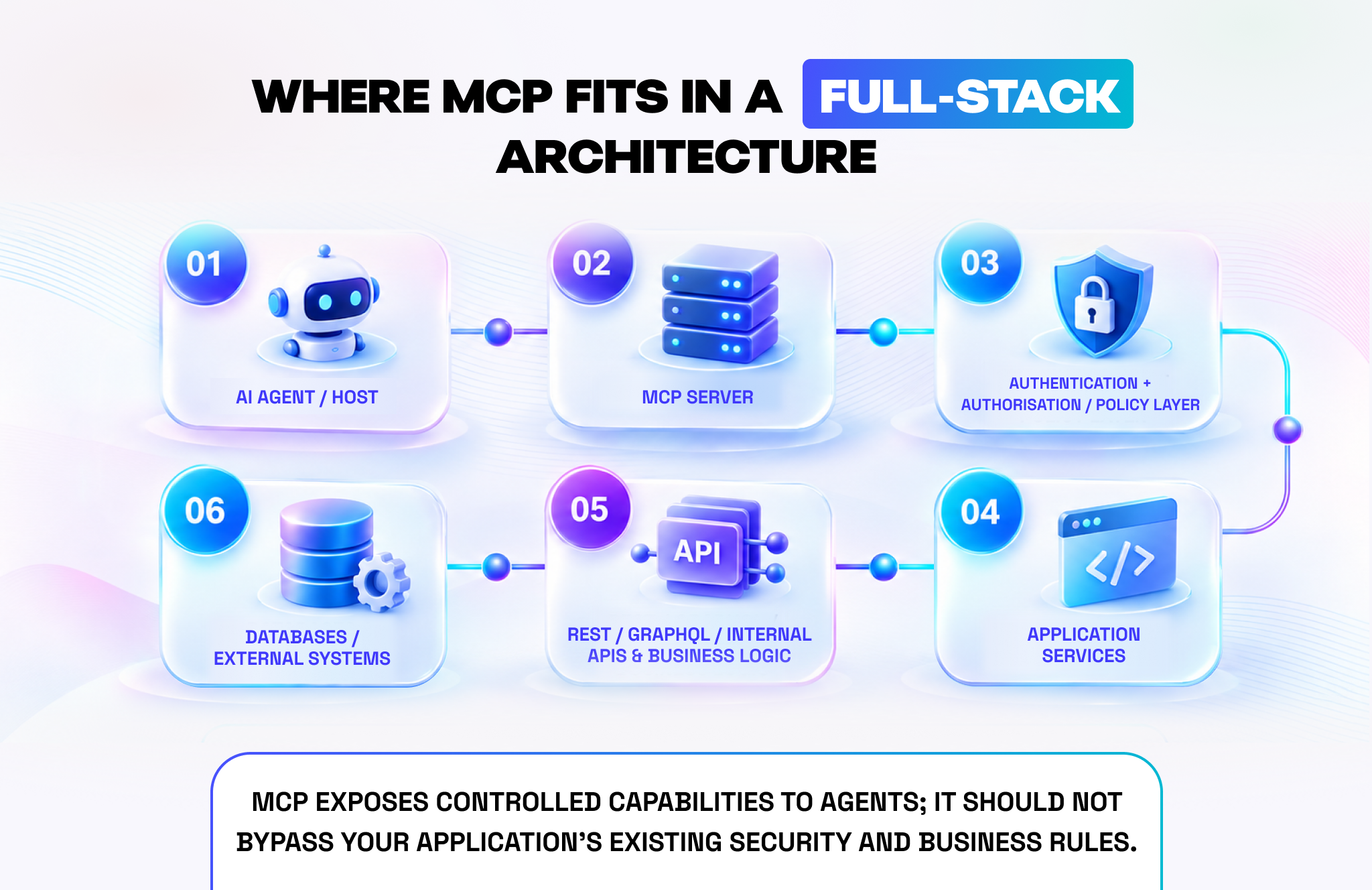
The anti-pattern to avoid is an MCP server that talks directly to your database or holds a privileged service key. That gives agents a back door around every business rule your application enforces.
MCP Architecture Design Principles
Building this well is full-stack work: the protocol layer, the service layer, the data layer and the security model have to be designed together. That is the kind of engagement our full-stack development services are built around.
Authentication answers "who is this?" and authorization answers "what may they do?" In an agent architecture, you must answer both for the human, the agent, and the tool call.
For remote MCP servers, use standards-based authorization, typically OAuth-based flows, so the agent acts on behalf of an identified user with explicit consent. Avoid shared API keys embedded in agent configuration.
The user's identity and tenant must travel from the MCP layer into application services, so downstream systems make the same access decisions they would for that user in your UI. A single powerful service account behind the MCP server means every agent action runs with maximum privilege.
Check whether the user may call the tool at all, then whether they may touch the specific record. Use scoped permissions per tool rather than one broad scope for everything.
A dedicated policy layer answers "may this principal perform this action on this resource now?" It keeps rules auditable and prevents authorization logic from scattering across tool handlers.
Tokens must be short-lived and revocable. When a user leaves, a role changes, or an integration is compromised, agent access has to end immediately.
MCP lets servers describe tools with hints, such as whether a tool is read-only or destructive. These help clients build better interfaces, but they are hints, not enforcement. Real controls live server-side.
For framework-level hardening that supports all of this, see our Next.js security best practices.
Good tool design is your first and cheapest security control. The following principles apply:
Name and describe tools by intent. getOrderStatus beats queryOrdersTable. Descriptions are effectively prompts, so write them precisely and honestly.
In multi-tenant SaaS, tenant isolation must be enforced by your server on every call. Never rely on the agent to pass or respect it.
For SaaS companies, a cross-tenant leak through an agent is a trust-destroying event. Tenant isolation deserves design review before launch, not after.
Some actions are cheap to undo. Others, such as payments, deletions, external emails, and permission changes, are not. Treat them differently.
| Tier | Examples | Control |
|---|---|---|
| Read-only | Status lookups, search | Standard authorization, logging |
| Reversible write | Draft creation, tagging | Authorization, validation, logging |
| Consequential | Refunds, deletions, outbound comms, access changes | Confirmation or approval, policy checks, idempotency, strict limits |
If you cannot reconstruct what an agent did and why, you cannot safely run it in production.
Good observability also shortens debugging. When an agent behaves oddly, tool-call traces show whether the fault lies in tool design, permissions, data quality, or model reasoning.
Agents and hosts discover tools dynamically, which makes tool contracts feel flexible. In practice, changing a tool's name, parameters, or behaviour can break workflows and change agent behaviour in ways that are hard to predict.
Agents can generate call volumes no human user would. Without controls, that means runaway cost and easy abuse.
MCP is not the answer to every AI question. Skip or defer it when:
Saying no here is a sign of sound architecture, not a failure of ambition.
A well-scoped pilot builds evidence and confidence without betting the business on it.
Build Internally: if you have strong platform engineers, a mature service layer, security expertise in-house, and capacity to own the server long term.
Bring In A Partner: if you need to move faster than your team can hire, your architecture needs modernisation first, or you want experienced review of your authorization and tenant isolation design before exposing anything to agents.
Many organisations land on a hybrid model: internal ownership of product and security decisions, with an external team accelerating architecture, implementation and hardening. If you need to extend your team quickly, you can hire full-stack developers with experience across backend services, APIs and secure AI integration.
MCP exposes controlled capabilities to agents. It should never bypass your application's existing security and business rules. Treat it as a governed interface on top of a strong service architecture, with identity, policy, isolation, and observability designed in from the start.
The organizations that get this right treat MCP as an architecture decision, not a feature flag. The ones that get it wrong usually skip straight to tool-building without asking who's authorized to call what, and find out the hard way.
If you're evaluating MCP for your product, our team can help you assess your architecture, define a safe tool surface, and run a scoped pilot before you commit to a full rollout. Talk to iSyncEvolution About Your MCP Architecture.
It is the design that places an MCP server between AI agents and your application services. The server exposes controlled, task-oriented capabilities, enforces authentication and policy, and calls your existing services, APIs, and data stores, so agents never bypass your business rules.
No. MCP complements them. Your APIs and services remain the system of record for business logic. MCP provides a discoverable, agent-friendly interface on top of them.
Authenticate real users, propagate identity to downstream services, apply least-privilege authorization per tool and per record, validate all inputs, filter sensitive data, treat retrieved context as untrusted, rate limit calls, log everything, and require confirmation for consequential actions.
Separate read and write tools, require explicit confirmation or approval for consequential operations, use idempotency keys, enforce server-side limits, and prefer prepare-then-execute patterns over direct execution.
Run a read-only pilot on a single workflow with full audit logging, a threat model, and clear success metrics. Expand to write actions only after the controls are proven.
Nikhil Shah is the CTO and Co-Founder of iSyncEvolution, an engineering leader who aligns modern technology best practices with long-term commercial success. A veteran of cloud infrastructure and scalable web/mobile solutions, he specializes in building high-performance software environments. Nikhil helps global brands master their technical roadmaps, optimizing both code performance and development economics to fuel growth.
© 2026 iSyncEvolution Pvt Ltd. All Rights Reserved.