
11 May, 2026
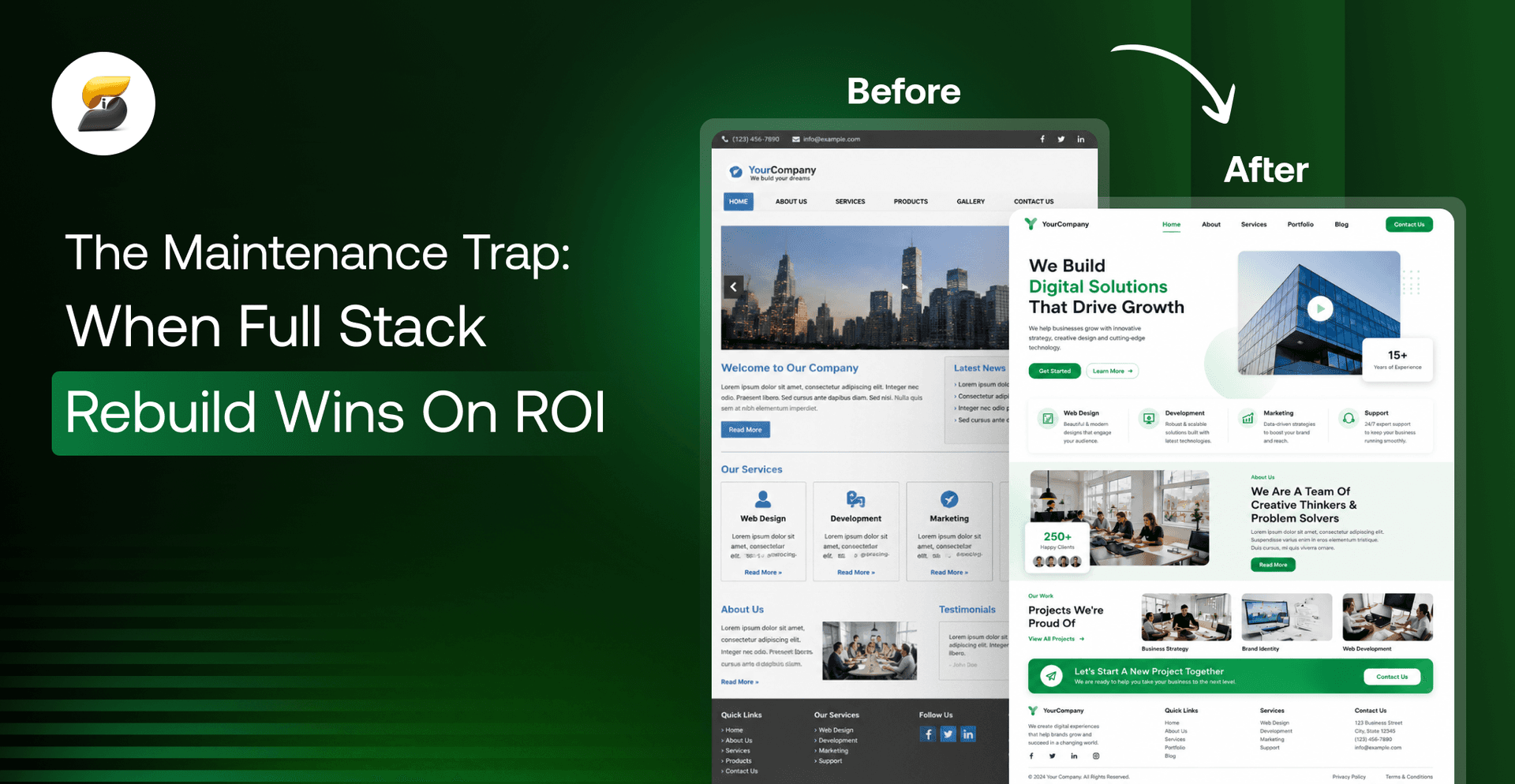
Most founders wait too long to question whether maintaining their legacy web app still makes financial sense. By the time the conversation happens, maintenance costs have already compounded, engineering velocity has dropped, and the product roadmap has quietly narrowed to stability over growth.
This guide breaks that cycle by framing the decision as a financial equation, not a technical preference. Instead of relying on instinct, you get a clear lens to evaluate when patching stops being efficient and when a full stack rebuild becomes the smarter investment.
You’ll walk away with:
The goal isn’t to push you toward rebuilding. It’s to ensure that whichever path you take, it’s based on numbers, trade-offs, and business impact, not habit or pressure.
Every quarter, your legacy web app gets slower, more expensive to keep alive, and harder to ship features on. Engineers spend more time firefighting than building, the AWS bill climbs while release velocity drops, and the same question keeps surfacing in leadership meetings: do we keep patching, or commit to a full stack rebuild?
That's the right question, but most founders answer it with instinct instead of math. Full-stack development services become financially smarter than maintenance at a specific, calculable point. Miss that point, and you spend twice: once on patches that don't compound, and again on the rebuild you delayed. This is the framework iSyncEvolution uses with founders to figure out where they actually stand before another quarter of spend gets locked in.
When founders say "our app is getting expensive to maintain," they usually mean developer hours. That's the visible cost. The dangerous costs are the ones nobody is tracking on a single sheet, and they compound faster than the obvious ones.
Technical debt behaves like financial debt with a variable interest rate that nobody is monitoring. Every shortcut taken three years ago, the un-versioned API, the database that should have been split, the framework that's now two majors behind, adds friction to every change made today. A feature that took 5 days to ship in year one now takes 12. A bug fix that touched one file now requires regression testing across four.
The compounding part is what kills founders. Each quarter, the cost of not fixing the foundation increases the cost of every future change made on top of it. By the time the team is spending 60% of its sprint on maintenance, the debt isn't a line item; it's the operating model. And unlike financial debt, you can't refinance technical debt. You can only pay it down or rebuild around it.
Most founders look at developer salaries and stop. The full picture has four lines:
Add those four together, and the monthly maintenance number is usually 2x to 3x what the founder thought it was. That's the number that belongs in the rebuild decision, not just the payroll line.
The Consortium for Information & Software Quality estimated that poor software quality costs the US economy $2.41 trillion annually. That sounds like an enterprise problem. It isn't. It's a compounding problem, and SMEs feel it more sharply because they have less margin to absorb it.
For a 20-person SaaS, technical debt shows up as a single engineer leaving and three months of velocity disappearing because nobody else understood the auth layer. It shows up in a Series A diligence call where the technical reviewer flags the codebase as a risk and the term sheet shifts. It shows up in board prep, where you're explaining again why the roadmap slipped. The macro number matters because the same dynamic is playing out in companies of your size every day, and most of them are reacting too late.
For a deeper look at why a modern stack changes the cost equation, see our breakdown of the operational benefits of full-stack development. If your current architecture is part of the problem, this piece on why lean full-stack architecture is replacing microservices is worth a read before scoping a rebuild.
Before you sign another maintenance retainer or take a rebuild quote to the board, run the math. The decision isn't philosophical, it's arithmetic.
Take your true monthly maintenance cost for all four lines from the section above and multiply by 18. That's your "do nothing" spending over the next year and a half.
Now take a realistic cost for a full-stack rebuild of an SME web app, depending on complexity, integrations, and data volume. Add 15% for parallel-run overhead during cutover.
If your 18-month maintenance number is higher than the rebuild number, you're already losing money by patching. If it's lower but within 30%, you're at the break-even line, and the tiebreaker is roadmap velocity. If patching is significantly cheaper, keep patching, but set a quarterly review trigger so you catch the crossover when it happens.
The 18-month window matters because that's roughly the payback period when a modern stack starts compounding in the other direction: faster feature shipping, lower infra spend, fewer incidents.
If three or more of these are true, the math has already moved against you:
These aren't tech complaints. They're financial signals dressed in engineering language.
A rebuild isn't always the smart call. Patching is the right answer when:
If that's you, don't rebuild. Refactor surgically, document aggressively, and revisit the decision in two quarters. Founders who rebuild for the wrong reasons: vanity, framework fashion, vendor pressure, burn runway they can't get back. The point of this framework isn't to push you toward a rebuild. It's to make sure that whichever path you pick, you pick it with the numbers in front of you.
If the math is pointing toward a rebuild and you want a structured second opinion, this is where a full-stack development partner evaluation typically begins, not with a quote, but with the break-even sheet. Founders who'd rather extend their existing team can also hire full-stack developers on a fractional basis to validate the rebuild scope before committing.
Most founders ask "how much will a rebuild cost?" before they've defined what they're actually buying. That's why quotes for the same scope vary by 4x and why the cheapest number on the table is almost always the most expensive decision in hindsight. If you're weighing full-stack development services against another year of patching, the cost structure below is where the real decision starts.
For a typical SME web application, moderate complexity, 3–5 core modules, integrations with payments, CRM, and analytics, full-stack rebuild costs in 2026 generally fall into three bands:
What drives the spread isn't developer rates; it's scope clarity, architectural decisions, and whether the existing system has documentation. A rebuild against an undocumented legacy app costs 30–50% more because reverse-engineering business logic is its own project.
Every founder gets burned by the same three line items missing from the original quote:
Add 15–25% on top of any quote that doesn't explicitly include these.
AI-assisted coding has compressed rebuild timelines roughly 20–30% for boilerplate-heavy work, such as CRUD interfaces, API scaffolding, test generation, and schema migrations. But it hasn't reduced the cost of the parts that actually matter: architecture decisions, business logic translation, performance tuning, and security review.
The real 2026 advantage isn't "AI builds your app." It's that senior engineers ship more in less time, so you pay for fewer hours of deep work instead of more hours of shallow work. Vendors who price as if AI eliminates senior oversight are the same ones who'll be back in 9 months asking for a "stabilisation phase."
Choosing the wrong partner is more expensive than choosing not to rebuild. Most founders evaluate vendors on price and portfolio aesthetics and miss the contractual and operational details that decide whether the project finishes on time or quietly bleeds for 18 months. The questions below separate vendors who've shipped from vendors who've sold.
If a vendor hesitates on any of these, that's your answer.
Fixed price works only when the scope is genuinely fixed, rare in rebuilds. It incentivises the vendor to cut corners on anything not explicitly written.
A dedicated team works best for rebuilds because the scope evolves as legacy logic gets uncovered. You retain control, the team retains context, and trade-offs happen in real time. This is why most serious full-stack development engagements use this model.
Outcome-based sounds attractive but requires a partner mature enough to price risk; most aren't. When it fails, it fails expensively.
| Feature | Fixed Price | Dedicated Team | Outcome-Based |
|---|---|---|---|
| Best For | Small, well-defined projects with zero scope ambiguity. | Complex rebuilds, scaling SaaS, and long-term roadmaps. | High-risk, specialised innovation with clear KPIs. |
| Scope Flexibility | Rigid. Changes require formal "Change Requests" and delays. | High. You can pivot and reprioritise tasks every sprint. | Moderate. Focused strictly on the agreed-upon metric. |
| Risk Ownership | Primarily with the Vendor (often leads to cutting corners). | Shared. iSync handles technical risk; you handle market risk. | Heavy on the Vendor (higher premium for the risk buffer). |
| Delivery Speed | Controlled but can stall during scope negotiations. | Maximum. No delays for paperwork when priorities shift. | Variable (dependent on hitting the specific milestone). |
| Team Integration | Outsourced; limited direct interaction with developers. | Full Integration. The team functions as your internal tech arm. | Specialised; works in a silo to hit a specific result. |
| Management Effort | Low (until a change is needed). | Moderate. Requires regular syncs with your Product Owner/CTO. | Low (focused only on the final delivery). |
| Transparency | Low (you see the result, not the process). | Total. Full access to Jira, GitHub, and daily stand-ups. | Medium (measured by the "Outcome"). |
Cross-check any vendor against the real shipped work.
The typical offshore approach optimises for billable hours. A strategic partner optimises for runway protection and post-launch ownership. The difference shows up in how the contract is written, not how the sales call sounds.
Every rebuild we run at iSyncEvolution moves through a defined gate sequence: discovery, architecture, module-by-module rebuild, parallel-run validation, feature parity sign-off, then controlled cutover. The legacy app stays live and supported throughout. Revenue is never at risk on a single deployment day.
For SMEs, runway is the real constraint. Our full-stack development services are structured around milestone-based payments tied to working software, not calendar dates, so you're never paying for progress you can't verify. This is the model that has consistently protected founders from rebuilds that bleed quietly.
If your maintenance costs keep rising while your ability to ship meaningful features keeps shrinking, you’re no longer dealing with a technical issue; you’re dealing with a financial one. A legacy system doesn’t become a problem overnight; it quietly compounds until patching stops being efficient and starts becoming expensive. The moment your 18-month maintenance run-rate approaches or exceeds the cost of a rebuild, continuing to patch isn’t saving money; it’s delaying an inevitable decision while increasing total spend. At that point, the question shifts from whether to rebuild to how to do it without risking revenue, team stability, or runway. A well-executed full-stack rebuild should reduce long-term costs, restore development velocity, and give your team a system they can confidently scale. The smartest next step isn’t rushing into a rebuild or blindly continuing maintenance; it’s running the numbers, validating your assumptions, and acting based on the math, not habit or pressure. If you want a clear, data-backed view of where you stand, get in touch with iSyncEvolution to evaluate your break-even point before committing another quarter of spend.
The true cost includes four key lines: direct engineering hours, infrastructure spend, downtime/incident costs, and the opportunity cost of missed features. Often, the total maintenance drain is 2x to 3x higher than the visible payroll cost.
Most SME web apps see a full ROI within 18 months. This is the point where reduced server costs, zero-jank performance, and significantly faster feature shipping velocity start compounding to outpace the initial rebuild investment.
When revenue is predictable, the roadmap is stable for 12–18 months, maintenance cost is flat (not growing), or you're close to an exit where rebuild ROI won't land in time.
Rebuilding for the wrong reasons, framework fashion, vendor pressure, or board optics instead of running the break-even math first. The second biggest is waiting two quarters too long to act on the math once it's clear.
Nikhil Shah is the CTO and Co-Founder of iSyncEvolution, an engineering leader who aligns modern technology best practices with long-term commercial success. A veteran of cloud infrastructure and scalable web/mobile solutions, he specializes in building high-performance software environments. Nikhil helps global brands master their technical roadmaps, optimizing both code performance and development economics to fuel growth.
© 2026 iSyncEvolution Pvt Ltd. All Rights Reserved.