
20 April, 2026
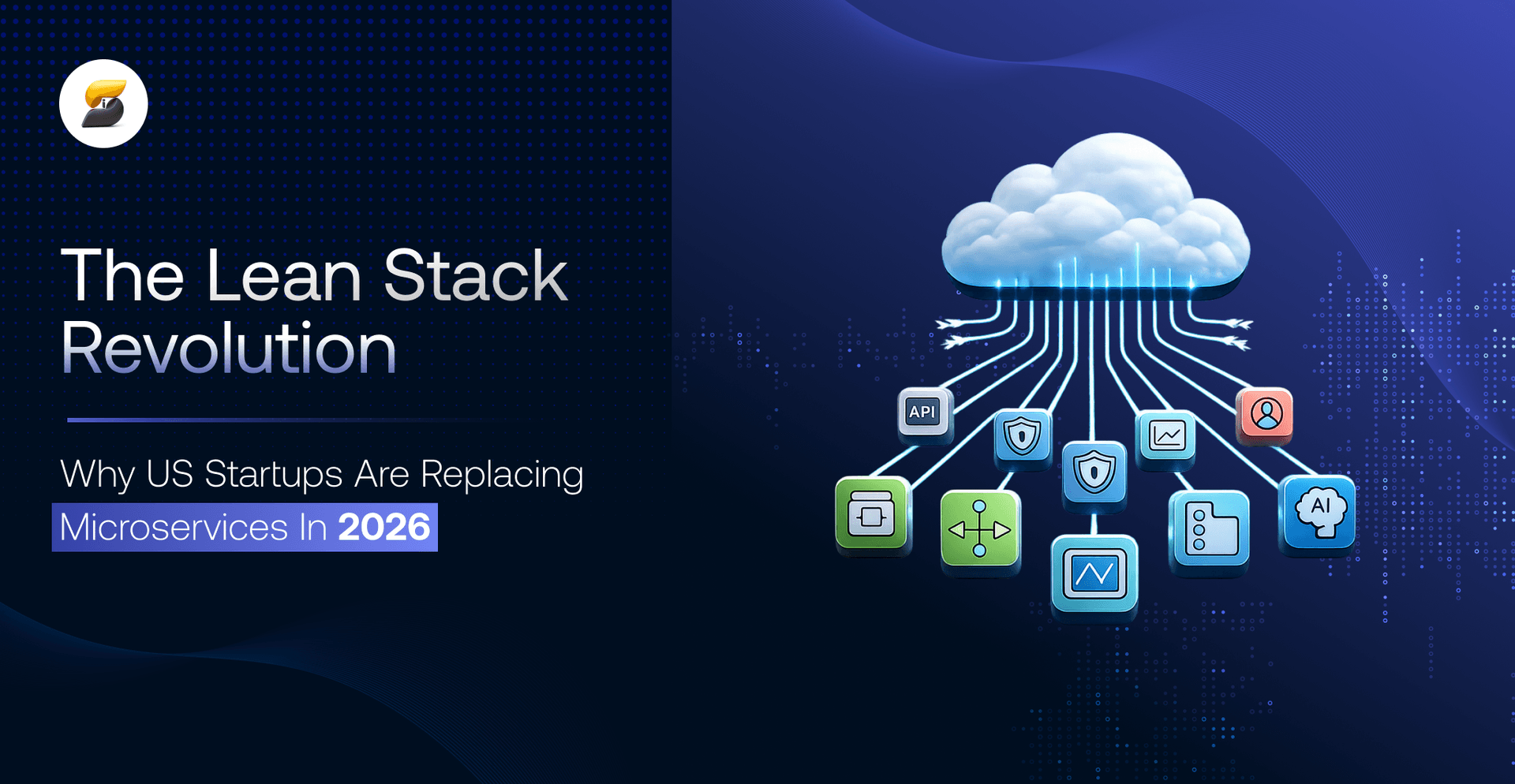
The startup ecosystem in 2026 is witnessing a major architectural shift. Instead of defaulting to microservices, startups are increasingly adopting lean full-stack architectures that prioritize speed, cost efficiency, and developer productivity. For early-stage and growth-stage teams, distributed systems often create more operational burden than business value.
A unified stack built with Next.js, PostgreSQL, serverless deployment, and modular monolith principles enables startups to ship faster, reduce infrastructure costs, and scale with smaller engineering teams. Compared to microservices, this approach significantly improves time-to-market, DevEx ROI, and feature ownership.
This guide explains why lean stack development is becoming the preferred architecture for modern SaaS startups, when microservices still make sense, and how companies can migrate without downtime.
The startup world is witnessing a dramatic shift in how founders build, ship, and scale their products. In 2026, lean stack development is no longer a fringe concept; it's the dominant strategy for resource-conscious US startups that want to move fast without getting bogged down in infrastructure complexity.
For years, microservices were treated as gospel. If you wanted to build something "serious," you needed Kubernetes clusters, service meshes, API gateways, and a small team of DevOps engineers just to keep the lights on. But startups aren't enterprises. They don't have the budgets, headcount, or time to manage distributed systems before validating their core offering.
Now, a growing wave of founders, CTOs, and full-stack development services providers are championing a different path: unified full-stack architectures built on modular monolith principles. This is the lean stack revolution, and if you're building a startup in the US right now, you need to understand why it matters.
Microservices were designed to solve problems that large organizations face problems most startups simply don't have yet. The ecosystem has collectively realized that adopting enterprise-grade distributed architectures too early creates more problems than it solves.
The appeal of microservices is clear on paper: independent deployment, technology flexibility, isolated scaling. But the hidden costs are brutal for early-stage companies:
The conversation has shifted from "what scales best theoretically" to "what lets our team ship fastest right now." Developer Experience (DevEx) ROI has become a first-class metric for startup technical leadership.
When a developer can clone a single repository, run one command, and have the entire application running locally in minutes, they ship features faster. When they don't need to understand service discovery and container orchestration just to fix a button, they stay focused on what matters.
A dedicated full-stack team working within a unified codebase can outpace a much larger team fragmented across dozens of microservices.
There's an uncomfortable truth that the industry is finally addressing. Many early-stage architecture decisions were resume-driven rather than business-driven. Engineers chose microservices and Kubernetes because those technologies looked impressive, not because the startup needed them.
In 2026, founders are asking harder questions: What's the full-stack vs microservices ROI for our specific stage? Do we need this complexity before we have paying customers? The answer, overwhelmingly, is no.
A unified full-stack architecture is an approach where the frontend, backend, and shared logic live within a single, cohesive codebase. It's structured modularly for maintainability but deployed and managed as one unit, often leveraging frameworks like Next.js to handle both server and client responsibilities seamlessly.
Building a lean stack isn't about choosing the cheapest tools. It's about choosing the right combination that maximizes output while minimizing operational burden.
Next.js has evolved from a React framework into a full-stack platform. It handles server-side rendering, API routes, middleware, static generation, and edge computing, all from a single project.
Next.js enterprise scalability has been proven by companies far larger than most startups. Teams looking for a reliable Next.js development company are finding that this single framework can carry them from MVP to Series B without a rewrite.
Instead of running separate databases for each microservice, lean stacks use a single, well-structured database, typically PostgreSQL, with clear schema boundaries that mirror domain separation. This eliminates data synchronization challenges and reduces hosting costs.
A serverless-first architecture removes the need to manage servers or container clusters. Combined with edge-native full-stack deployment, startups can serve users globally with minimal latency and pay only for actual usage.
The deployment pipeline for a lean stack is refreshingly simple:
Lean stacks integrate best-in-class third-party services through clean API boundaries rather than building custom services. This isn't about avoiding all services; it's about not building what you can buy for a fraction of the cost.
This is the question every startup CTO faces in 2026: for the vast majority of early and growth-stage startups, unified full-stack architecture wins decisively.
| Feature | Unified Full-Stack (Next.js/Node.js) | Microservices Architecture |
|---|---|---|
| Development Velocity | Extreme. One developer can own a feature from DB to UI. | Lower. Requires cross-team coordination and API contracts. |
| Operational Complexity | Minimal. Single CI/CD pipeline and one "Source of Truth." | High. Requires a dedicated DevOps/SRE to manage service meshes. |
| Debugging & Tracing | Simple. Standard stack traces in a single log stream. | Difficult. Requires distributed tracing (e.g., Jaeger/OpenTelemetry). |
| Scaling Potential | Vertical & Modular. Scale the whole app or specific modules. | Granular. Scale a single specific function independently. |
| Hiring Profile | Full-Stack Generalists. High-impact, versatile engineers. | Specialists. Backend, DevOps, and Platform engineers. |
| Best For | MVPs, Series A/B, and Lean SaaS Platforms. | Global Enterprise Scale (Netflix/Uber level) or legacy isolation. |
A unified codebase for startup MVP development eliminates coordination overhead. There's no need to define service contracts, manage API versioning between internal teams, or debug network failures between services.
When founders engage startup MVP development services, the fastest path to a working product is almost always a modular monolith.
Microservices architectures for early-stage startups often cost three to five times more in infrastructure compared to a well-built monolithic application.
Full-stack vs microservices ROI analysis consistently favors the lean approach for teams under fifty engineers:
A common argument for microservices is that they allow teams to work independently. While true at scale, this benefit is meaningless for a team of three to fifteen developers.
Modules within a modular monolith architecture can be owned by different team members. Code review, shared standards, and unified testing are actually easier when everything lives in one place.
Microservices make sense when:
For everyone else, lean stack development is the smarter bet.
For startups already running microservices and feeling the pain, migration doesn't require a big-bang rewrite.
Map every microservice, its dependencies, and actual usage. Many startups discover services that are barely used or redundantly duplicate logic. Identify high-pain, low-risk services to consolidate first.
Stand up your new lean stack, typically a Next.js application with a well-designed database schema. The full-stack app development approach here is critical: each module should be self-contained, preserving domain boundaries.
Use the strangler fig pattern. Route traffic for migrated functionality to the new unified application while legacy microservices handle everything else. Over time, the monolith grows, and microservices shrink.
Once migration is complete, optimize for performance. A single application means a single dashboard, single alerting pipeline, and single team responsible for uptime.
Working with a full-stack IT service provider experienced in migration can significantly reduce risk. iSyncEvolution has guided multiple startups through architectural consolidation with zero downtime.
The lean stack revolution isn't a trend; it's a correction. For too long, startups adopted enterprise-grade microservices architectures that slowed them down and burned through their runways. In 2026, the smartest US startups are embracing lean stack development and unified full-stack approaches that prioritize speed and cost efficiency.
The tools are better than ever. Next.js provides enterprise-grade capabilities in a single framework. Serverless platforms eliminate operational overhead. And founders are no longer apologizing for choosing simplicity.
If you're building a startup today, the question isn't whether you can afford to go lean. It's whether you can afford not to.
Ready to build your lean stack? Get in touch with iSyncEvolution to work with a dedicated full-stack team that builds architectures designed for startup speed and enterprise scalability.
Yes. A modular monolith built on frameworks like Next.js with edge-native deployment can scale to millions of users. The key is a modular design that allows you to extract services later only when genuine bottlenecks demand it.
Next.js consolidates frontend and backend into a single deployment, leverages edge caching, and supports serverless execution, billing only for actual usage. This eliminates always-on servers and inter-service network traffic.
A full-stack developer can own features end-to-end without depending on other services. For startups, this means faster iteration and lower hiring costs. Microservices specialists become valuable at scale, but most startups benefit more from versatile full-stack engineers.
A traditional monolith often becomes tangled with interconnected code. A modular monolith separates concerns into well-defined modules with clear boundaries, and the organizational benefits of microservices without the distributed systems overhead.
Consider the shift when your team grows beyond fifty developers, when modules have fundamentally different scaling requirements, or when compliance demands physical isolation. Until then, lean stack development will serve most startups more effectively.
Nikhil Shah is the CTO and Co-Founder of iSyncEvolution, an engineering leader who aligns modern technology best practices with long-term commercial success. A veteran of cloud infrastructure and scalable web/mobile solutions, he specializes in building high-performance software environments. Nikhil helps global brands master their technical roadmaps, optimizing both code performance and development economics to fuel growth.
© 2026 iSyncEvolution Pvt Ltd. All Rights Reserved.