
23 March, 2026
Choosing between custom and off-the-shelf Fintech software is a decision between security sovereignty and shared vulnerability. While off-the-shelf solutions offer speed, they often trap firms in "Security Silos" with limited control over data residency and compliance updates. Custom Fintech development eliminates these risks by implementing zero-trust architectures and proprietary encryption natively. For enterprises prioritizing data integrity and regulatory compliance, custom-built platforms provide the only scalable path to 100% data ownership and long-term risk mitigation.
Financial technology moves fast. But when speed comes at the expense of security, the consequences can be devastating. Data breaches, compliance failures, and regulatory fines aren't abstract threats; they're daily realities for fintech companies relying on generic software.
The appeal of off-the-shelf fintech software is understandable. It promises quick deployment, lower upfront costs, and familiar interfaces. But beneath that convenience lies a web of hidden risks most financial businesses only discover after the damage is done.
Custom fintech solutions offer a fundamentally different approach. They're built around your specific business logic, compliance requirements, and security architecture, not someone else's.
In this guide, we'll break down why the build vs buy fintech platform debate almost always tilts toward custom development when security is the priority. We'll examine the real costs of going generic, the security pillars where custom wins, and how companies like iSyncEvolution help fintech businesses build infrastructure that's secure by design.
Custom fintech software development is the process of designing, building, and deploying financial technology solutions tailored specifically to an organization's unique operational, regulatory, and security requirements. Unlike off-the-shelf fintech software serving a broad market with standardized features, custom-built platforms are architected from the ground up to address the precise workflows, data protection needs, and compliance frameworks of a specific business.
| Feature | Off-the-Shelf SaaS | iSyncEvolution Custom Solution |
|---|---|---|
| Data Ownership | Shared/Vendor-Managed | 100% Private & Isolated |
| Security Updates | Vendor Roadmap Dependent | Immediate & Proprietary |
| Compliance | One-size-fits-all | Purpose-built (PCI-DSS/GDPR) |
| Scalability | Tiered/Per-user fees | Horizontal & Unlimited |
The modern fintech landscape is flooded with SaaS platforms promising turnkey solutions for everything from payment processing to loan origination. On the surface, the value proposition seems unbeatable: sign up, configure a few settings, and you're live within weeks. But for financial services companies handling sensitive data, this convenience creates what industry insiders call the "SaaS Trap."
Off-the-shelf fintech tools are designed for the widest possible audience. Every feature, security protocol, and compliance mechanism is built to serve a generic use case. When your business operates in a specific regulatory environment, say, cross-border payments or digital lending in a particular jurisdiction, that generic architecture becomes a liability.
The initial savings on licensing fees often evaporate when you factor in:
When you use a multi-tenant SaaS product, your data lives alongside the data of hundreds or thousands of other customers. A vulnerability in the platform doesn't just affect one company; it affects everyone on that shared infrastructure.
For financial institutions, this is an unacceptable risk posture. Your customers trust you with their most sensitive information: bank account numbers, social security data, transaction histories, and personal identification. Shared environments increase the attack surface exponentially, and you have zero control over how the vendor patches vulnerabilities or responds to incidents.
Perhaps the most critical issue is control, or the lack of it. With off-the-shelf fintech software, you're dependent on the vendor's roadmap, their security update schedule, and their interpretation of compliance requirements.
If a new regulation demands changes to how you handle data encryption or user authentication, you're waiting in line with every other customer for that update. In financial services, waiting isn't an option. Regulatory deadlines are hard. Breach notification windows are narrow. And reputational damage from a security incident doesn't wait for your vendor's next release cycle.
When evaluating custom vs off-the-shelf fintech software, security is where the differences are most stark. Custom fintech solutions provide advantages across three fundamental pillars that generic platforms simply cannot match.
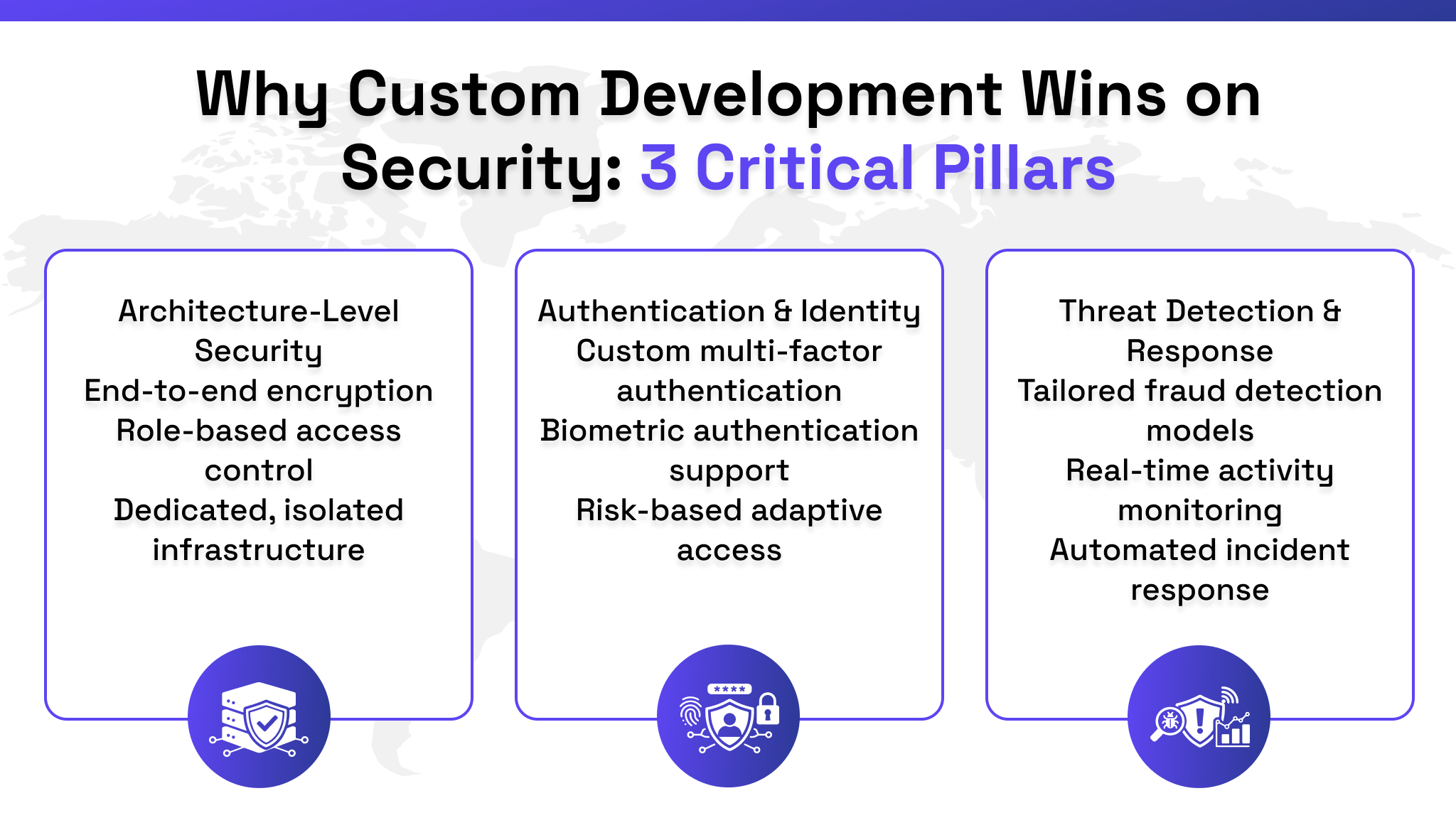
Security in custom development starts at the architecture level, not as an afterthought bolted onto a pre-existing framework. When we build financial software, every layer from the database schema to the API gateway is designed with the specific threat model of the client in mind.
This means:
Off-the-shelf platforms use one-size-fits-all security architectures because they serve thousands of different businesses. That architectural compromise is the single biggest reason why fintech software security is consistently weaker in generic products.
Financial applications demand sophisticated authentication mechanisms beyond basic username-and-password schemes. Custom fintech solutions allow you to implement:
With custom mobile app development, these authentication layers can be built directly into the user experience, providing strong security without creating friction.
Generic platforms typically offer a limited menu of authentication options. If your compliance framework requires a specific method, you're stuck with whatever the vendor provides.
Custom-built fintech platforms allow you to:
When every second counts in a security incident, the ability to respond with precision rather than relying on a vendor's generic alerting system is the difference between a contained event and a catastrophic breach.
Financial software compliance isn't a static checkbox exercise. Regulations evolve constantly, and the compliance landscape varies dramatically by geography, product type, and customer segment. Custom fintech solutions provide advantages that off-the-shelf platforms fundamentally cannot deliver.
When you build a custom fintech platform, compliance requirements are embedded into the development process from day one. Your development team works directly with compliance officers and legal advisors to ensure every feature, data flow, and user interaction meets applicable regulatory standards.
This is fundamentally different from trying to configure a generic platform after the fact. With off-the-shelf fintech software, you're forcing a square peg into a round hole, and the gaps become audit findings.
Data protection fintech requirements vary enormously between jurisdictions. GDPR in Europe, CCPA in California, and PDPA in Singapore each impose different requirements for data storage, processing, consent management, and breach notification.
Custom platforms can handle these differences natively, with data routing and storage logic that adapts based on the user's jurisdiction. Generic platforms typically offer a single compliance model, creating gaps that regulators are increasingly aggressive about penalizing.
Custom platforms can produce audit-ready reports and documentation automatically. Every transaction, access event, and configuration change can be logged in formats that align precisely with regulatory reporting requirements.
We understand that compliance isn't a feature to be added later; it's a foundational requirement shaping every architectural decision in custom software development.
One of the most overlooked risks of off-the-shelf fintech platforms is what happens when you connect them to the rest of your technology ecosystem. Every integration point is a potential data leakage vector, and generic platforms create far more of these vulnerabilities than most organizations realize.
Off-the-shelf fintech software rarely works in isolation. It needs to connect to your core banking system, CRM, KYC/AML provider, payment processors, and reporting infrastructure. Each connection requires middleware, API adapters, or custom scripts, and each creates an opportunity for data exposure.
Every additional integration layer introduces:
Data leakage doesn't always look like a dramatic breach. More often, it's subtle: customer data cached in middleware that was never designed for PCI compliance, transaction details logged in plain text, or API responses exposing more data than necessary.
With custom fintech solutions, every integration is purpose-built. Data flows are mapped end-to-end, encryption is maintained throughout, and each connection point is designed with the principle of least privilege.
When iSyncEvolution developed LumoPay, a secure payment system, the team designed every integration point to maintain data integrity and security throughout the entire transaction lifecycle. This end-to-end control is only possible with custom development.
Growth is the goal of every fintech company, but scaling introduces security challenges that off-the-shelf fintech software handles poorly. As transaction volumes increase and user bases expand, security infrastructure must scale in lockstep.
Banking software security isn't just about preventing breaches; it's about maintaining security standards under load. When transaction volumes spike, off-the-shelf platforms often degrade security controls to maintain performance. Rate limiting gets relaxed. Logging gets reduced. Monitoring thresholds get widened.
Custom fintech solutions maintain their full security posture under peak load conditions because performance and security architectures are designed together.
When your fintech business launches new products, every new feature must be evaluated for security implications. With custom platforms, new features are developed within the same security framework as the rest of the application.
With off-the-shelf platforms, new features come from the vendor's roadmap and may or may not align with your security requirements.
Custom platforms give you complete sovereignty over infrastructure decisions: where your data is hosted, how it's replicated, which cloud regions are used, and how failover is managed. When regulators ask how you protect customer data, "our vendor handles that" is an increasingly unacceptable answer.
Intellectual honesty demands acknowledging that off-the-shelf fintech software isn't always wrong. There are legitimate scenarios where generic platforms are appropriate.
When a fintech startup is validating a business model, speed to market often matters more than architectural perfection. An off-the-shelf platform can provide the functionality needed to test assumptions without the investment of custom development. The key is recognizing when you've outgrown that platform.
Not every function requires custom development. Internal collaboration tools and basic marketing automation can run on off-the-shelf solutions because they don't handle sensitive financial data. The distinction is clear: core financial operations require custom fintech solutions; supporting functions can use generic tools.
Some fintech companies face genuine budget constraints. In these cases, a phased approach can work: start with an off-the-shelf platform, but begin custom development of security-critical components immediately. We frequently work with companies in this situation, helping prioritize which components to build custom first.
The cost of off-the-shelf fintech software isn't measured in licensing fees alone. It's measured in security vulnerabilities you cannot control, compliance gaps you cannot close, integration risks you cannot eliminate, and scaling limitations you cannot overcome.
Custom fintech solutions address all of these challenges by putting you in complete control of your security architecture, compliance posture, and technology roadmap. The build vs buy fintech platform decision is ultimately about how seriously you take your responsibility to protect customer data. For fintech companies handling sensitive financial information, custom development isn't a luxury; it's a strategic necessity.
iSyncEvolution specializes in building secure, compliant, and scalable fintech platforms. From custom software development to mobile app development, the team brings deep expertise in financial software development and prioritizes security at every layer.
Ready to move beyond the limitations of off-the-shelf fintech software? Talk to iSyncEvolution about building a fintech platform that's secure by design.
Not necessarily. While custom fintech solutions have higher upfront costs, they often cost less over time with no recurring licensing fees or expensive workarounds. You also avoid the hidden costs of adapting generic software to evolving compliance needs.
Timelines vary based on complexity, but typically three to nine months from discovery through deployment. Teams like iSync Evolution use agile methodologies that deliver functional modules incrementally.
Yes, this is one of the strongest advantages. Custom platforms are designed with your specific integration requirements in mind, eliminating the middleware sprawl that plagues off-the-shelf alternatives.
Custom platforms can be built to support any compliance framework, such as PCI DSS, SOC 2, GDPR, regional banking regulations, or industry-specific requirements. The architecture adapts to your regulatory environment.
Key indicators include frequent compliance workarounds, security concerns from auditors, integration costs exceeding expectations, or growth plans that the current platform can't support securely.
Nikhil Shah is the CTO and Co-Founder of iSyncEvolution, an engineering leader who aligns modern technology best practices with long-term commercial success. A veteran of cloud infrastructure and scalable web/mobile solutions, he specializes in building high-performance software environments. Nikhil helps global brands master their technical roadmaps, optimizing both code performance and development economics to fuel growth.
© 2026 iSyncEvolution Pvt Ltd. All Rights Reserved.