
27 January, 2026
Understanding why app projects fail is crucial for anyone planning to build a mobile application. The path from concept to successful launch presents challenges that can bother even the most promising ideas. Poor planning, communication breakdowns, and technical missteps consistently lead to mobile app project failure, costing businesses significant time and money.
The good news? Most app failures are preventable. When you recognize the common mobile app mistakes that plague development teams, you can take proactive steps to avoid them. This guide explores the top 10 reasons why software projects fail before launch and provides actionable strategies to help your app succeed.
Whether you're a startup founder, product manager, or business owner, spotting these failure points early can save your project.
Mobile app development failure doesn't happen overnight. It results from accumulated mistakes throughout the project lifecycle. Understanding these app failure reasons helps you identify warning signs early and take corrective action.
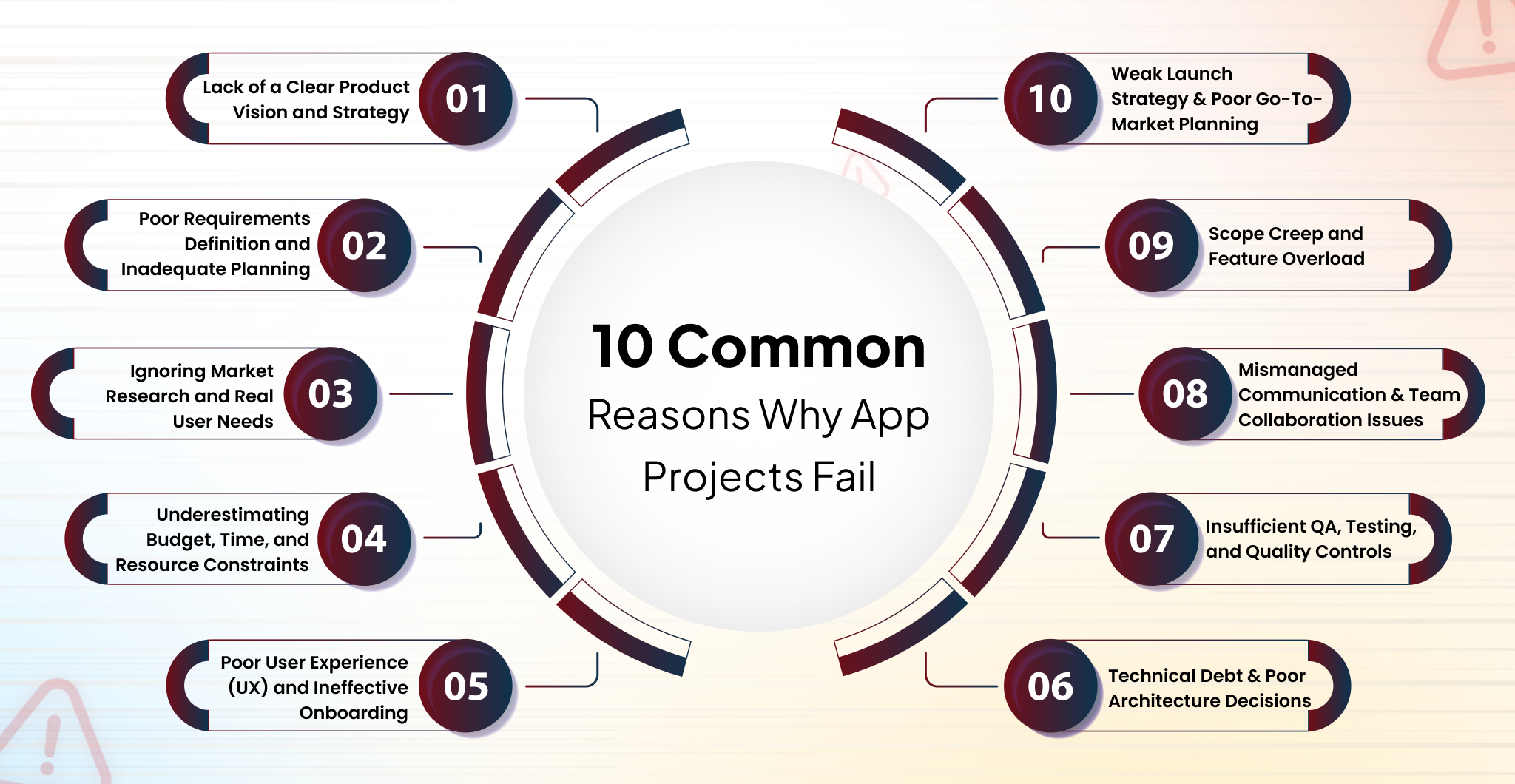
Without a well-defined product vision, your app project becomes a ship without a compass. Teams make decisions in isolation, features get added without purpose, and the final product fails to solve any specific problem effectively.
A clear product vision answers fundamental questions: Who is this app for? What problem does it solve? How will success be measured?
Common Signs of Vision Problems:
Before writing a single line of code, validate your app idea thoroughly to ensure your vision is grounded in reality.
App planning mistakes during the requirements phase create ripple effects throughout development. Vague requirements lead to misinterpretations, rework, and frustration.
Proper requirements documentation goes beyond listing features. It includes user stories, acceptance criteria, technical specifications, and clear priorities. Many projects fail because stakeholders assume everyone shares the same understanding of terms like "simple" or "user-friendly."
Understanding the complete mobile app development process helps teams establish realistic expectations and appropriate time allocations for each phase.
Building an app without understanding your target market is one of the primary reasons why mobile apps fail. Many founders fall in love with their ideas and skip validating whether users actually want what they're building.
Effective Market Research Includes:
The MVP feature prioritization framework helps teams focus on features that matter most to users rather than building everything at once.
Mobile app development failure often stems from unrealistic budget and timeline expectations. Entrepreneurs frequently underestimate costs, leading to projects that run out of funding before completion.
Understanding the hidden costs in mobile app development is crucial. Beyond development, budget for design, testing, infrastructure, maintenance, marketing, and updates.
The app development timeline varies based on complexity, but rushing through phases inevitably creates quality issues. When stakeholders pressure teams to deliver faster, corners get cut.
UX and performance issues in mobile apps drive users away within seconds. First impressions matter enormously when users have countless alternatives at their fingertips.
Poor User Experience Manifests As:
If you're wondering why your app isn't converting users, the answer often lies in UX problems. Working with professional UI/UX designers ensures your app delivers the seamless experience users expect.
Early architecture decisions have long-lasting consequences. Choosing the wrong technology stack, ignoring scalability, or taking shortcuts creates technical debt that compounds over time.
Technical debt makes future changes expensive and risky. Simple feature additions become complex undertakings, and bug fixes create problems elsewhere.
If you can't scale your app, architecture is likely the culprit. Many projects learn that cheap app development becomes expensive when poorly constructed features need rebuilding.
Lack of testing in app development creates apps that crash, perform poorly, and frustrate users. When testing gets compressed or skipped, bugs make it into production and damage your reputation. Professional QA testers bring systematic approaches to finding bugs before users do.
Comprehensive Testing Should Include:
Team communication problems kill projects slowly. Misunderstandings accumulate, assumptions go unchallenged, and critical information falls through cracks.
Effective Communication Requires:
Scope creep occurs when new features are continuously added without adjustments to the timeline or budget. Each addition seems small, but collectively they overwhelm the project.
Feature overload creates apps that try to do everything and excel at nothing. Users become confused by cluttered interfaces.
Signs of Scope Creep:
Strong project management maintains scope discipline with formal evaluation processes for changes.
App launch failure reasons often trace back to treating launch as an afterthought. Teams focus intensely on building the product but fail to plan how it will reach users.
Understanding what app store optimization (ASO) is helps your app get discovered. Marketing campaigns, user acquisition channels, and support readiness all need planning.
Knowing why software projects fail is only half the battle. Implementing preventive measures throughout your project lifecycle dramatically improves your chances of success.
Before investing heavily in development, validate your concept with a minimum viable product. Early validation reveals whether your assumptions about user needs are accurate. This approach reduces risk by identifying problems early when they're cheap to fix.
Invest time upfront in articulating your product vision. Document who the app serves, what problems it solves, and what success looks like. A strong vision acts as a filter for feature requests and a guide for design decisions.
Not all features are equally important. Use frameworks to evaluate features against user needs, business value, and implementation effort. Establish change control processes that make the cost of scope changes visible to stakeholders.
Design your app with first-time users in mind. The initial experience should clearly communicate value and make it easy to accomplish meaningful tasks.
Test your onboarding with users who match your target audience and iterate until the experience flows smoothly.
Build quality into your process rather than trying to test it in at the end. Automated tests quickly catch regressions, giving teams the confidence to make changes. Allocate sufficient time and resources for testing throughout the development process.
Establish regular communication rhythms that keep everyone aligned. Create an environment where problems can be discussed openly. Document decisions and share context generously so everyone understands what's happening and why.
Your launch strategy deserves the same attention as your product development. Start planning early, not weeks before release. iSyncEvolution's mobile app development services include launch planning as an integral part of the process, ensuring your app gets the visibility it deserves.
Understanding the reasons why app projects fail can help you build more successful applications. Common pitfalls include unclear vision and poor launch planning, but each of these can be avoided with the right attention and processes.
Key lessons to keep in mind are: validate your ideas early, plan thoroughly, prioritize effectively, invest in quality, maintain open communication, and prepare diligently for launch. Teams that embrace these principles are more likely to evade the common mistakes that can hinder their competitors.

Lack of clear product vision and poor planning are the most common reasons. When teams don't understand what they're building or why, every subsequent decision becomes harder, leading to scope creep and wasted resources.
Yes, most app failures are preventable with proper planning, validation, and execution. The failures discussed here result from known mistakes that teams make repeatedly. Learning from these patterns dramatically improves your chances.
Test your app idea before writing any code. Use techniques like user interviews, surveys, and prototypes to validate assumptions. The earlier you discover problems, the cheaper they are to fix.
Absolutely. Users expect seamless, intuitive experiences and abandon apps that frustrate them. First impressions happen quickly, and users rarely give second chances.
Build a realistic budget that includes hidden costs, contingency reserves, and post-launch maintenance. Phased development approaches let you validate before committing full resources.
Nikhil Shah is the CTO and Co-Founder of iSyncEvolution, an engineering leader who aligns modern technology best practices with long-term commercial success. A veteran of cloud infrastructure and scalable web/mobile solutions, he specializes in building high-performance software environments. Nikhil helps global brands master their technical roadmaps, optimizing both code performance and development economics to fuel growth.
© 2026 iSyncEvolution Pvt Ltd. All Rights Reserved.