
02 November, 2026
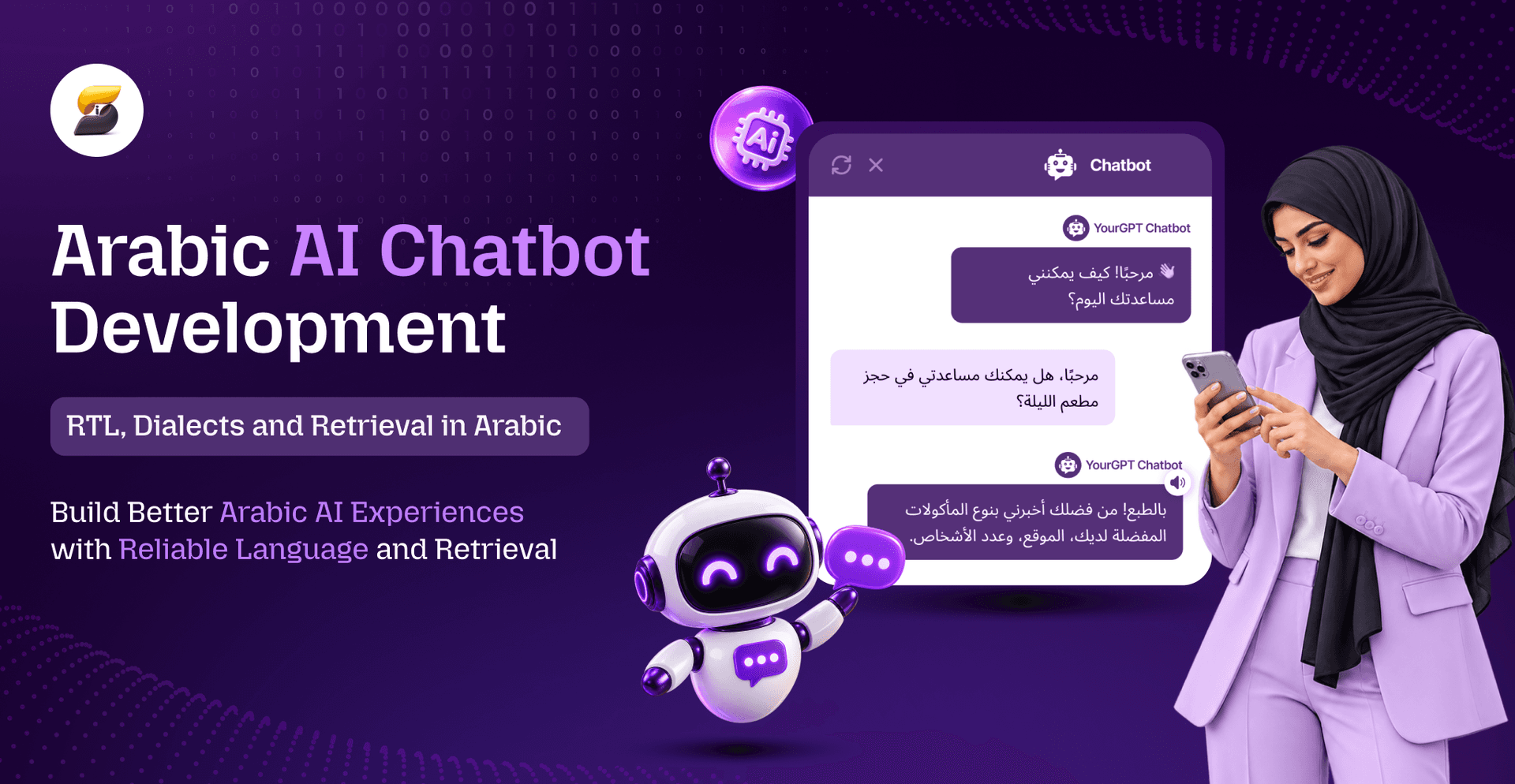
Building an Arabic AI chatbot involves more than choosing a language model. RTL rendering, regional dialects, mixed Arabic-English messages, spelling variations, and retrieval accuracy can all affect how reliably a chatbot understands users and delivers grounded answers.
This post explains:
An Arabic AI chatbot differs from an English one in right-to-left display, dialect variation, spelling variants that break search, and evaluation. The main risk is silent retrieval failure: the model answers fluently in Arabic while the search layer misses the right source passage, so users receive confident answers with no grounding in your content.
CTOs and technical founders building for users in the UAE and the wider Gulf will find the engineering decisions here. The guide covers the chat interface, dialect handling, retrieval, model testing, and the point at which an outside partner makes sense.
This guide reflects practice as of October 2026. Model and framework behaviour changes quickly, so confirm against current documentation.
Five things differ. Arabic is written right to left while digits and Latin words run left to right. Users write Modern Standard Arabic (MSA, the formal written standard) and regional dialects. Spelling variants and attached prefixes disrupt search. Messages mix Arabic and English. Quality needs native reviewers, because fluent output can still be wrong.
The main risk is silent retrieval failure. When search misses the right passage, the model still writes fluent Arabic, so reviewers who read only the answer may not notice that it is ungrounded.
Set direction per message paragraph, not per page. Use dir="auto" as the baseline, override it from detected language when a Latin word opens an Arabic sentence, write layout with logical CSS properties, isolate numbers, links, and identifiers, and fix direction before streamed text moves the layout.
An RTL (right-to-left) chatbot interface treats direction as a property of each message, not of the page. The Unicode Bidirectional Algorithm orders mixed-direction text visually, but the paragraph's base direction is yours to set.
Take “Wi-Fi لا يعمل” (“Wi-Fi is not working”). With dir="auto", the first strong character is the Latin W, so the browser lays out the paragraph left-to-right and left-aligns it, setting the direction based on the detected language of the message or its share of Arabic letters. Wrap embedded order codes and phone numbers in bdi elements, which isolate their direction from the surrounding text. The W3C guidance on right-to-left markup prefers the dir attribute over CSS for this.
Logical CSS properties describe layout relative to text direction instead of screen edges. Use margin-inline-start, padding-inline-end,d and text-align: start in place of left and right values, as MDN's reference lists.
Streaming adds a problem that static pages lack. The first token may be punctuation, a Markdown marker, or a Latin word, so direction can flip when the first Arabic letter arrives, and the bubble jumps under the reader. Decode the byte stream with a streaming decoder so that Arabic characters split across network chunks do not become replacement characters.
Where this goes wrong. A reply that opens with an English product term and continues in Arabic can change alignment mid-generation. Decide direction once per paragraph, from the expected response language or the first letters received, and lock it for that paragraph.
Arabic text uses Western digits (123) or Eastern Arabic-Indic digits (١٢٣, “123”). State the policy in the system prompt and normalise both forms in search.
Auto-linkers that split on whitespace can pull adjacent Arabic punctuation into the URL. Render citation markers as separate elements instead of inline “[1]”, because brackets are mirrored characters whose appearance depends on the surrounding direction.
In Flutter, the Localizations widget sets the ambient Directionality from the active locale, so layouts should use EdgeInsetsDirectional and AlignmentDirectional instead of left and right values. For message bubbles, detect each message's direction and pass it as the Text widget's textDirection, because the ambient direction follows the app locale, not the message. Model integration and streaming state are covered separately in a guide to AI features in Flutter apps.
In Next.js, set lang and dir on the html element in the root layout from the locale, and keep dir="auto" or a detected direction on each message container. Model calls and transport belong to the wider LLM architecture in Next.js.
Dialects change vocabulary, grammar, and spelling, so a chatbot built mostly on Modern Standard Arabic (MSA) can misread everyday messages. MSA is the formal written standard; regional dialects such as Gulf, Levantine, and Egyptian are used in speech and informal chat. Plan for dialect detection, code-switching, and Latin-script Arabic, and test on real conversations.
An Arabic dialect chatbot has to map one intent expressed in different words. The table shows one phrase in four varieties.
| Variety | Spoken / Written | Meaning & Usage |
|---|---|---|
| MSA (Modern Standard Arabic) | أريد (Urīd) | Formal / Written standard Arabic |
| Gulf (Khaleeji) | أبي (Abī) | Common in Kuwait, Saudi Arabia, UAE, etc. |
| Egyptian (Masri) | عايز (‘Āyiz) | Masculine form (‘Ayza / عايزة for feminine speakers) |
| Levantine (Shami) | بدي (Baddī) | Used in Lebanon, Syria, Jordan, and Palestine |
Code-switching means mixing languages within one message, such as أبي أغيّر الـ password (“I want to change the password”). Many users also write Arabic in Latin letters, with digits standing in for sounds: 3andi mushkila (“I have a problem”), where 3 represents the Arabic letter ع.
Detect language at the message level, because users switch within a conversation. Return script, language, and a dialect guess with confidence, and treat the dialect as a hint rather than a gate.
Build the test set from real conversations: support tickets, chat logs, search queries, and voice transcripts, with personal data removed. Tag each item by dialect, script, topic, and whether it mixes languages, and hold some items back from prompt tuning.
Where this goes wrong. A test set made by translating English questions produces MSA-flavoured text that does not match how users write. Scores look healthy, and the first real Gulf-dialect or Latin-script message exposes the gap.
Retrieval for Arabic content follows the usual RAG pipeline, with extra steps before indexing. Text is normalised, tokenised so prefixes do not hide word roots, chunked on Arabic punctuation, then searched with keyword and vector methods together and reranked. Skipping normalisation splits one word's spelling variants into separate index entries.
A clitic is a short particle attached to a word, such as و (“and”) or ب (“by”). An embedding is a numeric vector that places similar meanings close together; hybrid search combines keyword and vector matching, and a reranker re-scores the top results with a slower, more accurate model.
| Pipeline Step | Challenge / Problem | Recommended Action |
|---|---|---|
| Letter Variants | Orthographic inconsistencies: Alef variants (أ, إ, آ, ا), ى/ي, and ة/ه indexed as distinct strings. | Normalize/fold Alef forms to plain ا, convert ى to ي, and ة to ه for indexing while maintaining raw text for display. |
| Diacritics & Tatweel | Vowels (Tashkeel) and elongation (Tatweel ـ) break exact string matches (e.g., كُتُب vs كَتَبَ). | Strip all diacritics and Tatweel characters during preprocessing for matching. |
| Prefixes & Clitics | Agglutinative prefixing (e.g., وبالسيارة hiding the root noun سيارة). | Apply morphological segmentation via tools like Farasa or CAMeL Tools, or generate character n-grams. |
| Tokenisation | Arabic subword tokenizers create higher token counts per sentence than English. | Calibrate maximum chunk sizes using the exact tokenizer of your target embedding/LLM model. |
| Chunking | English sentence splitters fail on Arabic punctuation (؟, ،). | Custom-split chunks using Arabic-specific punctuation marks and Markdown/document structural headings. |
| Embeddings | Inconsistent performance across dialectal vs. Modern Standard Arabic (MSA) in generic models. | Benchmark multilingual and Arabic-tailored embedding models against a domain-specific query test set. |
| Hybrid Search | Vector search misses precise entity matches/codes, while keyword search misses conceptual synonyms. | Implement Hybrid Search combining BM25 keyword scoring with dense vector retrieval via Reciprocal Rank Fusion (RRF). |
| Cross-Lingual Retrieval | Loss of precision when querying Arabic documents with English inputs (or vice versa). | Evaluate multilingual dense embeddings against query-translation strategies, followed by a cross-encoder reranker on top-K results. |
Where this goes wrong. Normalising documents but not queries, or the reverse, produces zero matches that look like missing content. PDF extraction can also yield Arabic presentation-form characters or reversed text. Unicode NFKC folds the presentation forms into standard letters, but reversed text needs a manual check.
Choose models by criteria, not by public rankings: Arabic and dialect coverage, tokeniser efficiency, instruction following in Arabic, citation behaviour, data-handling terms, latency and hosting options. Then test each candidate with native reviewers on your own conversations and content, and use a pre-launch checklist to confirm results.
An Arabic AI chatbot needs these criteria checked against your content, not a vendor's general claims:
Reviewers should speak your target dialects and know the domain, rather than translate from English. Hide which model or prompt produced each answer, and score against a written rubric covering accuracy against the source, language correctness, register, and mixed-script handling. Use two reviewers per sampled answer and record disagreements.
An Arabic AI chatbot is not worth building yet when the content it should answer from is missing, outdated, or scattered, when message volume is too low to produce usable test data, or when nobody can review Arabic output. A partner becomes useful when the team lacks native evaluation, Arabic retrieval experience, or delivery capacity.
A static FAQ page or better site search may meet the need. Whether AI belongs in the product at all is the wider question addressed in a guide on when to add AI to a web application.
Prepare these inputs before the first call:
An Arabic AI chatbot succeeds or fails on details outside the model: how mixed-direction messages render while streaming, how dialects appear in real conversations, and how Arabic text is normalised before indexing. Native reviewers and a test set built from real conversations turn those details into measurable results.
iSyncEvolution designs and builds AI features for web and mobile applications, and its AI development services page describes how engagements start. A short brief covering content sources, languages and dialects, volume, channels, and data constraints is enough to begin a conversation.

Yes, a bilingual Arabic-English chatbot is feasible, but it needs per-message language detection, per-paragraph text direction, and retrieval that works across both languages. Users switch languages mid-conversation and mix them inside sentences, so test code-switched messages explicitly instead of testing Arabic and English separately.
A common cause is spelling and form variation: letter variants, diacritics, and attached prefixes make one word appear as several index entries. Normalise text identically at index and query time, segment prefixes, combine keyword and vector search, and check retrieval separately from answer quality so you know which layer failed.
Reply in MSA by default for business content, and mirror dialect only when a native reviewer has approved the output for that dialect. MSA is understood across the Arab world and matches formal written sources. Dialect replies can feel natural but add error risk in vocabulary and spelling, so treat them as a tested feature.
You cannot fully replace native reviewers. Engage native speakers of your target dialects, ideally with domain knowledge, and give them a written rubric covering accuracy against sources, language correctness, register, and mixed-script handling. Automated grading can triage large sets, but calibrate it against reviewer scores before relying on it.
The answer depends on the country, the sector, and the type of data. The UAE has a federal personal data protection law, and other Gulf states have their own rules on personal data and transfers; some sectors add further requirements. Read the primary texts and have qualified counsel review this before choosing hosting regions.
Nikhil Shah is the CTO and Co-Founder of iSyncEvolution, an engineering leader who aligns modern technology best practices with long-term commercial success. A veteran of cloud infrastructure and scalable web/mobile solutions, he specializes in building high-performance software environments. Nikhil helps global brands master their technical roadmaps, optimizing both code performance and development economics to fuel growth.
© 2026 iSyncEvolution Pvt Ltd. All Rights Reserved.