
22 January, 2026
Launching a mobile app is exciting. But here's the harsh reality: most apps fail within the first 90 days of going live. The mobile app failure reasons vary widelyfrom poor user experience to weak retention strategies. Understanding why apps fail in the first 90 days can mean the difference between building a thriving product and watching your investment vanish.
The first three months after launch are critical. Users decide whether your app deserves a permanent spot on their phones or gets deleted without a second thought. In this guide, we'll explore the most common app development mistakes, examine the app success vs failure factors, and provide actionable solutions to help your app thrive beyond day 90.
Whether you're preparing for launch or trying to course-correct an underperforming app, these insights will help you navigate the treacherous early waters of app development.
App failure occurs when a mobile application doesn't achieve its intended goalswhether that's user acquisition, retention, revenue generation, or engagement. Most commonly, failure manifests as rapid user abandonment within the first 90 days, resulting in low daily active users and eventual app store obscurity.
The mobile app landscape is brutally competitive. Millions of apps fight for user attention, and most never gain meaningful traction. The difference between app success vs failure often comes down to execution in those crucial early weeks.
Users today have incredibly high expectations. They've experienced polished apps from major tech companies and expect that same quality from every download. When an app falls shortthrough slow loading, confusing navigation, or unclear valueusers abandon it quickly and rarely return.
The first 90 days represent your window to prove value. During this period, your app must:
Understanding this reality is the first step toward beating the odds.
Apps usually don’t fail for a single reasonthey fail because multiple weaknesses stack up fast. Poor validation leads to the wrong users, weak onboarding fails to activate them, and bad retention ensures they never return. Add ignored analytics or rushed technical decisions, and traction collapses before momentum ever builds. The reasons below represent the most commonand most damagingmistakes that prevent apps from gaining real market adoption.
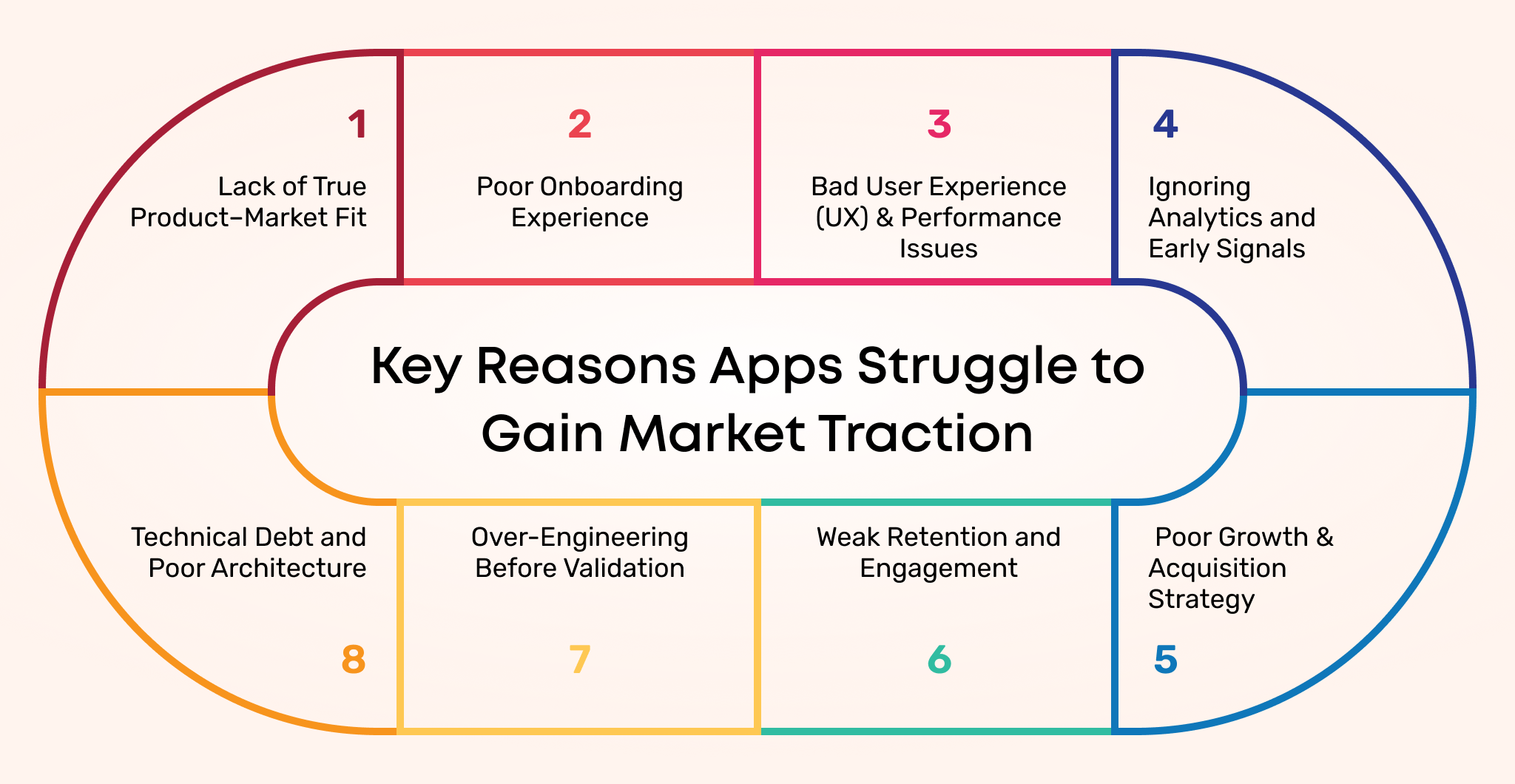
Many apps enter the market, solving problems that don't truly exist or targeting audiences that don't need the solution. This fundamental disconnect is among the most devastating mobile app failures.
Product-market fit means your app addresses a genuine pain point for a specific audience willing to use (and potentially pay for) your solution. Without this alignment, no amount of marketing or feature development will save your app.
Before investing heavily in development, smart founders validate their app ideas through user research, prototype testing, and market analysis. This validation reveals whether real demand exists for your solution.
User onboarding problems represent one of the most common reasons mobile apps fail early. The onboarding experience shapes first impressions and determines whether users grasp your app's value proposition.
When onboarding fails, users feel confused, overwhelmed, or underwhelmed. They expected a solution but encountered friction instead. This disconnect drives immediate abandonment.
Great onboarding delivers value quickly. It shows rather than tells. It guides users to experience the core benefit within minutes. Progressive disclosure reveals features as users need them, preventing overwhelm while building competence.
Technical problems and poor design choices frustrate users fast. In a world where alternatives are one search away, patience for buggy or confusing apps has vanished.
Performance issues particularly damage trust. Slow loading, crashes, and unresponsive interfaces signal low quality. Users assume that if basic performance suffers, the entire product lacks polish. These common app development mistakes accumulate into abandoned apps.
If your app isn't converting users, UX and performance problems likely contribute.
Flying blind guarantees failure. Yet many app creators launch without proper analytics, missing critical signals about how to avoid app failure.
The first 90 days generate invaluable data. Where do users drop off? Which features get ignored? What causes crashes? Without tracking these metrics, you're guessing at solutions rather than making informed improvements.
Understanding key metrics for early app success requires tracking user behavior from day one. Monitor session lengths, feature usage, drop-off points, and crash reports. This data reveals exactly where your app succeeds and fails.
Building a great app means nothing if nobody discovers it. Many founders assume quality products market themselves. This assumption explains why most mobile apps fail within the first 90 days despite decent execution.
Acquisition strategy must begin before launch, not after. Understanding where your users spend time, what messages resonate, and how to reach them cost-effectively determines early growth trajectory.
Effective acquisition combines multiple channels. Organic discovery through ASO, content marketing, social presence, and word-of-mouth creates sustainable growth. Paid acquisition amplifies what's working but shouldn't replace organic foundations.
Acquiring users costs money. Losing them immediately wastes that investment. Weak retention represents one of the most expensive mobile app failure reasons because it drains resources without building value.
The gap between app success vs failure often comes down to retention mechanics. Successful apps create habits, deliver ongoing value, and give users reasons to return daily.
Retention isn't an afterthought; it's designed into your core experience. Consider how your app fits into daily routines. Identify triggers that prompt return visits. Create progress systems that reward continued engagement.
Building everything before testing anything is a recipe for disaster. This approach wastes resources on features users don't want while delaying the feedback needed to build what they do want.
Over-engineering stems from assumptions. Founders imagine what users want instead of testing hypotheses. They build elaborate systems before confirming basic demand. These common app development mistakes drain budgets and extend timelines unnecessarily.
Understanding hidden costs in mobile app development helps teams avoid this trap by making trade-offs visible early.
Short-term coding shortcuts create long-term problems. Poor architecture decisions made early become expensive to fix later, especially when you need to iterate quickly based on user feedback.
Technical debt accumulates silently. It slows development, introduces bugs, and makes scaling difficult. When apps can't scale due to bottlenecks, technical debt often bears responsibility.
Smart teams balance moving fast with building sustainably. They make conscious decisions about where to accept debt and where to invest in solid foundations. They document shortcuts and schedule time to address them.
Working with experienced mobile app developers helps establish solid architectural foundations from the start.
Understanding problems is only half the battle. Implementing solutions requires systematic approaches that address multiple failure points simultaneously.
Validation before heavy development investment saves countless resources. Test assumptions with real users before building features. Use prototypes, landing pages, and user interviews to confirm demand.
Following a proven mobile app development process builds validation into every stage rather than treating it as a one-time event.
Focus your initial release on the minimum feature set that delivers core value. An MVP feature prioritization framework helps identify what's essential versus what can wait. Lean MVPs launch faster, cost less, and provide real-world feedback sooner.
Map every step of your onboarding experience. Identify friction points and eliminate unnecessary barriers. Design the path from the first open to the first value as short and clear as possible. Test onboarding with fresh eyespeople unfamiliar with your appto catch confusing elements.
Set up analytics before launch, not after problems emerge. Track the key metrics for early app success from day one. Create dashboards that surface important signals quickly.
Beyond quantitative data, establish qualitative feedback channels through in-app forms, user interviews, and support ticket analysis.
The acquisition strategy should develop alongside the product strategy. Understand your channels, messaging, and competitive positioning before launch.
App store optimization deserves special attention. Keywords, screenshots, descriptions, and ratings significantly impact organic discovery.
Pouring users into a leaky bucket wastes resources. Before aggressive acquisition, ensure retention fundamentals work. Identify and fix drop-off points. Build engagement loops that bring users back.
Build systems that can evolve as you learn. Avoid premature optimization for scale you haven't achieved, but don't create debt that prevents necessary pivots.
Working with experienced mobile app development teams provides access to battle-tested architectural patterns.
Measuring the right things enables improvement. These key metrics for early app success reveal whether your app is on track.
The first 90 days determine whether your app thrives or dies. Understanding mobile app failure reasons empowers you to avoid common pitfalls and build for success.
The reasons mobile apps fail early cluster around predictable patterns: lack of validation, poor user experience, weak retention, and technical shortcuts. Addressing these patterns systematically improves your odds dramatically.
Building a successful app requires expertise across strategy, design, and development. Partnering with iSyncEvolution provides access to experienced teams who understand how to navigate the first 90 days and beyond. Don't leave your app's success to chance.

Apps lose users quickly due to poor first impressions, confusing onboarding, or failure to demonstrate immediate value. Users have countless alternatives and little patience for apps that don't meet expectations within the first few sessions.
Recovery is possible but difficult. It requires identifying root causes, making significant improvements, and often re-acquiring lost users through marketing. Apps with sound value propositions can recover; those lacking product-market fit rarely do.
Healthy 90-day retention rates vary by category but generally range from 15-25% for most consumer apps. What matters most is improvement over time and comparison against category benchmarks.
Analytics should be set up before launch, ideally during beta testing. Having baseline data from day one enables proper measurement and quick problem identification. Retrofitting analytics after launch means losing valuable early insights.
Pre-launch marketing builds anticipation, establishes initial audiences, and creates launch-day momentum. It helps validate messaging, build email lists, and secure early reviews. Apps that launch into silence face harder acquisition challenges.
Nikhil Shah is the CTO and Co-Founder of iSyncEvolution, an engineering leader who aligns modern technology best practices with long-term commercial success. A veteran of cloud infrastructure and scalable web/mobile solutions, he specializes in building high-performance software environments. Nikhil helps global brands master their technical roadmaps, optimizing both code performance and development economics to fuel growth.
© 2026 iSyncEvolution Pvt Ltd. All Rights Reserved.