
21 September, 2026
Flutter GenUI and A2UI are changing the way AI-powered applications deliver interactive user experiences. But for CTOs, the key question is not whether the technology works; it is whether it delivers measurable business value without introducing unnecessary cost, security, or operational risk.
Flutter currently describes GenUI as highly experimental, while A2UI is evolving toward its 1.0 release. Organizations considering adoption should therefore start with a controlled, measurable workflow rather than a broad rollout.
Key Takeaways for CTOs:
An interface can become a business constraint when customers must navigate too many screens, employees struggle to assemble the right information, or support teams repeatedly guide users through the same process. Generative UI offers a way to test whether an interface that responds to user intent can reduce that friction.
For leaders responsible for a Flutter product, the investment decision starts with a specific workflow: where could an adaptive interface improve completion, reduce service costs, or help users make better decisions within a Flutter app development strategy?
Our recommendation is to fund a bounded pilot when a workflow has measurable friction, varied user needs, and reliable underlying data. Expand only when the results justify the full cost of operating it.
This guide explains how to evaluate that opportunity, compare alternatives, and set the conditions for a responsible rollout.
| Decision | Recommended approach |
|---|---|
| Where to start | One workflow with varied user needs and a measurable baseline |
| What to compare | GenUI against the existing experience and a simpler rules-based improvement |
| What to fund | Discovery, a limited implementation, evaluation and a usable fallback |
| What to measure | Successful task completion, total cost, user effort, and operational reliability |
| What must remain controlled | Access to data, permissions, and consequential business actions |
| When to expand | When benefits persist under realistic traffic, costs, and failure conditions |
The near-term opportunity is selective adoption. A pilot should produce evidence that helps leadership approve, revise, or stop further investment.
Flutter GenUI is an SDK for composing interactive interfaces at runtime from an application’s existing widget catalog. The model supplies a structured description; developers implement the components. It does not need to generate executable Flutter code.
A2UI stands for Agent-to-User Interface. It is an open-source format and supporting ecosystem for communicating agent-generated interface descriptions to a client that renders them.
| Element | Responsibility |
|---|---|
| Flutter | The application’s UI framework |
| GenUI | Composing and rendering the generative experience in Flutter |
| A2UI | Describing interface content in a structured format |
| Widget catalog | Defining the components available to the agent |
| Backend | Enforcing data access, permissions and business rules |
Consider an employee buying equipment. A request for “a laptop suitable for design work within my department’s budget” could produce a comparison with relevant specifications and purchasing controls. The value depends on whether that experience helps the employee complete an authorized purchase more effectively than the existing catalog.
The interface is only one part of the solution. Product data, eligibility rules, and transaction systems still need to work reliably.
Flutter labels GenUI highly experimental and warns that its APIs may change significantly. Its repository currently states A2UI v0.9 support.
A2UI identifies v0.9.1 as its current production release and v1.0 as a release candidate, while describing the overall project as an early-stage public preview. A protocol release designation does not establish the readiness of your application.
For an enterprise team, our recommendation is to isolate the dependency within a feature boundary, maintain a conventional fallback, and budget for compatibility work. A critical workflow needs an explicit review of whether the organization can tolerate dependency changes and operating failures.
Record the SDK, protocol, and model versions used in evaluation. Recheck compatibility before release and reassess the feature after material changes. A successful demonstration is evidence of feasibility; production approval requires evidence of reliability under the conditions your users will encounter.
Start where users need different combinations of information or controls and the existing experience makes them do unnecessary work.
The following are evaluation candidates, not guaranteed sources of return.
| Workflow | Business hypothesis | Primary measure | Simpler alternative to test |
|---|---|---|---|
| Complex product discovery | Relevant comparisons help users choose suitable products | Qualified purchase completion | Better search, filters and comparison pages |
| Support intake | Contextual fields reduce incomplete submissions and rework | Correctly resolved cases per attempt | Conditional forms and clearer instructions |
| Enterprise analysis | Relevant views reduce time spent assembling information | Accurate task completion time | Saved reports and configurable dashboards |
| Product onboarding | Contextual guidance helps users reach a useful first outcome | Activation within a defined period | Role-based onboarding paths |
Suppose a support workflow asks every customer the same twenty questions. Before introducing an agent, determine whether five explicit branching rules would remove most of the friction. If they would, a conventional form may deliver the required outcome with less operating complexity.
Generative UI becomes more compelling when the combinations are difficult to anticipate, users express goals in varied language, and a fixed set of paths leaves substantial friction unresolved.
Defer a pilot when you cannot measure the current problem, the relevant data is unreliable, or no team can own the feature after launch. Also defer when an ordinary interface change is likely to solve the problem within the available budget.
For authentication, payment authorization, and other consequential actions, our recommendation is to keep the critical steps predictable and independently controlled. An adaptive interface can assist with surrounding discovery or explanation without deciding whether an action is permitted.
If your product primarily needs summarization, search, or text assistance, start with the broader options in our guide to adding AI features to a Flutter app.
Evaluate total cost per successful task alongside the business value of the outcome. Token prices alone cannot tell you whether a feature is worth funding.
Define “successful” before building. For a support workflow, submitting a form is insufficient if the case is later reopened. For purchasing, a completed order may still be unsuitable or returned. Include the downstream quality checks that matter to the business.
Capture three groups of costs:
For the same measurement period, calculate:
Use consistent cost boundaries for both experiences. Account for unsuccessful attempts and fallback use; excluding them makes the new workflow appear artificially efficient.
Consider a hypothetical support workflow with 10,000 monthly attempts. Assume both experiences achieve 8,000 successful resolutions, so this example isolates operating efficiency.
| Monthly measure | Existing workflow | GenUI pilot scenario |
|---|---|---|
| Workflow attempts | 10,000 | 10,000 |
| Successful resolutions | 8,000 | 8,000 |
| Attributable operating cost | $16,000 | $12,000 |
| Operating cost per successful resolution | $2.00 | $1.50 |
Assume the $12,000 includes model use, retries, infrastructure, human handling, and ongoing maintenance. The modeled monthly benefit is $4,000. At an assumed one-time implementation cost of $32,000, simple payback would be eight months after reaching that operating level.
If the monthly benefit falls to $2,000, payback extends to sixteen months. If operating costs reach $16,000, there is no operating-cost saving to recover the implementation expense.
These figures are invented for illustration. They are not a GenUI price estimate or a forecast. The calculation excludes rollout ramp-up and financing effects. Staff time saved becomes a financial benefit only when it creates usable capacity or reduces actual expenditure; it does not automatically become cash savings.
For a revenue-focused workflow, evaluate incremental contribution after variable costs and returns. Avoid counting the same improvement as both labor savings and revenue uplift without establishing that both benefits are independently realized.
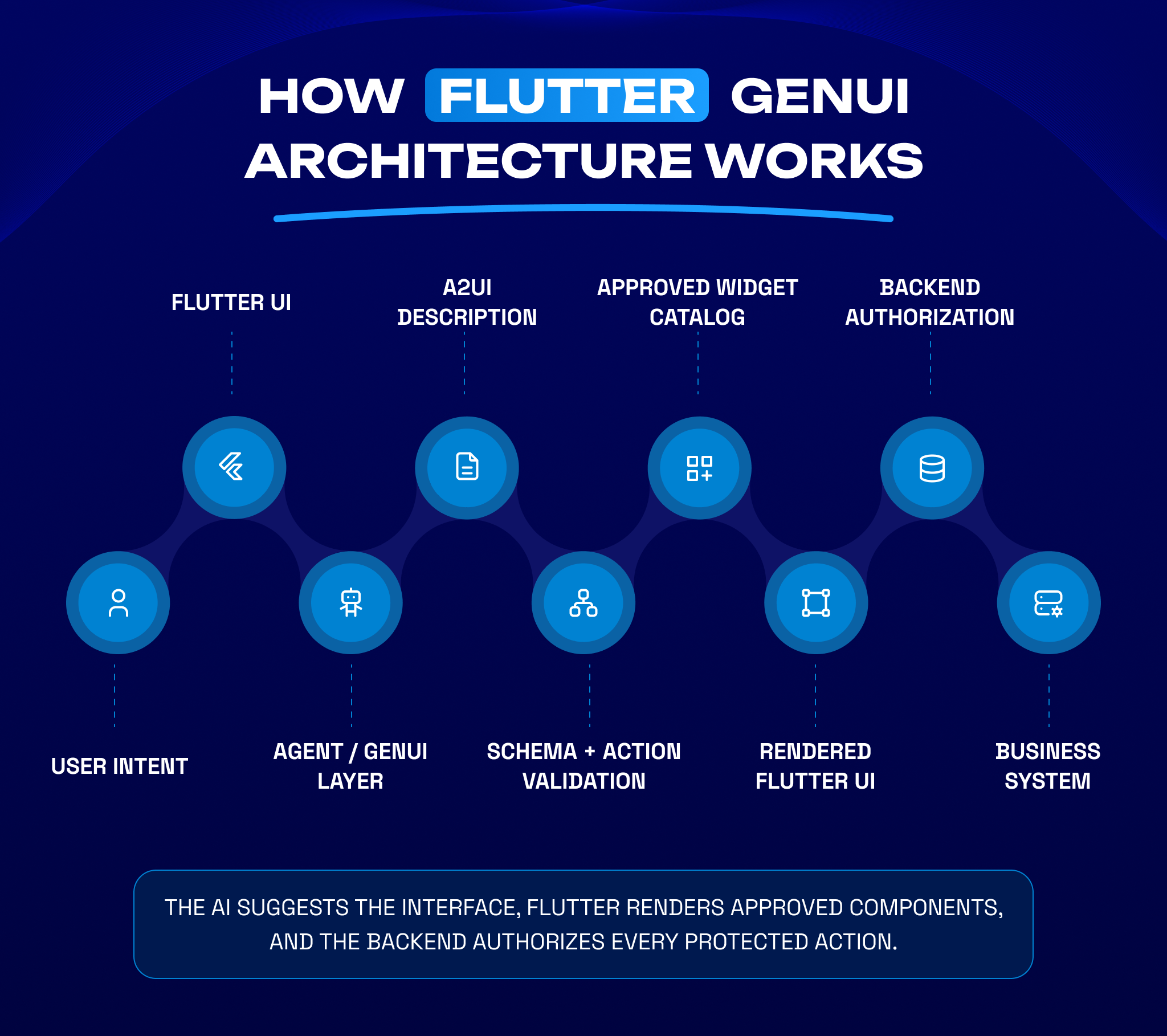
Ask the engineering team to demonstrate where decisions are made, where they are checked, and how users recover when generation fails.
The following is a recommended allocation of responsibilities, not a required SDK implementation.
| Boundary | Required responsibility | Evidence to request |
|---|---|---|
| Agent and model | Propose a relevant interface using permitted context | Examples of supported and unsupported requests |
| UI validation | Check component types, properties and allowed interactions | Rejection tests for malformed or unsupported output |
| Flutter client | Render components and maintain usable application state | Accessibility, navigation and recovery tests |
| Backend services | Authorize every protected operation and validate business data | Tests covering permissions and cross-tenant access |
| Operations | Detect failures, control spending and disable the feature | Monitoring, budget limits and a tested rollback procedure |
Treat displayed prices, account details and entitlements as business data that must come from authoritative systems. A plausible-looking interface can still present stale or incorrect information.
A component catalog limits the available presentation vocabulary. It does not establish whether a user can view a record, approve a request, or initiate a transaction. Those checks belong in trusted application services.
For multi-tenant products, review these boundaries alongside the principles in our Flutter SaaS architecture guide.
Assign owners to unresolved risks. A feature should not enter broader use while responsibility for its failures remains ambiguous.
A useful pilot tests one business hypothesis with a defined audience, capped expenditure and an exit decision. Its deliverables should include the implemented workflow, evaluation results, an operating-cost model and a recommendation to expand, revise or stop.
1. Establish the Baseline and Compare Alternatives
Measure completion, quality, handling time and cost for the current workflow. Identify a simpler improvement to compare against. This prevents the team from attributing benefits to AI that might come from better wording, cleaner data, or fewer form fields.
2. Define Scope, Ownership and Governance
Choose a limited user group, a small component catalog, and a restricted set of actions. Name a product owner for outcomes, an engineering owner for delivery and operations, and a security owner for access and data controls. Finance should review how claimed benefits translate into economic value.
3. Build the GenUI Experience and Fallback
Implement the minimum workflow needed to test the hypothesis. Include validation, spending controls, and fallback behavior in the pilot scope. Estimate delivery effort from the actual integrations, data readiness, and review requirements rather than promising a universal timeline.
4. Test Under Realistic Conditions
Test ordinary requests alongside ambiguous inputs, unavailable records, provider outages, invalid components, and unauthorized actions. Where feasible, compare randomly assigned groups and account for differences in task difficulty. Assess repeat usage so that an initial novelty effect does not determine the decision.
5. Apply Pre-Agreed Pilot Success Criteria
The following thresholds illustrate how a team could make its approval criteria explicit. They are not industry standards and must be adjusted to the workflow’s economics and risk.
| Dimension | Illustrative pilot criterion | If the criterion is missed |
|---|---|---|
| Completion | At least five percentage points above baseline, with sufficient evidence that the gain is real | Investigate friction before expanding |
| Economics | Total operating cost per successful task at or below the approved ceiling | Revise scope, model use, or implementation |
| Quality | No material decline in correctness or downstream resolution quality | Correct the failure and repeat evaluation |
| Responsiveness | The 95th-percentile response time meets the agreed workflow limit | Improve latency or narrow the use case |
| Access control | No successful unauthorized action in the defined test suite | Block release and investigate |
| Recovery | Users can complete the task through the fallback during tested outages | Fix recovery before expanding |
Passing an access-control test suite does not prove the absence of vulnerabilities. It is one release gate within a wider review.
Report fallback users and unsuccessful attempts in the results. Where a pilot is too small to establish a reliable outcome, extend evaluation within the approved budget instead of presenting uncertain results as proven value.
Internal delivery is a strong option when the organization can allocate product design, Flutter engineering, backend development, AI evaluation, and security expertise. For organizations that need additional expertise, working with an experienced Flutter development company can help validate the architecture and implementation approach.
An experienced partner should be able to set up a sandboxed A2UI validation prototype within 4 to 6 weeks, allowing your internal team to audit the security architecture before a single line of production code is written.
A partner may be useful when those capabilities are fragmented, or your internal team needs help validating the architecture before committing to a larger implementation.
Ask prospective partners to explain the proposed workflow, its alternatives, the evaluation method, and the expected operating responsibilities. Request relevant evidence, such as a working demonstration or a documented project whose scope and results can be verified.
The proposal should state who owns the code, evaluation assets, component catalog, and provider accounts. It should also explain how your team will maintain the feature and disable it when necessary. These details make estimates easier to compare and reduce uncertainty during handover.
Flutter GenUI deserves consideration when varied user needs create friction that simpler interfaces cannot resolve economically. The next decision is the scope of the experiment: the workflow, baseline, budget, and evidence required for approval.
To discuss that scope with iSyncEvolution, explore our Flutter app development services. Bring the workflow you want to improve, its current performance, and the constraints your team must meet. Those inputs provide a practical starting point for a conversation about feasibility and implementation.
For initiatives extending across agents, retrieval, automation, and other products, see our AI development services.
Yes. GenUI is designed to integrate with Flutter applications. For an established product, we recommend introducing it within a bounded feature and keeping the rest of the application independent of its implementation details.
Not necessarily. GenUI uses A2UI internally but supports different backend and model integrations. A separate agent backend is an architecture choice; internal protocol use and backend selection are distinct decisions.
The scope determines the cost. Estimate discovery, component design, integrations, evaluation, and ongoing operation separately. A narrow workflow with usable APIs requires a different budget from a feature that also needs data cleanup or backend redesign. The illustrative model above explains how to assess payback; it is not a quotation.
Waiting is reasonable when the workflow is critical, the expected benefit is small, or your team cannot absorb dependency changes. A limited pilot is more appropriate when the problem is measurable, the feature can be isolated, and the organization can support evaluation and maintenance.
Identify whether the constraint is interface quality, data, latency, cost or the underlying business hypothesis. Make a bounded revision only when the evidence supports it. Stop when the expected improvement no longer justifies further investment, and retain any useful findings for conventional product improvements.
Nikhil Shah is the CTO and Co-Founder of iSyncEvolution, an engineering leader who aligns modern technology best practices with long-term commercial success. A veteran of cloud infrastructure and scalable web/mobile solutions, he specializes in building high-performance software environments. Nikhil helps global brands master their technical roadmaps, optimizing both code performance and development economics to fuel growth.
© 2026 iSyncEvolution Pvt Ltd. All Rights Reserved.