
09 November, 2026
Outsourcing software development to India can help US, UK and UAE companies extend their engineering capacity while maintaining control over project delivery. However, a successful outsourcing arrangement requires more than selecting a development partner. Clear IP ownership, secure data access, effective time-zone coordination and accountable delivery processes must be established from the beginning.
This guide explains:
Outsourcing software development to India works when the client retains ownership of the code, repositories, and access controls, and when a single accountable lead owns delivery on the India side. The main risk is lock-in through weak contracts and shared control of code and environments, which makes later changes of team slow and disputed.
CTOs, VP Engineering and founders at companies of 20 to 200 people in the US, UK or UAE will find a practical way to decide whether and how to work with an India-based development team. The guide covers time zones, contracts, data protection, quality control, engagement models and the cases where another route fits better.
Outsourcing software development to India suits projects with written scope, documented requirements, and a client who can review work asynchronously. It suits poorly any project that needs constant live collaboration, strict data residency, or on-site presence. The deciding factor is whether the client can define, review, and own the work, not where the engineers sit.
Offshore means the development team works from another country, and an offshore development team in India is one example. Nearshore means a team in a nearby country with a similar time zone. Choose an India-based development team when the work can be specified, reviewed, and handed over in writing.
India (UTC+5:30, no clock changes) is 1.5 hours ahead of the UAE all year, 5.5 hours ahead of the UK in winter and 4.5 in summer, and 9.5 to 10.5 hours ahead of US Eastern. Illustrative overlap on a 9:00-18:00 day is about 7.5 hours with the UAE, 3.5 to 4.5 with the UK, and none with the US.
| Region | Offset from India | Overlap model that works |
|---|---|---|
| UAE | India is 1.5 hours ahead, all year | Shared working hours; about 7.5 hours of illustrative overlap |
| UK | India is 5.5 hours ahead in winter, 4.5 in summer | Shifted hours or split shifts; about 3.5 hours (winter) to 4.5 (summer), illustrative |
| US Eastern | India is 10.5 hours ahead in winter, 9.5 in summer | Later India shift; about 4.5 hours in winter, illustrative |
| US Pacific | India is 13.5 hours ahead in winter, 12.5 in summer | Async-first with a short handoff window |
Time zone overlap between India and the US, UK and UAE shapes how outsourcing software development to India works day to day, and it depends on each team's actual hours, so every figure above is illustrative. US and UK clock changes happen on different dates, so offsets shift for a few weeks each year. Plan overlap around the hours both teams actually work, not around the offset alone.
Shifted hours move the India working day later so it meets the client’s morning. UK teams already share 3.5 to 4.5 hours at standard hours, so a small shift can widen the window. For US Eastern, a shift of roughly 6 hours gives about 4.5 hours of overlap in winter. Async-first means work is organised so progress does not depend on live conversation, and a handoff is a written summary of status, blockers, and next steps passed on at the end of each working day. A local lead, based in the client's time zone, owns the overlap window and answers what the written handoff cannot.
Where this goes wrong. A team built around one live call with US Eastern stakeholders has no fallback when that call is missed. The call moves by an hour in India time when US clocks change, and any blocker raised after it waits for the next working day.
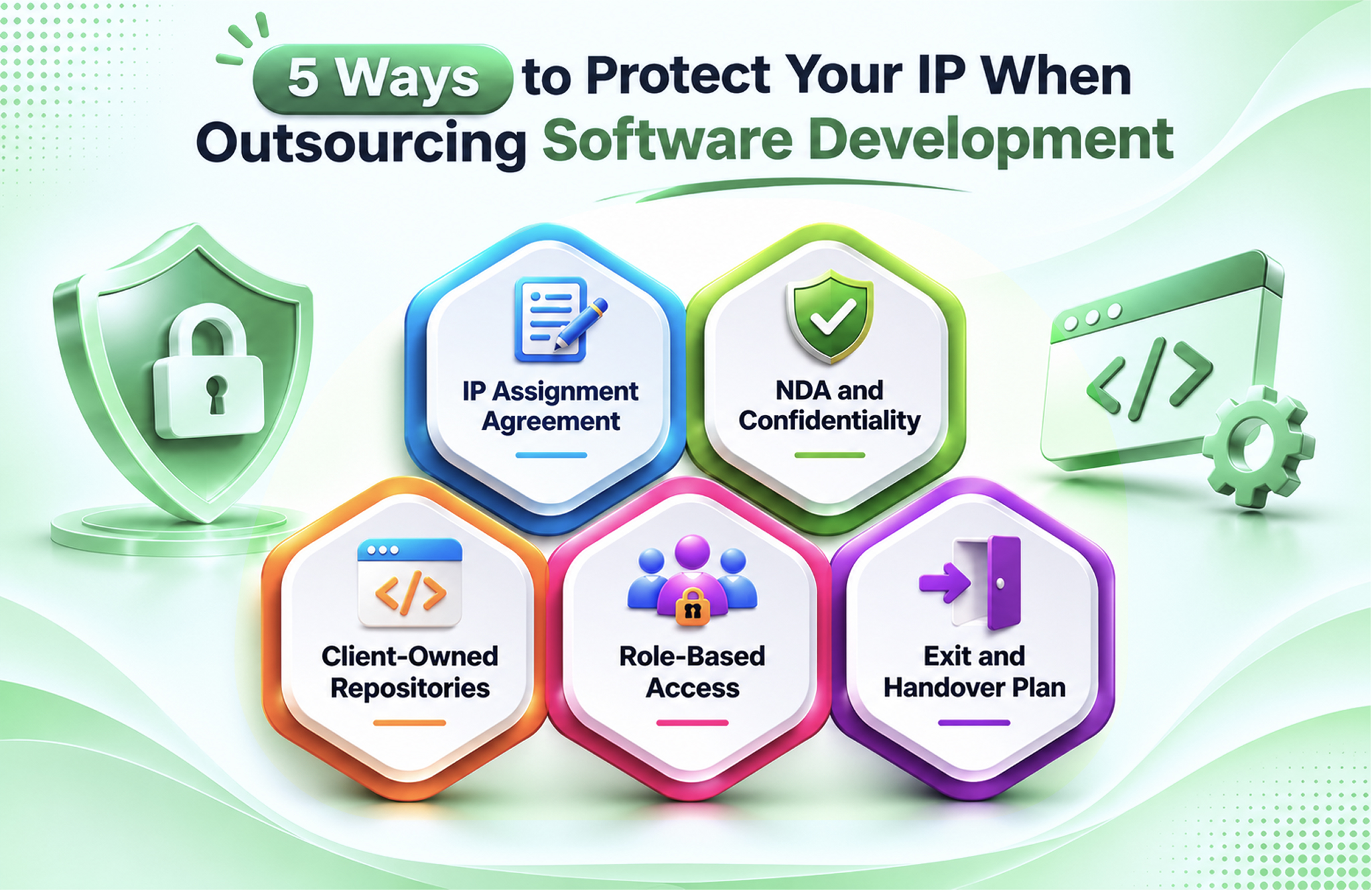
Intellectual property (IP) assignment is a written transfer of ownership of the work product from the contractor to the client. Handle it with a signed IP assignment, a non-disclosure agreement (NDA), code held only in the client's own repositories and cloud accounts, tight access control, and written exit and handover terms that guard against lock-in.
Signed before work starts, covering code, designs, documentation and any subcontractors.
Covers the vendor's staff and subcontractors.
Hosted in the client's own organisation; the vendor's engineers receive access, not ownership.
Cloud, CI/CD (the automated build and release pipeline), domains and app-store accounts registered to the client.
Granted by role on a least-privilege basis, which means each person gets only the access the task needs, and removed when someone leaves the project.
Documentation, environment and credential handover, named transition support and a list of deliverables.
Exit and handover terms are the main safeguard against lock-in: they say what the vendor must hand over, in what form, and with what support, if the engagement ends.
Where this goes wrong. A vendor creates the repository and the CI/CD pipeline in its own organisation and gives the client read access. At exit, the client holds a code export but not the commit history, the pipeline configuration or the deploy keys, and has to rebuild its delivery tooling before it can ship a fix.
The governing law of the contract and the place where disputes are resolved should be chosen deliberately, not left to default. Have qualified counsel review this.
Protect data by limiting what the India-based development team can reach: role-based access, separate development, staging and production environments, no production data in development, managed secrets, controlled devices and networks, and audit logs. The governing principle is data minimisation: each engineer gets the least data and access the task needs.
Controls to put in place:
Single sign-on, multi-factor authentication and role-based permissions, reviewed when people join or leave.
Development, staging and production run in separate accounts with separate credentials.
Use synthetic or masked data for building and testing.
Credentials live in a managed vault, never in code or chat.
Managed laptops, disk encryption, access through a VPN or zero-trust gateway, and no local copies of client data.
Access to repositories, environments, and data is logged and retained for review.
The NIST Cybersecurity Framework offers a shared vocabulary for agreeing these security controls with a vendor.
Data-protection rules depend on where the client and its users are. In the UK, the regulator publishes ICO guidance on international transfers of personal data. In the UAE, the government portal lists the federal personal data protection law. In the US, requirements vary by state and sector.
Where this goes wrong. A developer copies a production database snapshot to a laptop to reproduce a bug. The snapshot stays on the device after the fix, no log shows who copied it, and the client cannot say which personal data left the controlled environment.
Keep quality under control with one accountable lead on the India side, a written definition of done, mandatory code review, regular demos, independent QA, written documentation, and a named escalation path. Each control makes problems visible early, whatever the time zone. A task with no named owner and no definition of done drifts, which is a common reason app projects fail.
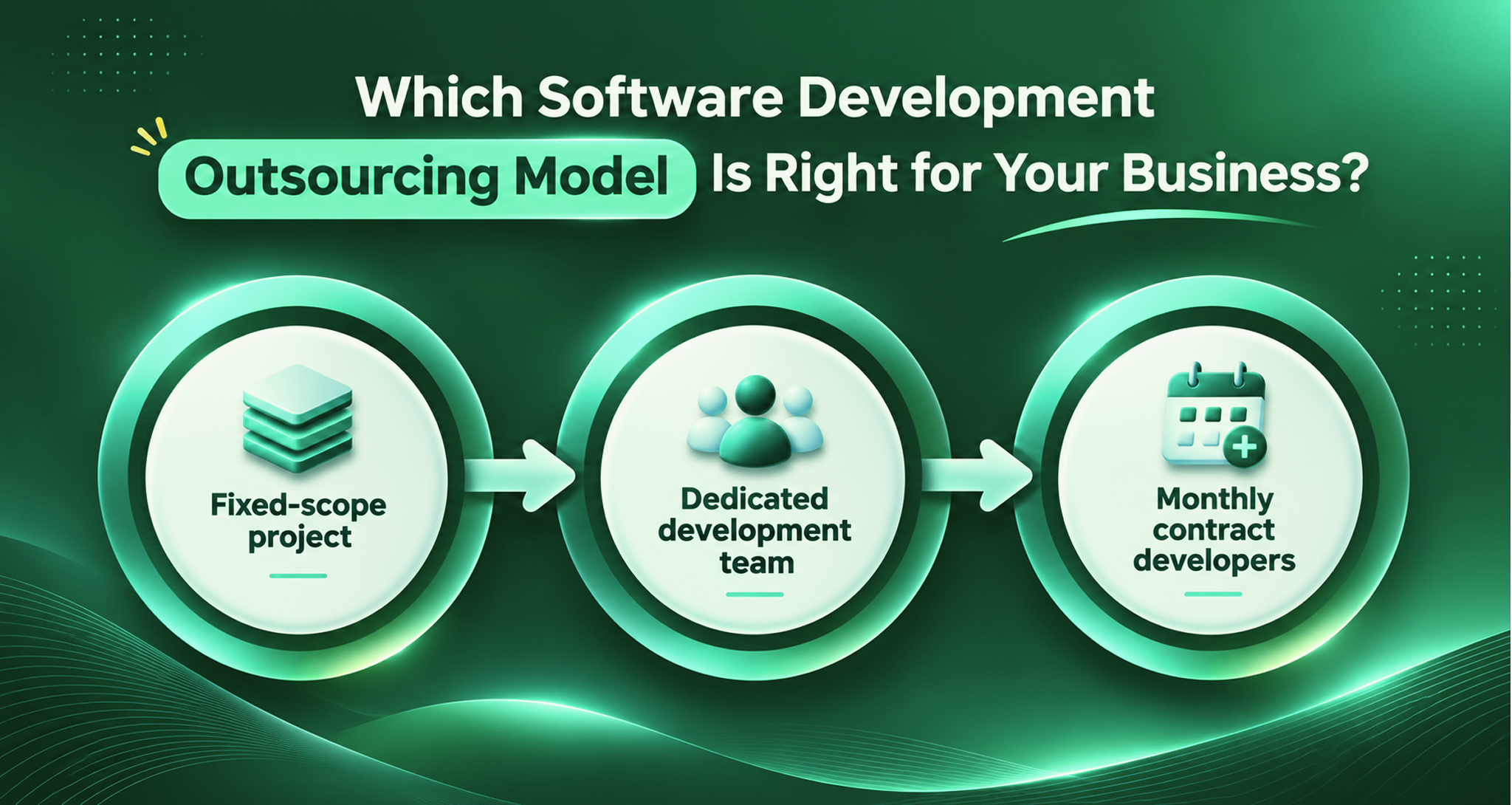
Fixed-scope projects fit well-defined work with a clear end. A dedicated team fits a continuing product and gives the most control. Monthly contract developers, also called staff augmentation, are individual engineers added to your team and managed by you; they fit gaps in an existing team. The main risk differs by model.
| Model | Control and flexibility | Management effort | Main risk |
|---|---|---|---|
| Fixed-scope project | Low flexibility once scope is agreed; changes go through change requests | Low to medium; client reviews milestones | Scope gaps and disputes over what was agreed |
| Dedicated team | High control; priorities change sprint to sprint | Medium to high; client owns the backlog | Dependence on key engineers and weak handover when people change |
| Monthly contract developers | Highest day-to-day control; engineers work inside your process | High; client manages daily work and quality | Quality and continuity rest on the client's management capacity |
A fixed-scope project fits a bounded deliverable, such as an internal tool or a migration, where requirements can be written before work starts. Agree acceptance criteria and a change-request process up front, because scope disputes are the main failure of this model.
When companies hire a dedicated development team in India, the engineers work only on the client's product while the client sets priorities. Dedicated development team engagements fit products that keep changing, because engineers keep context from sprint to sprint.
Monthly contract developers suit a company that already has strong engineering management and needs added capacity in a specific skill. Without that management, the added engineers receive unclear tasks and produce uneven work.
Stack matters as much as model when outsourcing software development to India. A product that spans front end, back end, and APIs usually needs engineers who cover all three, which is the reasoning behind hiring a full-stack team.
A good first phase is a small, bounded piece of real work that tests the contract, access setup, communication, and quality controls before a larger commitment. It ends with working software in the client's own repository and a written review of what to change.
Outsourcing software development to India is the wrong choice when work needs constant live collaboration, when data must stay in one country, when the scope is too small to absorb onboarding, or when engineers must be on site. In those cases, a local hire, a nearshore team, or an in-house build fits better.
If the work cannot be done without live conversation, local presence, or in-country data access, do not structure it as an India-based engagement.
Outsourcing software development to India works when the client owns the code and accounts, agrees on an overlap model that fits its time zone, limits data access, and keeps quality controls and exit terms in writing. A small first phase tests these controls before a larger commitment. When the work needs live conversation, local presence or in-country data, another route fits better.
If you are weighing an India-based development team, talk to our team about scope, access setup and the first phase. A short brief covering scope, stack, working hours and data constraints is enough to start. We are a custom software development company with offices in the US, UK, Germany and the UAE, and a development hub in Ahmedabad, India.
Outsourcing to India can be safe for IP when ownership and control are written down and enforced in the setup. Use a signed IP assignment, an NDA, code held in your own repositories and accounts, role-based access, and exit terms. Safety comes from structure, not geography. Have qualified counsel review the contract.
Time zones change how work is organised, not whether it can be delivered. India overlaps with the UAE for most of a working day, with the UK for part of it, and with US Eastern only through a shifted schedule. US West Coast work is usually async-first with a short handoff window.
The client should own the code, provided a written IP assignment transfers ownership from the contractor, and the code lives in the client's own repositories and accounts. Without both, ownership can become unclear. Qualified counsel can confirm how assignment works under the governing law of your contract.
Data is protected by limiting access and keeping production data out of development. Use role-based permissions, separate environments, masked test data, managed secrets, controlled devices, and audit logs. Which data-protection rules apply depends on the client's location and sector, so have qualified counsel review the requirements.
Start with a small, bounded first phase. Pick a deliverable with acceptance criteria, sign the NDA and IP assignment, set up repositories and accounts in your own organisation, name accountable leads on both sides, and review the results against agreed criteria before committing to a larger engagement.
Nikhil Shah is the CTO and Co-Founder of iSyncEvolution, an engineering leader who aligns modern technology best practices with long-term commercial success. A veteran of cloud infrastructure and scalable web/mobile solutions, he specializes in building high-performance software environments. Nikhil helps global brands master their technical roadmaps, optimizing both code performance and development economics to fuel growth.
© 2026 iSyncEvolution Pvt Ltd. All Rights Reserved.